
 Dogs
 Cats
 Birds
 Horses
 On the Land
 In the Sea
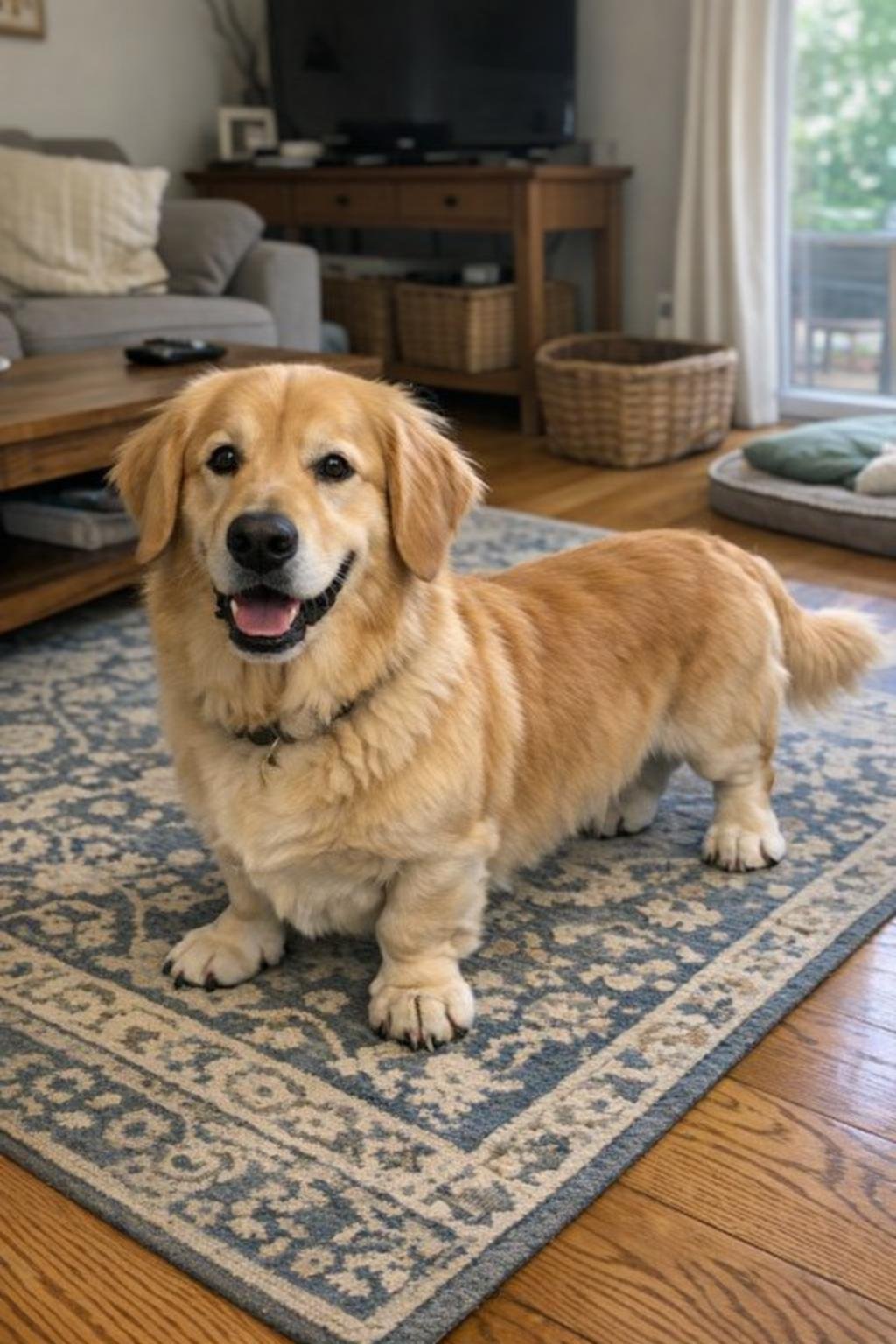
When my neighbor told me the shelter had listed their new dog as a simple “Golden mix,” I expected the usual possibilities: maybe a little Lab, maybe some spaniel, maybe one of those mystery combinations that only a DNA test could untangle. Then I saw the new kid trot across the living room, and I had to stop myself from laughing out loud in the nicest possible way, because this dog looked like somebody had taken the cheerful, feathered top half of a golden retriever and set it onto the wonderfully low-slung chassis of an entirely different breed.
That contrast is exactly what makes mixed-breed dogs so irresistible. You get one familiar trait, one surprise trait, and then a completely original dog in the middle of it all. In this case, the clues are all there if you know what to look for: the broad golden face, the soft expression, the plush coat, and then those short, outward-turned legs and long body that make you do a double take. If you’re trying to guess the other half, this is the mix I’d put my money on.
See for yourself:
1. My guess: golden retriever and basset hound
If I had to call it from appearance alone, I’d say the other half is basset hound. The biggest giveaway is the body shape: long through the back, low to the floor, with noticeably shortened legs that turn slightly outward at the feet. A pure golden retriever usually stands around 21.5 to 24 inches at the shoulder. A basset hound is much lower, often only 11 to 15 inches tall, but heavy and substantial. This dog looks like it inherited the golden’s head and coat texture, then the basset’s frame.
That combination is unusual enough that it sticks in your head immediately. Shelters often use broad labels like “retriever mix” when they see a golden-colored coat and a friendly face, but once you notice the proportions, basset hound becomes a very strong possibility.
2. The head says golden before anything else
The face is doing a lot of the golden retriever work here. A golden typically has a broad skull, gentle eyes, medium-length muzzle, and that soft, open expression people instantly read as friendly. This dog appears to have exactly that sort of face rather than the more deeply set, droopier overall look you’d expect from a full basset hound.
The coat also matters. Goldens tend to carry a dense double coat with visible feathering around the ears, chest, legs, and tail. Even when mixed, that fluffy texture often survives. If the dog had a smoother, tighter coat, I’d be less confident, but the plush golden fur pushes the guess strongly in that direction.
3. The body proportions practically shout basset hound
The long torso is the real tell. Basset hounds have one of the most distinctive silhouettes in the dog world: elongated body, deep chest, heavy bone, and very short legs caused by dwarfism-related limb structure. In a mix, you may not get the full classic basset outline, but you often still see the “long and low” build.
On a dog like this, the difference is obvious even indoors on a flat rug. The distance from floor to belly is small, the back seems longer than you’d expect for a retriever-type dog, and the front feet angle outward. Those are not random features. Together, they point much more toward basset hound than toward something like cocker spaniel, beagle, or corgi.
4. Why people confuse this kind of mix at first glance
Most people identify dogs by the face first and the legs second. That’s why a dog with a retriever head gets labeled “golden mix” so quickly, even if the rest of the body tells a different story. I’ve seen the same thing happen with poodle mixes that get called terriers because of coat texture, or hound mixes that get called Labs because they’re black and broad-headed.
In a shelter environment, staff may have only a few minutes, a kennel card, and a best guess. Breed IDs by sight are famously unreliable. Several studies and shelter behavior groups have noted that visual breed identification often differs significantly from DNA results. So a label like “Golden mix” is usually a starting point, not a conclusion.
5. Temperament could be a fun blend of both breeds
If this dog really is golden retriever and basset hound, the personality could be delightfully mixed too. Goldens are typically social, biddable, and eager to participate in whatever the family is doing. Bassets are affectionate and charming, but also independent, nose-driven, and sometimes hilariously selective about listening when a scent is more interesting.
That can produce a dog who is deeply friendly with guests, loves lounging near people, and also decides that following one smell across the yard is more urgent than coming when called. In practical terms, I’d expect moderate trainability, a strong food motivation, and a sense of humor from the humans handling the leash.
6. Exercise needs may be lower than a full golden’s, but not minimal
This is the part where people can get fooled by short legs. A lower dog is not automatically a low-energy dog. A golden retriever often does well with 60 to 90 minutes of daily activity, depending on age and health. A basset hound may not want to sprint for an hour, but can be surprisingly persistent on walks, especially if there are new smells every 10 feet.
For a mix built like this, I’d expect a sweet spot of roughly 30 to 60 minutes of daily exercise, broken into two or three outings. Think two 20-minute sniff-heavy walks plus a short indoor play session. Because of the longer back and shorter legs, I’d skip repetitive high-impact jumping, long stair sessions, and constant leaps on and off tall furniture.
7. Weight management would matter a lot
This kind of build can look sturdy even when a dog is carrying extra pounds, which is exactly why owners have to stay ahead of it. Goldens can be prone to overeating, and bassets are famous for acting as though they have never once been fed in their lives. Put those appetites together and you have a dog that may gain weight fast if meals and treats aren’t measured.
Even 5 to 8 extra pounds on a low, long-backed dog can put noticeable added strain on joints and spine. I’d want to keep a dog like this lean enough to feel ribs easily under a light fat covering, with a visible waist from above. Measured meals, maybe 1.5 to 3 cups of food a day depending on the dog’s size and calorie needs, would be smarter than free-feeding.
8. Grooming could be moderate, especially during shedding season
If the golden side came through in the coat, there will probably be shedding. Maybe not the full “tumbleweeds under the sofa” level of a pure golden, but enough that a weekly brushing won’t be optional. In spring and fall, that could easily become three brushing sessions a week, about 10 to 15 minutes each with a slicker brush and undercoat-friendly comb.
The ears are another thing I’d watch closely. Basset-type ears can reduce airflow and hold moisture, while retriever coats can trap debris. A quick ear check once a week and gentle cleaning when needed can head off irritation. And with those lower legs and belly, muddy days are going to come home attached to the dog, so a towel by the door is basically part of the breed mix package.
9. Health clues hidden in the shape
Whenever I see a long-bodied, short-legged dog, I think immediately about back and joint care. Not every such dog develops problems, of course, but structure affects risk. Bassets can be prone to elbow issues, shoulder strain, and spinal stress. Goldens, meanwhile, are known for concerns like hip dysplasia, certain skin problems, and ear issues.
For a dog with both sets of traits, prevention matters more than perfection. I’d use a ramp for getting onto a couch or into a car if the dog is allowed there, keep nails trimmed every 3 to 4 weeks so stance stays comfortable, and talk with a vet early about ideal weight and joint support. A good bed with real cushioning, not a flattened mat, also goes a long way on a low-framed dog.
10. The tail and movement can help confirm the guess
If I were standing in the room watching this dog for five minutes, I’d look at the gait almost as much as the coat. Basset influence often shows up in a rolling, slightly side-to-side movement with short but determined steps. A golden influence may soften that look with a more flowing tail carriage and a generally buoyant, happy demeanor.
The tail itself can be revealing too. A golden retriever often carries a feathery, expressive tail, while a basset tail tends to be sturdy and upright with a slight curve. In a mix, you might see a plume-like golden tail attached to a basset-ish rear assembly, which is exactly the kind of visual contradiction that makes people grin.
11. Why this mix is such a conversation starter
There are some mixed-breed dogs you pass on the sidewalk without much thought, and then there are dogs like this one, where everybody stops and asks, “What is that adorable creature?” A golden-basset combination has instant novelty because the pieces are so recognizable on their own. Your brain knows the golden head, and your brain definitely knows the basset body, but seeing them together takes a second to process.
I think that’s part of the charm of rescue dogs in particular. They don’t arrive as a catalog description. They arrive as themselves. Sometimes the shelter card gives you 50 percent of the story, and the rest is standing there on a rug, grinning at you on comically short legs.
12. If they ever do a DNA test, I would not be shocked by a few extras
Even though basset hound is my best guess for the “other half,” mixed dogs are often more mixed than anyone expects. A DNA panel could come back with golden retriever, basset hound, and then small percentages of beagle, cocker spaniel, or even Labrador retriever. Shelter dogs especially can carry three, four, or five breed influences that blend into one very convincing look.
Still, if the question is what the obvious other half appears to be from the visible clues, I’d answer basset hound first and pretty confidently. The low height, elongated frame, and outward-turned feet are just too distinctive to ignore.
13. My final verdict on the new kid
So what do I think the other half is? Basset hound, without much hesitation. The dog looks like a golden retriever up top and a basset down below, which is honestly one of the more endearing combinations I can imagine. It’s the kind of rescue reveal that makes you appreciate how creative genetics can be.
And really, that’s the best part. Whatever the exact percentages turn out to be, this dog hit the jackpot: a home, a funny unforgettable look, and probably a future full of people saying hello before they even ask the name. If my neighbor’s new arrival is any indication, “Golden mix” was only the opening line of the story.