
 Dogs
 Cats
 Birds
 Horses
 On the Land
 In the Sea
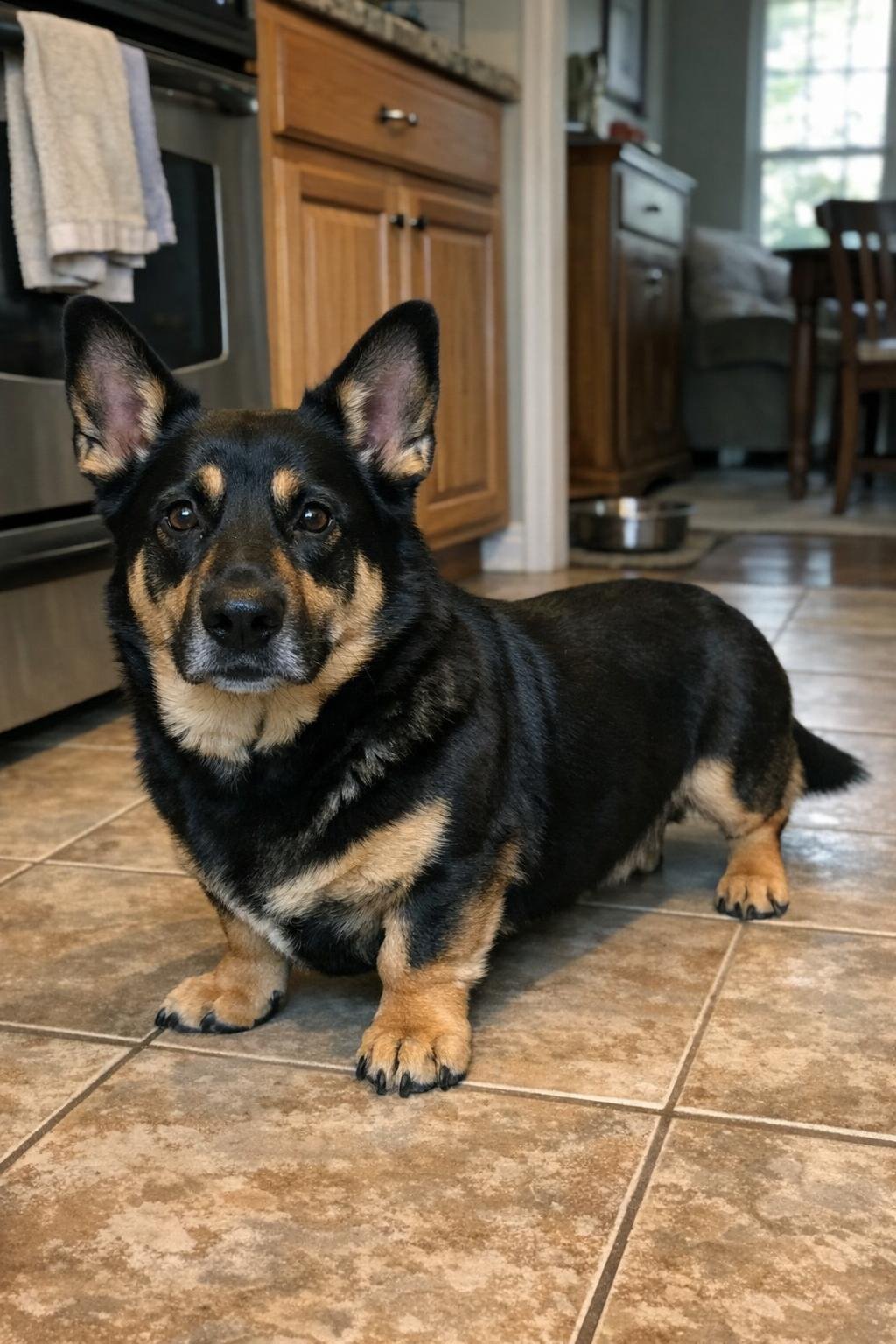
When my daughter brought this shelter dog home under the wonderfully vague label “Shepherd mix,” I did what every family does: I looked at the ears first. Big, alert, upright ears? German Shepherd, no doubt. Black-and-tan coloring? Again, no mystery there. But then he turned sideways, toddled across the kitchen, and the whole room stopped. I’ve spent enough years around dogs to know when the front half and the back half seem to come from two entirely different committee meetings.
What makes him so charming is that nothing about him is subtle. He has the noble face, steady gaze, and serious expression of a working dog, paired with a body plan that seems to have been lowered several inches all at once. He’s stout, low, a little bow-legged, and completely adorable in motion. If you’re the sort who likes guessing dog breeds from clues in structure, gait, and temperament, this one is a delight—and by the time you see him, I suspect you’ll land where we did.
Here he is:
1. The most likely answer: German Shepherd and Basset Hound
If I had to put money on it without seeing a DNA test, I’d say German Shepherd on one side and Basset Hound on the other. The shepherd contribution is doing the heavy lifting in the head, ear set, coloring, and expression. The basset side shows up in the shortened legs, denser frame, lower center of gravity, and that unmistakable bowed stance that makes a dog look half practical, half cartoon.
Shelters often use “mix” as a catchall because breed ID by sight is notoriously imperfect. Studies have shown that visual guesses can miss the mark badly, especially in mixed-breed dogs. But sometimes the body gives the game away, and in this case those legs are a very loud clue.
2. Why the head reads pure shepherd at first glance
The first thing most people notice is the face. A German Shepherd-type head usually has a longer muzzle, a wedge-shaped profile, and an alert, intelligent expression. If the ears are standing, triangular, and set fairly high, that pushes the visual impression even further toward shepherd.
Black-and-tan patterning matters too. Classic shepherd coloring often includes a black saddle across the back, tan on the legs and face, and darker shading around the muzzle. Even when the body proportions are unusual, people tend to identify breed from face and color first, which is why a dog like this can initially pass as “mostly shepherd” until he takes a few steps.
3. The short bowed legs are the giveaway
Basset Hounds are one of the best-known examples of chondrodysplasia, the genetic trait that causes shortened limbs. In practical terms, it produces that low-slung body and legs that appear much shorter than you’d expect for the dog’s torso. If a shepherd-shaped dog suddenly seems to be traveling only 10 to 14 inches off the ground, something dwarfing the legs is almost certainly involved.
The slight outward bow in the front legs is another strong tell. Lots of short-legged mixes are simply low to the ground, but basset influence often adds a heavier-boned, slightly curved front assembly. It gives the dog a sturdy, planted look rather than the finer, straight-legged profile you’d see in a corgi cross or beagle cross.
4. How the body shape supports the basset theory
A Basset Hound typically carries a long body, substantial chest, and surprising weight for height. An average basset stands only around 11 to 15 inches at the shoulder but can weigh 40 to 65 pounds. German Shepherds, by contrast, are much taller—often 22 to 26 inches—but leaner in outline relative to height.
When you blend those two blueprints, you can get a dog that looks as if someone compressed a shepherd vertically without shrinking the torso enough to match. That’s exactly the sort of proportion that makes people stare, laugh, and then immediately reach for their phone to take a picture.
5. What I’d expect this mix to weigh and measure
A German Shepherd–Basset Hound mix often lands somewhere between 35 and 60 pounds, though some run smaller or heavier depending on which parent they favor. Height can be all over the place, but many end up in the 14-to-20-inch range at the shoulder—short for a shepherd-looking dog, tall for a classic basset.
If this dog has the stoutness I suspect, I’d keep a close eye on body condition rather than relying on appearance alone. A low dog can look stocky even at a healthy weight, and just 5 extra pounds on a short-legged frame can put noticeable strain on elbows, shoulders, and the lower back.
6. Temperament clues that would fit both breeds
German Shepherds are known for loyalty, attentiveness, trainability, and a tendency to keep an eye on their people. Basset Hounds, meanwhile, are affectionate, stubborn, scent-driven, and often more comedic than obedient. Put those together and you may get a dog who is deeply devoted, fairly smart, and selectively cooperative.
In my experience, that combination can be delightful. The shepherd side may make him responsive and watchful around the house, while the basset side may make him pause mid-walk because a smell from 20 minutes ago is suddenly the most important item on his agenda. Families sometimes mistake this for defiance when it’s really competing wiring: one part “let’s work,” one part “follow the scent.”
7. The walk probably tells the story even better than the photo
Photos catch structure, but movement reveals heritage. A shepherd mix usually covers ground with purpose, while a basset influence can introduce a shorter stride, more side-to-side body motion, and a determined little roll through the shoulders. If he moves like a serious dog in a compact chassis, that’s very much on brand for this pairing.
I’d also expect him to tire a bit differently from a full shepherd. Instead of long-distance, high-speed athleticism, he may prefer moderate walks—say 20 to 40 minutes—paired with scent games, yard time, and training sessions. That lower build changes the mechanics of exertion, even when the dog is energetic.
8. Health issues worth watching in a low, heavy mix
Whenever short legs and a longer back show up together, I think about joint and spine protection right away. Repeated jumping off beds, sofas, porches, or SUVs can add wear over time. Using ramps, keeping nails trimmed, and maintaining a healthy weight are small things that matter enormously.
With a shepherd-basset mix, I’d ask a veterinarian about hips, elbows, and spine health during routine exams. I’d also watch the ears. If he inherited heavier ear leather or slightly less ventilation than a classic shepherd, moisture and wax can build up faster. A quick ear check once a week and cleaning only when advised can save trouble later.
9. Training this mix may require equal parts discipline and diplomacy
The shepherd side usually likes structure. The basset side often likes to negotiate. That means the best approach is short, consistent sessions—5 to 10 minutes at a time—with clear cues and rewards that are actually worth working for. Dry biscuits may not cut it; tiny pieces of chicken, cheese, or a soft training treat often work better.
Recall deserves extra attention. Scent hound heritage can override good intentions in a hurry. I’m a big believer in long-line practice, fenced areas, and not assuming intelligence equals reliability. A smart dog with a nose is not the same thing as an off-leash dog.
10. Why shelters so often miss a mix like this
Shelter staff usually have a few minutes, not a laboratory. They’re trying to assess age, health, behavior, and adoptability, often with limited history. If a dog’s face screams shepherd, “Shepherd mix” is a reasonable label, especially when the alternative is a wild guess involving three or four breeds.
And to be fair, some dogs really are impossible to sort out visually. But a Basset Hound mix can hide in plain sight when the ears stand up instead of droop. People expect the classic basset package—long ears, sad eyes, low body. Remove one or two of those visual markers, and the short-legged genetics can surprise everybody.
11. Other possible guesses people might make—and why I’d still lean basset
Corgi is the other common short-leg guess, and I understand why. Corgis also produce low, compact mixes. But corgi crosses often have straighter forelegs, a lighter overall frame, and a different silhouette through the chest and shoulder. Dachshund might come up too, especially if the dog is very low, but dachshund mixes tend to look narrower and more elongated rather than broad and stout.
Beagle could explain some hound traits, but not usually that degree of short, heavy, bowed front structure. The combination of shepherd head plus substantial, low, curved-legged body is what keeps bringing me back to Basset Hound as the cleanest answer.
12. A DNA test would settle it for about $80 to $150
If your family really wants to know, a canine DNA kit is the simplest route. Most use a cheek swab, and results typically come back in 2 to 4 weeks. Depending on the brand, you may also get trait markers, likely adult weight range, and some health screening information.
I always tell people to treat the result as interesting data, not destiny. Even if the test says 50 percent German Shepherd and 25 percent Basset Hound plus a few surprises, what matters day to day is the dog in front of you: his joints, his habits, his energy level, and whether he steals socks when no one is looking.
13. What makes this kind of mix so irresistible
There’s something wonderfully endearing about a dog who looks both dignified and slightly improvised. The shepherd half says, “I am here to guard the household.” The basset half says, “Yes, but first I need to investigate this crumb under the toaster.” It’s a marvelous contradiction.
These are often family favorites because they’re memorable in the best way. People don’t forget the dog with the serious face and tiny legs. Children adore them, neighbors ask questions, and even people who claim they’re “not dog people” tend to grin the moment they see one cross the room.
14. My final vote
If I were answering the headline directly across a kitchen table, I’d say the other half looks very much like Basset Hound. Not a maybe, not a vague hound, but specifically basset—or at least a close short-legged hound relative with strong basset-like structure.
Of course, mixed-breed dogs love making fools of our certainty, and I’d be thrilled to see a DNA panel prove me wrong. But based on the shepherd head, black-and-tan coat, low-slung body, and those unmistakably short, sturdy bowed legs, my best guess is a German Shepherd–Basset Hound mix. In other words: a shelter surprise, a conversation piece, and almost certainly the new kid everyone in the house is already smitten with.