
 Dogs
 Cats
 Birds
 Horses
 On the Land
 In the Sea
When a French Bulldog has a litter, most of us expect the puppies to look broadly alike at first glance: the same compact body, the same blocky little head, the same velvet-short coat that makes Frenchies feel almost polished when you run a hand over them. So when one puppy in a litter shows up looking noticeably fluffier than the others, people assume something odd must have happened. I’ve heard every version of the question over the years: Was there another father? Is it mixed? Did the coat just puff up because it’s a baby?
The surprising answer is usually much simpler and much more interesting. A long-haired, “fluffy” French Bulldog can appear in an otherwise standard-looking litter when both parents quietly carry a recessive long-hair gene. That means two smooth-coated dogs can produce a fluffy puppy without either parent looking fluffy themselves. If you’ve never seen the difference side by side, it can be startling the first time.
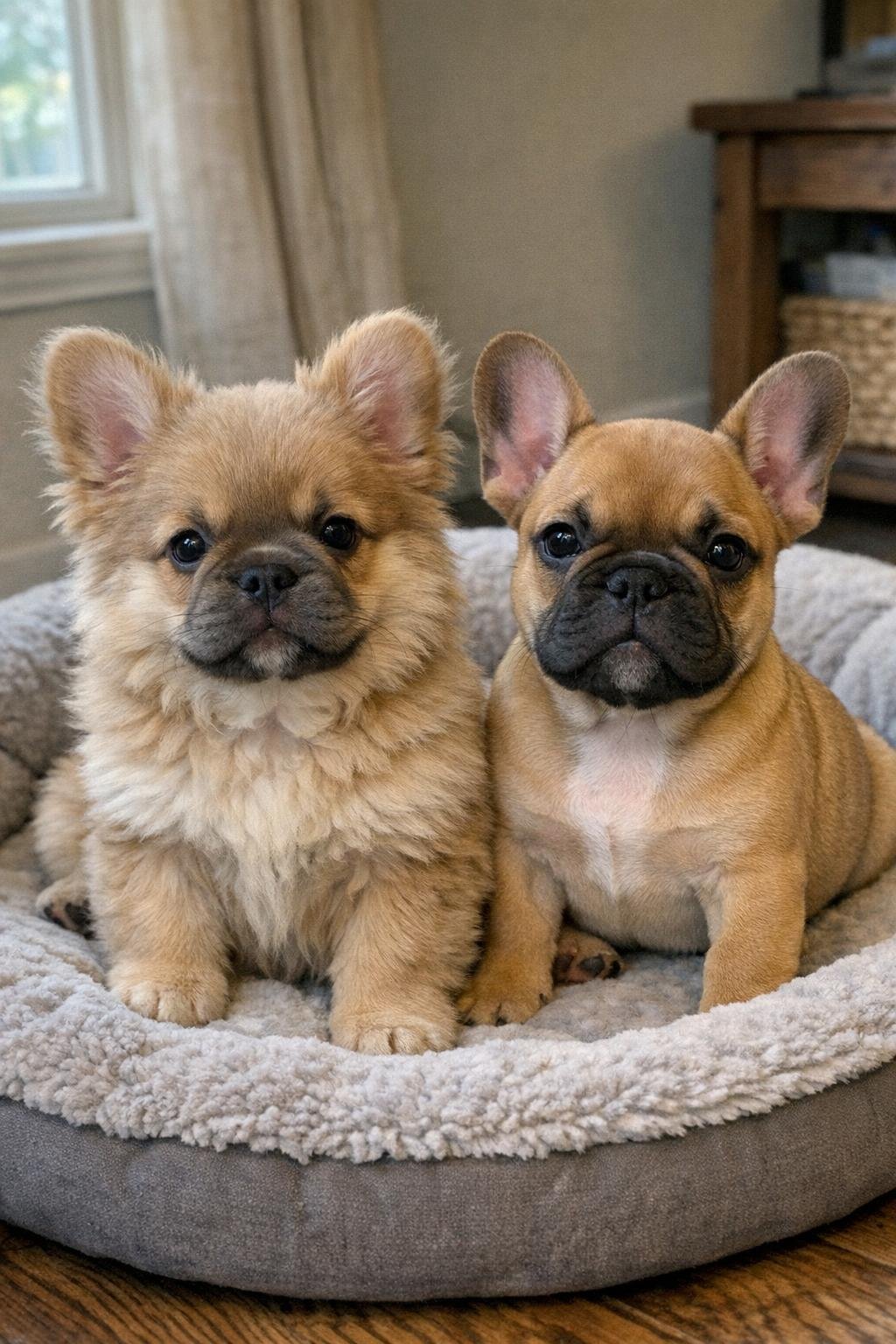
Here it is:
1. Why the last puppy looks so different
The big visual shock is the coat. A typical French Bulldog has a short, close-lying coat that is smooth over the back, sides, ears, and legs. A fluffy Frenchie, by contrast, shows longer hair around the ears, chest, legs, and sometimes along the neck and back. In a young puppy, that can make the face look softer and rounder, and the entire body can seem fuller even when the pup weighs about the same as its littermates.
In a litter of 4, seeing 1 fluffy puppy is not unusual if both parents carry the hidden gene. At birth and during the first 7 to 14 days, the difference may already be visible around the ears and shoulders. By 3 to 6 weeks, it’s often obvious enough that even people who know nothing about canine genetics notice immediately.
2. The simple genetics behind it
This usually comes down to a recessive trait. In plain English, each parent contributes one copy of a gene related to coat type. If the long-hair version is recessive, a puppy needs 2 copies of that version—1 from the mother and 1 from the father—to actually look fluffy.
If both parents are smooth-coated carriers, a common genetic shorthand is N/l for each parent, where N is the usual short-coat version and l is the recessive long-hair version. When you map out the possibilities, each puppy has roughly a 25% chance of being l/l and therefore fluffy, a 50% chance of being a carrier like the parents, and a 25% chance of inheriting no long-hair copy at all. Those percentages apply to each puppy individually, not to the litter as a guaranteed total.
3. Yes, two normal-looking parents can have a fluffy puppy
This is the part that makes people do a double take. Carriers often look completely ordinary. A smooth-coated French Bulldog can carry the recessive long-hair gene for life and never show a visible hint of it. That is exactly how the trait can seem to “appear out of nowhere.”
It didn’t really come from nowhere, of course. It was sitting quietly in the pedigree, sometimes for generations. Then, when two carriers were bred together, the right combination landed in one puppy. In a litter of 4, you might get 0 fluffy puppies, 1 fluffy puppy, 2 fluffy puppies, or even more rarely 3 or 4. Genetics is about probabilities, not quotas.
4. What “25% chance” really means in a litter of 4
A lot of people hear “25% chance” and assume that automatically means exactly 1 out of every 4 puppies will be fluffy. That’s not how probability works in real litters. Each puppy is its own genetic roll of the dice.
Think of flipping a coin 4 times. You do not always get exactly 2 heads and 2 tails. You might get 4 heads, 3 tails and 1 head, or any other combination. The same idea applies here. In a 4-puppy litter, 1 fluffy puppy is certainly plausible, but so is none at all. Over a very large number of puppies, the average may drift toward 25%, but one family’s litter is a tiny sample size.
5. The gene most often involved
In dogs, long hair is commonly associated with variants in a gene called FGF5. Different breeds can express long coat traits a bit differently, but the basic principle is the same: the hair growth cycle is altered enough to produce a longer coat than the standard short-haired look.
For a pet owner, you do not need a molecular biology degree to make sense of it. What matters is that there is a known, testable genetic explanation for a fluffy Frenchie. Modern canine DNA panels can often identify whether a dog is clear, a carrier, or genetically long-haired. A cheek swab sent to a reputable lab can provide answers in a couple of weeks, sometimes in as little as 7 to 10 business days.
6. Does a fluffy coat mean the puppy is mixed?
Not necessarily. A fluffy coat by itself does not prove a French Bulldog is mixed with another breed. If both parents are purebred French Bulldogs and both carry the recessive long-hair gene, a fluffy purebred puppy is genetically possible.
That said, coat type is only one detail. If someone is trying to verify lineage, the sensible route is documentation plus DNA, not guesswork based on appearance. Plenty of people see an unusual trait and jump straight to “there must have been another dog involved,” but genetics regularly produces surprises that are fully explainable within one breed.
7. How early you can tell which puppy is fluffy
Experienced breeders and veterinarians can sometimes spot the difference very early, often within the first week. The coat may look slightly fuzzier over the shoulders, outer ears, and thighs. By 2 to 3 weeks, when the puppies are gaining strength and their coats are more visible, the distinction tends to sharpen.
By 4 weeks, many fluffy Frenchie puppies have a noticeably plush look compared with their smooth-coated siblings. If the litter is all fawn, like in your scenario, the color may be nearly identical while the texture is dramatically different. That contrast is exactly why people gasp: same breed, same size, same little face, but one coat looks almost like a different setting was switched on.
8. What the fluffy puppy will feel and look like as it grows
A smooth-coated French Bulldog feels sleek and close-textured, with very little feathering. A fluffy puppy will usually develop softer furnishings around the ears, sides of the neck, rear legs, and sometimes the tail area. The hair is not usually as long as a Pomeranian or a Sheltie, but it is distinctly longer than breed standard Frenchie coat length.
As an adult, the fluffy Frenchie may weigh the same 16 to 28 pounds as many standard French Bulldogs, but can look bigger because the coat adds visual volume. Bathing and drying can also make that contrast more obvious. After a bath, a smooth-coated Frenchie can towel dry quickly in 10 to 15 minutes, while a fluffier coat may need more careful drying to avoid dampness near the skin.
9. Grooming differences you should expect
The grooming needs are not extreme, but they are different. A standard Frenchie coat can often be maintained with a soft rubber brush or grooming mitt once or twice a week for 5 to 10 minutes. A fluffy Frenchie usually benefits from more frequent brushing, often 3 to 4 times a week, especially around the chest, behind the ears, and the hindquarters where tangles can begin.
I always tell owners to keep the routine simple: a slicker brush, a metal comb, and 10 minutes on a regular schedule do more good than an occasional 45-minute battle. During seasonal shedding, daily quick brushing may be easier than letting loose fur build up. It is also smart to check skin folds, armpits, and the area under a harness, because trapped moisture and friction can irritate the skin.
10. Health-wise, the fluff itself is not the main issue
The long coat gene itself is not usually what worries veterinarians most. The more important health concerns in French Bulldogs are the same ones people should already be thinking about: breathing, heat tolerance, spinal issues, skin care, allergies, and maintaining a healthy body condition score.
For example, a French Bulldog that is even 2 to 4 pounds overweight can have a harder time with exercise and heat than one kept lean. In warm weather, I prefer short walks of 10 to 20 minutes during cooler hours rather than a midday outing on hot pavement. Whether the pup is fluffy or smooth, access to shade, water, and air conditioning matters far more than coat novelty.
11. Why this surprises so many people
Most people think visible traits must come directly from visible parents. If Mom has short hair and Dad has short hair, common sense says the babies should all have short hair too. Recessive inheritance breaks that intuition, which is why it feels almost magical the first time you see it happen.
I’ve watched the same reaction play out with coat type, color, and markings in many species. Once people see the genetics chart and understand that hidden traits can pair up, the mystery fades fast. What looked impossible turns out to be classic inheritance.
12. The role of DNA testing for curious owners
If you want certainty, DNA testing is the cleanest answer. A coat-trait panel can often tell you whether each parent is clear or a carrier and whether the fluffy puppy inherited 2 copies of the long-hair variant. Kits usually involve a cheek swab, careful labeling, and mailing the sample to a lab. Prices vary, but many pet DNA and breeder-focused trait tests fall somewhere between about $60 and $200 depending on how broad the panel is.
Testing can also help future breeding decisions. If someone wants to avoid producing fluffy coats, they would avoid pairing 2 carriers. If they specifically want the possibility of fluffy puppies, they would still need to understand the odds rather than assume outcomes. Either way, the test replaces rumors with data.
13. Is the fluffy puppy rarer or more valuable?
“Rare” is a slippery word. Fluffy French Bulldogs are less common than standard smooth-coated Frenchies, but uncommon does not mean mysterious or biologically impossible. It usually just means the recessive combination shows up less often and not every breeder is working with carrier lines.
As for value, that quickly becomes a marketplace question rather than a genetics question. Some people are drawn to novelty and will pay more for an unusual look. Personally, I think owners should be careful not to let the coat distract from the basics: clear breathing, sound movement, stable temperament, ethical breeding practices, proper veterinary care, and honest record-keeping.
14. The short answer to “How is this even possible?”
It is possible because both parents can carry a hidden recessive long-hair gene while still looking like ordinary smooth-coated French Bulldogs. When one puppy inherits that recessive gene from both sides, the fluffy coat appears.
So if your French Bulldog had 4 puppies and the last one looks dramatically fluffier than the others, you are probably not looking at a miracle, a mix-up, or a mystery father. You are looking at genetics doing exactly what genetics has always done: quietly storing traits, then revealing them at the moment the combination finally lines up.