
 Dogs
 Cats
 Birds
 Horses
 On the Land
 In the Sea
When my sister brought this dog home from the shelter, all they could really tell her was “Dalmatian mix,” and honestly, that felt about right for the first day or two. He had the spots, the sweet face, and that goofy, curious energy shelter dogs sometimes have when they’re trying to act brave in a brand-new house. But once he settled in, stood up straight, and started moving around the kitchen like he owned the place, we all started giving each other that look. This was not just a little sprinkle of mystery breed mixed in with Dalmatian.
I’m the kind of person who notices size by practical things first: whether a dog can rest his chin on the counter, whether his tail clears the coffee table in one sweep, and whether I need to move the dining chairs before supper so nobody gets wedged under one. By the end of the first weekend, we had a pretty strong theory about the “other half,” and the clues just kept stacking up. See if you come to the same conclusion we did.
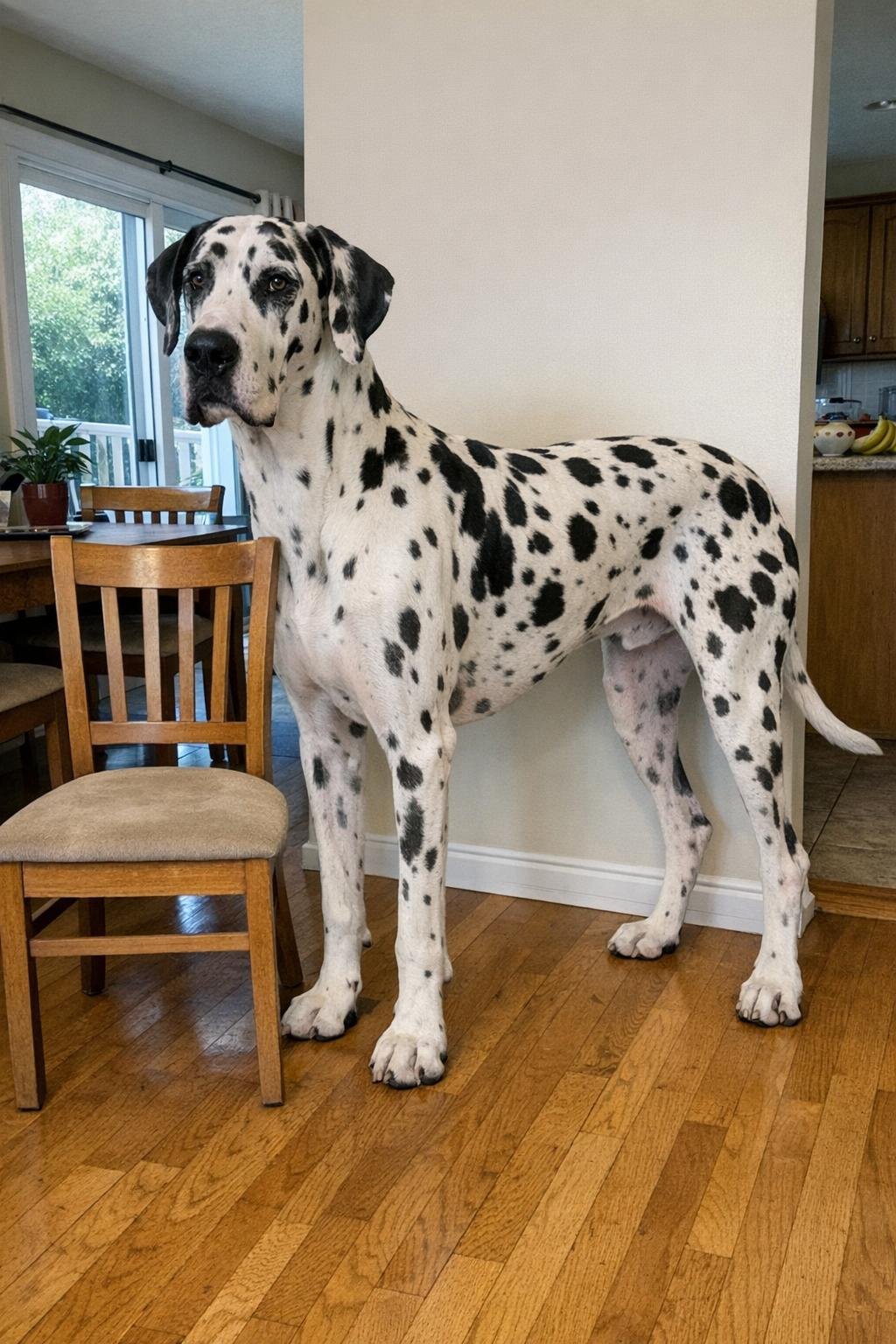
Here he is:
1. The first clue was his height
Dalmatians are athletic, medium-to-large dogs, but they do not usually make a standard dining chair look small. This boy did. When he stood next to the chair, the top of his back looked close to the seat height, and when he lifted his head, he seemed to go on forever. That was the first thing that made me think Great Dane.
A grown male Dalmatian often stands around 22 to 24 inches at the shoulder. Great Danes commonly stand 30 to 34 inches, sometimes more. A mix can land anywhere in between, but this dog clearly leaned tall. Even in a still photo, you can see those long vertical lines in the legs and that overall stretched, elegant frame that screams Dane influence.
2. That chest is pure big-dog architecture
One feature I always notice on giant breeds is the chest. Great Danes tend to have that deep, dramatic ribcage that drops low between the front legs. It gives them a statuesque look, almost like a horse in dog form. This dog has exactly that kind of front end.
Dalmatians are strong and well-balanced, but their bodies are usually a little more compact and square. When you see a dog with a chest that deep and a front half that substantial, it points strongly toward Great Dane. In everyday life, that kind of build also means you start thinking about practical things like elevated water bowls, roomy crates, and making sure he doesn’t barrel into the table during taco night.
3. The leg length tells a big part of the story
Long legs can change a dog’s whole silhouette, and this pup has them in spades. His legs look unusually tall and straight, with that lanky, slightly oversized look many young Danes have before they fully fill out. Even if you took away the spots for a minute, the outline would still suggest a giant breed.
That matters because breed guesses are often easier from structure than color. Lots of mixed dogs can inherit flashy markings, but body shape tends to narrow things down. Here, the long legs and higher overall reach point much more toward Great Dane than toward another common Dalmatian cross like Labrador, Pointer, or Pit Bull.
4. The spots say Dalmatian, but the canvas says something bigger
The coat itself is what made the shelter label him a Dalmatian mix, and that part makes perfect sense. He appears fully spotted, with the kind of clear pattern most people instantly connect to Dalmatians. But what makes him so striking is that the Dalmatian pattern is spread over a body that seems much larger than expected.
That combination is exactly why a Great Dane-Dalmatian mix feels like the most likely answer. It’s as if somebody took a very tall Dane body and wrapped it in Dalmatian print. From a family standpoint, I have to admit it is one of those dogs who gets attention before he even does anything. He just has to walk into the room.
5. His head shape looks softer and longer than a typical Dalmatian
Another clue is the head. Dalmatians usually have a clean, nicely proportioned head with a balanced muzzle, but Great Danes often carry a longer, more substantial face, especially through the muzzle and jawline. In this dog, the head looks a little more elongated and roomy than I’d expect from a pure Dalmatian.
That doesn’t mean blocky or heavy. In fact, many Dane mixes keep a gentle, elegant expression. This one seems to have that same soft-faced look giant breeds often wear, especially when they’re standing there acting innocent after stealing a dinner roll off the edge of the counter.
6. His overall proportions fit a Great Dane mix best
When I’m trying to guess a mix, I look at the whole dog instead of one dramatic feature. Height, chest depth, neck length, leg length, and body proportion all have to make sense together. Here, the proportions line up beautifully with Great Dane mixed with Dalmatian.
If he were mixed with a shorter, stockier breed, you’d expect a heavier middle, shorter legs, or a broader, lower frame. If he were mixed with a slimmer sporting breed, you likely wouldn’t get that same giant-breed chest and towering presence. Everything about him reads “very tall, very leggy, very likely Dane.”
7. Shelter labels are often best guesses
I always remind friends not to take shelter breed labels as a guarantee. Shelter staff do amazing work, but they’re often making educated guesses based on a quick intake assessment, age, coat pattern, and whatever history came with the dog. If a dog is covered in spots, “Dalmatian mix” is a perfectly sensible starting point.
But once a dog starts growing, or once you see him in a home environment next to familiar objects like a sofa, a baby gate, or a dining chair, you can notice things that weren’t obvious in a kennel. That’s why so many families end up saying, “Well, that label explained half of him.” In this case, I think the shelter absolutely got the spotted half right.
8. A DNA test would settle it, but the visual case is strong
If my sister wants a firm answer, a canine DNA test would be the cleanest way to do it. Most of the major pet DNA kits cost roughly $80 to $150 depending on sales and how much health screening is included. You swab the dog’s cheek, mail it in, and usually get results in 2 to 4 weeks.
That said, if someone showed me this dog and asked for my best guess without a test, I would say Great Dane-Dalmatian mix with a fair amount of confidence. Could there be something else in there too? Absolutely. Mixed dogs can surprise you. But based on the build alone, Great Dane feels like the most believable “other half.”
9. What a Great Dane-Dalmatian mix may be like at home
Temperament in mixes can vary, but this combination can produce a dog who is affectionate, goofy, alert, and surprisingly people-oriented. Dalmatians are energetic and smart. Great Danes are often gentle, sensitive, and deeply attached to their families. Put those together, and you may get a dog who wants to be near everyone all the time while also taking up the square footage of a loveseat.
In family life, that can be lovely, but it also means training matters early. A 15-pound puppy jumping up is one thing; an 80- to 120-pound adolescent doing it is another. I always say giant-ish dogs need house manners as badly as toddlers need routines. Sit at doors, wait at feeding time, and learn not to body-check Grandma on the way to the backyard.
10. Feeding a dog built like this takes some planning
If he does have strong Great Dane influence, my sister will want to be thoughtful about nutrition, especially if he’s still growing. Large- and giant-breed puppies need carefully balanced food, not just extra calories. Too-fast growth can be hard on developing joints. That usually means choosing a food specifically labeled for large-breed growth and sticking to measured portions instead of free-feeding.
As an example, a large adolescent dog might eat anywhere from 4 to 8 cups of food a day depending on age, weight, and calorie density, but the bag directions and the veterinarian’s guidance matter more than guesswork. Around my table, I measure everything, whether it’s flour or kibble, because “a little extra” adds up fast with big appetites.
11. Joint care and exercise should be handled with common sense
One thing about a likely Great Dane mix is that his size changes the conversation around exercise. He still needs daily activity, but hard repetitive impact during growth is not the goal. I’d lean toward steady walks, short play sessions, sniffing games, and controlled backyard zoomies rather than nonstop jumping off decks or chasing balls for an hour on concrete.
For a young large dog, two or three 15- to 25-minute walks a day can be more helpful than one overlong outing. Soft surfaces are kinder than slippery floors, too. If he’s galloping through the kitchen like a baby deer on ice, a few washable runners can save both dignity and joints.
12. Giant dogs need giant-household adjustments
This is the part people don’t always think through. A tall dog changes the flow of a home. Trash cans need lids. Counters need to stay clearer. Dining tables suddenly have a nose at plate level. Even tail height matters; a happy sweep can empty a coffee table in 3 seconds flat.
My practical checklist would include a bed at least 42 to 48 inches long, sturdy food and water bowls, a vehicle he can step into safely, and a crate sized for giant breeds if crate training is part of the routine. And if you’ve got picky kids, don’t leave chicken nuggets unattended on the edge of the counter. Consider that my warm Midwestern public service announcement.
13. Training should start with the basics and stay cheerful
A dog this size does not need harsh training. He needs consistency, repetition, and rewards he actually cares about. I’d start with name recognition, sit, down, wait, leash walking, leave it, and a reliable recall practice in a fenced area. Five-minute sessions, two or three times a day, can do wonders.
For food-motivated dogs, tiny training treats the size of a pea work just fine. You do not need a whole biscuit every time. And for families with children, I always recommend teaching the kids a few dog rules too: no climbing, no hugging around the neck, and let the dog eat in peace. Good family-dog relationships are built from both sides.
14. Health questions worth discussing with the vet
If the Great Dane guess is right, I’d be extra attentive to giant-breed concerns. Your veterinarian may want to talk through growth rate, body condition, joint development, and signs of bloat, also called gastric dilatation-volvulus. Deep-chested dogs can carry increased risk, and every big-dog household should know the warning signs: unproductive retching, a swollen abdomen, pacing, drooling, and distress.
It’s also worth asking about ideal adult weight, neuter timing if applicable, and how to keep him lean. In big dogs, carrying even 5 to 10 extra pounds can matter. I say the same thing I say in my kitchen: a good plan early saves trouble later.
15. My honest guess: Dalmatian plus Great Dane
So what do I think the other half is? Great Dane. Not just because he’s big, but because the whole package fits: the towering height, the deep chest, the long legs, the elongated frame, and that unmistakable giant-dog presence under all those Dalmatian spots.
And truly, he is a handsome new kid. Whatever his exact percentages turn out to be, he looks like one of those unforgettable shelter wins: unusual, lovable, and just a little larger than life. If my sister does a DNA test, I’d love to see the results—but if I were placing my bet today, I’d put my casserole dish and my last dinner roll on Great Dane.