
 Dogs
 Cats
 Birds
 Horses
 On the Land
 In the Sea
When my daughter brought this little shelter dog home and told me the paperwork said only “Terrier mix,” I smiled the way mothers do when we know there’s more to the story. I’ve spent enough years around farm dogs, town dogs, porch dogs, and every sort of homemade Midwestern mix in between to know that sometimes a dog tells you exactly who he is before anybody ever opens a file folder. One look at this scruffy new fellow trotting across her living room, nails clicking on the floor and tail wound up like a spring, and I started making my guesses.
Now, shelter labels are often the best honest guess from hardworking staff, and I don’t fault that one bit. A mixed dog can be a little mystery quilt of traits—ears from one side, coat from another, personality from somewhere all its own. But this darling had a face that stopped me in my tracks: terrier everywhere you looked, until he turned toward the light and those soft wrinkles and that compact little muzzle gave the whole secret away. Before I tell you what I think, have a look at the new kid yourself.
See for yourself:
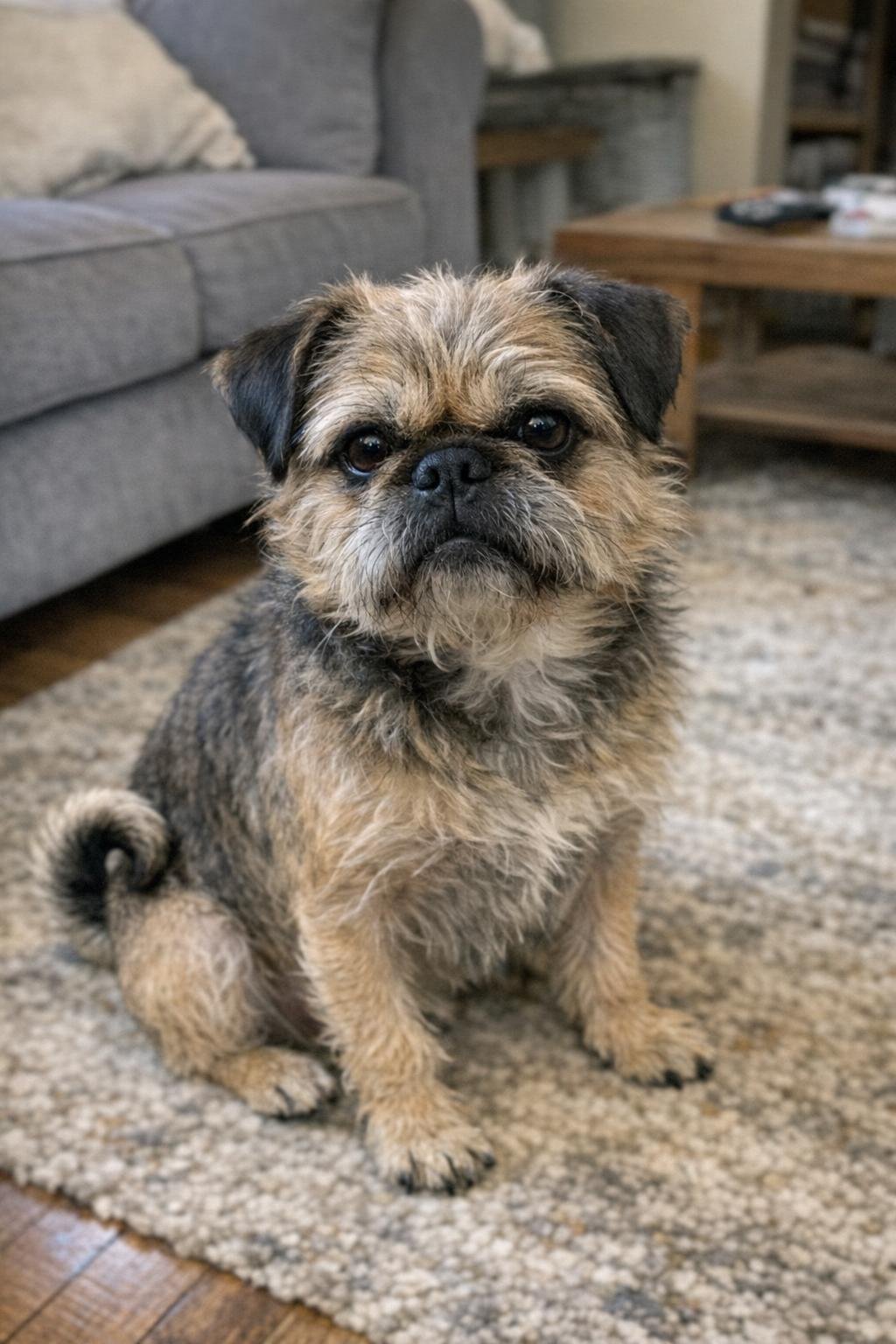
1. My first guess: there’s Pug in that face
If you ask me what the “other half” is, I’d say Pug without much hesitation. The biggest clue is that face. A lot of terrier mixes have longer muzzles, even the compact ones, but this pup has that shorter, flatter profile with a rounded forehead and a bit of wrinkling across the nose and brow. That’s classic Pug country. Not a pure Pug face, no, but enough of one that it jumps right out once you notice it.
The curled tail is another strong sign. Plenty of terriers carry their tails high, but that tight curl over the back is something I associate much more readily with a Pug. Put that together with the stockier middle and the slightly wide-set eyes, and I’d be mighty comfortable calling this little fellow a Pug-terrier mix.
2. Why shelters often use the label “Terrier mix”
I think folks sometimes imagine shelters have a secret breed detector hidden in the back room, but most of the time they are making a visual assessment in a matter of minutes. If a dog weighs 18 to 25 pounds, has a rough or wiry coat, and carries himself with that alert, busy, terrier look, “Terrier mix” is a sensible label. It’s broad, safe, and usually at least partly true.
In my area, I’ve seen dozens of dogs labeled terrier mixes that later turned out—through DNA tests or simple common sense—to include Pug, Chihuahua, Beagle, Miniature Pinscher, Dachshund, or even a little Boxer farther back. Mixed dogs can wear one side of the family on the outside and keep the rest tucked away in the details.
3. The body says terrier, and that matters too
What keeps this dog from reading as “mostly Pug” is the overall shape. He has that leaner, leggier outline many terriers carry, especially through the chest and front legs. A pure Pug often has a more barrel-shaped body, a broad chest, and a very smooth, close coat. This pup looks more athletic than that, with a little spring in his stance and a coat that seems to have texture rather than silkiness.
If I had to picture his size, I’d guess somewhere around 15 to 20 pounds, maybe standing 11 to 14 inches at the shoulder. That is a very common range for small terrier blends, and it also fits many Pug mixes nicely. He looks like the kind of dog who can scoot after a squeaky toy in one second and snore in a sunbeam the next.
4. Which terrier might be in the mix?
Now this is where the guessing gets a little more slippery. “Terrier” is a wide church supper of a category, and lots of dogs get placed there visually. Looking at a wiry coat and compact size, I’d first think along the lines of Jack Russell Terrier, Border Terrier, Cairn Terrier, or even a rough-coated rat terrier type. Not necessarily a papered, purebred version of any one of those, but something in that family of looks.
A Jack Russell-Pug mix is common enough to have a nickname in some circles, and those dogs often inherit a lively terrier body with a more rounded Pug face. A Cairn or Border influence can also bring that tousled, rustic coat. If this were my granddog, I’d say the Pug half feels clearer than the terrier half, which may be a blend itself.
5. The ears, eyes, and tail tell their own story
Whenever I’m trying to read a mixed dog, I go feature by feature the way I’d study a recipe card in my mother’s handwriting. The ears matter. Pugs usually have small folded ears, while terriers vary all over the map—button ears, semi-prick ears, folded ears. If this pup’s ears sit neatly and don’t stand fully upright, that lends a little more support to the Pug theory.
The eyes are another clue. Pugs are known for larger, rounder, more expressive eyes, while many terriers have slightly more almond-shaped, deeply set eyes. And then there’s that tail again. A true corkscrew or tight curl over the back is one of the strongest visual hints I’d look for. One feature can mislead you, but three or four together start to paint a picture.
6. Personality can hint at breed, though it never tells the whole tale
If he’s anything like the Pug-terrier mixes I’ve known, your daughter may have brought home a comedian with a motor. Terriers tend to be curious, determined, and quick to investigate every rustle, dropped crumb, and half-open door. Pugs, bless them, are affectionate little shadows who like to be near their people and can be gloriously silly.
Put those together and you often get a dog who wants to play hard for 20 minutes, patrol the windows for 10, then collapse beside a warm leg on the couch. I once watched a neighbor’s Pug mix spend half an hour trying to outsmart a treat ball and then proudly carry it around like he’d won a blue ribbon at the county fair. That sort of bright, funny persistence feels very possible here.
7. Coat texture is one of the most interesting clues
The wiry or scruffy coat is what keeps this dog from looking like a straightforward small companion breed mix. Pugs generally have a short, smooth, dense coat that sheds more than people expect. Terriers, on the other hand, may have rough, broken, or wiry coats that stand off the body a bit, especially around the muzzle, chest, and legs.
If this little dog has whiskery furnishings around the mouth or eyebrows that look a touch untidy even right after brushing, that points toward terrier genes coming through strongly. A mixed coat like that may need brushing 2 to 3 times a week with a slicker brush or a rubber curry, depending on whether it is coarse, medium, or soft under the hand.
8. If your daughter wants a more certain answer, a DNA test can help
Visual guessing is fun—I enjoy it the way some folks enjoy guessing the secret ingredient in a church potluck casserole—but it isn’t perfect. If your daughter truly wants to know, a canine DNA test is the best next step. Most of the popular kits run somewhere between $75 and $150, depending on sales and whether they include health screening.
The process is usually simple: swab the inside of the dog’s cheek for about 30 to 60 seconds, let the sample dry if the instructions say so, then mail it in. Results often take 2 to 4 weeks. Even then, breed percentages are estimates, but they can confirm whether Pug is really in the family tree or whether another flat-faced breed is playing tricks on the eye.
9. Health traits to watch in a Pug-terrier type mix
Whenever a dog appears to have some brachycephalic, or short-muzzled, features, I pay attention to breathing. Not every Pug mix has significant issues, but if he snores heavily while awake, struggles in hot weather above 80 degrees, pants excessively after only 10 minutes of play, or seems reluctant to exercise, it’s worth mentioning to the vet.
Terrier influence may bring a more active frame and sturdier stamina, but those Pug traits can still matter. I’d also keep an eye on skin folds if he has any facial wrinkles, as moisture can collect there. Gentle cleaning with a soft cloth and a veterinarian-approved wipe can help. Weight matters too. On a small dog, even 2 or 3 extra pounds can put more strain on breathing and joints.
10. Exercise for this kind of mix should be steady, not extreme
If I were setting a routine for a dog like this, I’d aim for two walks a day of about 20 to 30 minutes each, plus a few short indoor play sessions. That’s enough to satisfy a terrier’s busy mind without overdoing things if the Pug side limits endurance. A game of fetch down a hallway, a snuffle mat, or 10 minutes with puzzle toys can tire a smart little dog almost as well as a long outing.
In Midwestern summers, I’d choose morning before 9 a.m. or evening after 7 p.m. when the air eases up. In winter, a dog with a shorter coat may appreciate a sweater once temperatures drop below about 35 degrees, especially if the wind is up. Small dogs feel weather fast, and I’ve seen many a sturdy-looking pup decide he was done with January after exactly 4 minutes outside.
11. Feeding a compact mix like this takes a careful hand
One thing Pugs and terriers can have in common is enthusiasm for food. That means portion control matters. A small adult dog in the 15- to 20-pound range might eat roughly 3/4 cup to 1 1/4 cups of quality dry food a day, split into two meals, though of course the exact amount depends on calorie density, age, and activity level.
I always tell people to use a measuring cup, not a hopeful glance. Treats count quickly on a small frame. A biscuit here, a scrap there, and before long that curled tail is riding over a thicker waistline. Lean is healthier, especially if the dog has any Pug-related breathing tendencies.
12. Grooming may be easier than you expect, but not no-work
A mixed coat often means mixed maintenance. If he has a true wiry outer coat, brushing 2 or 3 times weekly may keep shedding and tangles under control. If the undercoat is dense, a deshedding tool once a week during seasonal coat blows can help. Nails usually need trimming every 3 to 4 weeks unless he wears them down naturally on sidewalks.
And don’t forget the practical little things: wipe muddy paws, check ears weekly, and brush teeth several times a week if he’ll tolerate it. Small dogs are notorious for dental buildup. I’ve learned over the decades that a 90-second tooth-brushing routine can save a great deal of trouble—and expense—down the road.
13. Why these shelter mysteries are often the best dogs of all
Some of the finest dogs I’ve ever known would have looked mighty ordinary on paper. “Mixed breed, brown, medium” doesn’t begin to describe loyalty, humor, cleverness, or the way a dog chooses his person. There’s something sweet about not knowing every branch on the family tree right away. You get to meet the dog first and the breed story second.
That feels especially true with a pup like this one. The terrier side brings spark. The Pug side brings heart and clownish charm. The result is the sort of dog who tends to make himself at home not by grand gestures, but by quietly becoming everybody’s favorite within a week.
14. My final answer: I’d call him a Pug-terrier mix and feel good about it
So if you’re asking for my porch-swing opinion, I think the “other half” is Pug. Not because of one single feature, but because the clues line up: the flattened wrinkled face, the rounded expression, the curled tail, and that sturdy little companion-dog sweetness under all the terrier scruff.
Of course, only a DNA test could sort out the finer details, and even then you may find two or three breeds braided together. But from where I sit, this new kid looks very much like a terrier crossed with a Pug—and I mean that as a compliment of the highest order. He looks lively, lovable, and just unusual enough to be unforgettable.