
 Dogs
 Cats
 Birds
 Horses
 On the Land
 In the Sea
When our poodle had her litter last week, I did what every excited dog mama-by-proxy does: I counted noses, checked tiny paws, changed bedding, and sent far too many photos to family. We had five healthy puppies, all warm and wiggly and about the size of a loaf of sandwich bread lined up side by side on their fleece bed. At first glance, most people noticed the usual things—how shiny they were, how tiny their little tails looked, and how one was especially loud at mealtime.
Then they saw the last puppy and stopped cold. Right next to solid-colored littermates was one little black-and-white spotted baby that looked completely different from the others, and I have heard every question you can imagine since then. Was there another father? Was something mixed in somewhere down the line? Did nature just get confused? The short answer is that this is absolutely possible in purebred poodles, and once you understand parti-color genetics, it makes perfect sense. See for yourself:
Here she is:
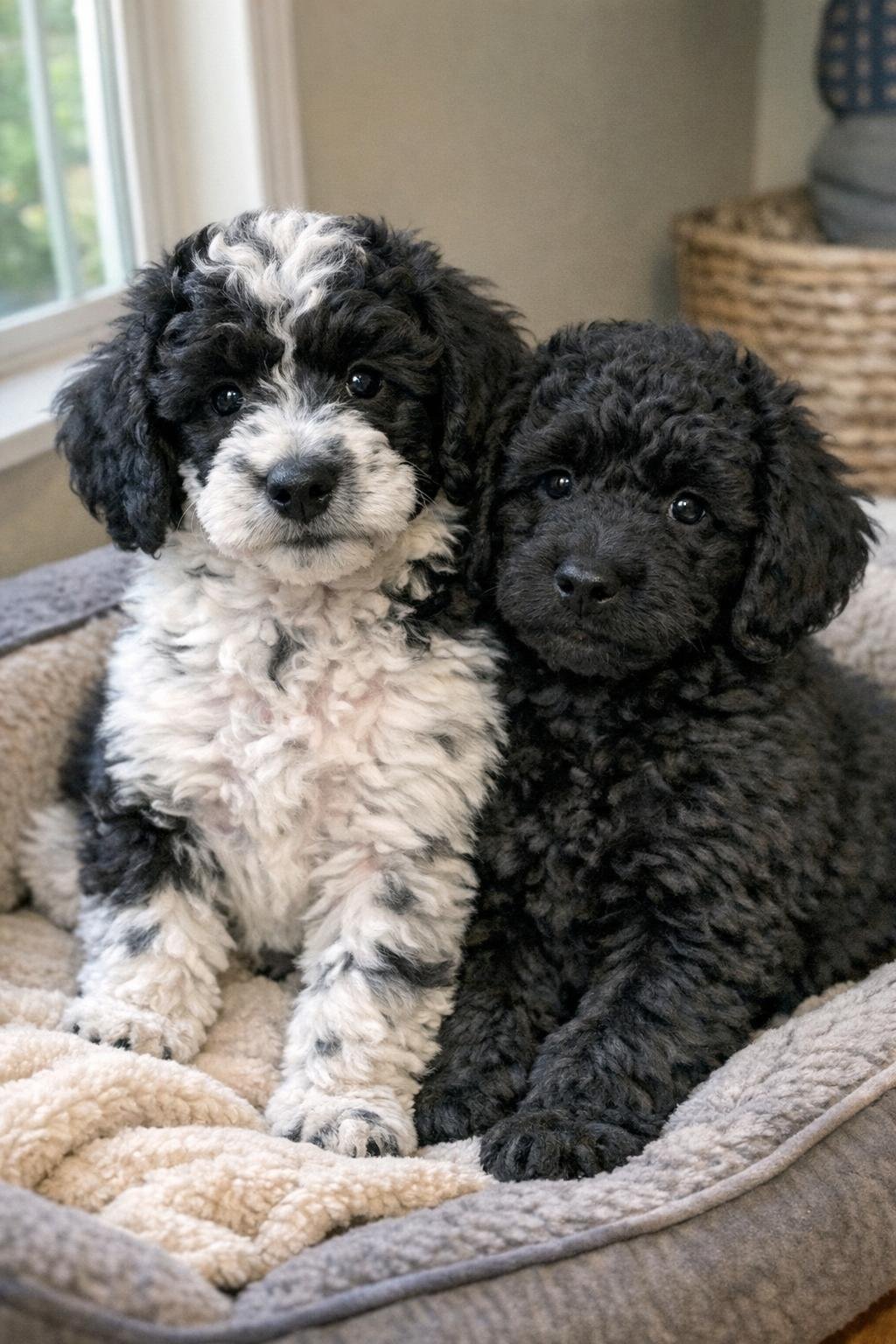
1. Yes, a purebred poodle can absolutely have a parti puppy
This is the first thing I want to clear up, because it is where most of the gasps come from. A black-and-white parti poodle is not automatically a mixed-breed puppy. In poodles, “parti” simply means the dog has a base of white coat with patches of another color, such as black, brown, silver, blue, or apricot. It is a recognized color pattern genetically, even if not every kennel club accepts it in conformation showing.
In plain family-language, that spotted puppy did not appear out of nowhere. The genes for that coat pattern were already present in the parents. The surprise usually comes because both parents may look solid-colored, and many people assume what you see on the outside tells the whole story. Genetics is rarely that simple.
2. What “parti” actually means in poodles
A parti poodle has at least 50% white in the coat, plus clearly defined patches of another color. In black-and-white parti puppies, those patches can look like little islands of color across the ears, eyes, back, or sides. Some puppies are mostly white with a few bold spots. Others have large dark blankets of color with white legs, chest, belly, and neck.
When puppies are brand new, the markings can look especially dramatic because their coats are short, soft, and cleanly separated by color. As they grow, the curl tightens, and the exact shape of the patches can look a bit different under fluffier hair. But the basic pattern is there from birth. It is not a stain, and it does not “turn into” another pattern later. The spots are part of the dog’s genetic blueprint from day one.
3. The reason solid parents can produce a spotted puppy
This is where recessive genetics comes in. Parti patterning in poodles is tied to genes at what breeders often call the S locus, specifically a recessive form associated with white spotting. For a puppy to be parti, it generally must receive the spotting version from both parents.
That means two solid-colored poodles can carry the parti gene without showing it themselves. If each parent carries one copy, there is a chance a puppy will inherit both copies and express the parti pattern. In a simple carrier-to-carrier pairing, the rough probability for each puppy is 25% parti, 50% solid but carrying parti, and 25% solid and not carrying parti.
That 25% figure does not mean every litter of four gets exactly one parti puppy. Each puppy is its own genetic roll of the dice. In a litter of five, you might get zero parti puppies, one, two, or more. Probability is not a recipe card; it is just a likelihood.
4. Why one puppy can look so different from the rest of the litter
This is one of those things that feels surprising emotionally, even when it is scientifically normal. Siblings do not have to match. In fact, in many animal litters, individual puppies can vary quite a bit in size, markings, and even how much white they show.
Think of it like a family with five children who all inherit different combinations of mom’s and dad’s features. One child gets dad’s dark hair, another gets mom’s freckles, another gets grandma’s nose. In dogs, coat color can work the same way. If one puppy inherits two copies of the parti allele and the others do not, that one puppy may stand out instantly, even though it belongs to the same litter and the same two parents.
5. No, this does not automatically mean there were two fathers
I have heard this question more than once, and I understand why people ask it. When one puppy looks dramatically different, folks jump to the most dramatic conclusion. While litters with more than one father can happen in dogs under some circumstances, a single parti puppy in a poodle litter is not, by itself, evidence of that.
If both parents carry the recessive parti gene, one parti puppy is completely explainable without any mystery at all. In most cases, if the timing, supervision, and breeding records are clear, coat color alone is not a good reason to assume something unusual happened. Genetics can create plenty of variation all on its own.
6. Black-and-white is only one version of parti
People often picture parti poodles as black and white because it is a very striking look, especially in photos. But parti can show up in several color combinations. You may also see brown and white, apricot and white, silver and white, blue and white, cream and white, or red and white.
The color patch itself is determined by other genes layered on top of the spotting pattern. So one gene set says, in effect, “this puppy will have white spotting,” while another helps determine whether the dark patch areas are black, brown, or another color. That layering is one reason poodle color genetics can look complicated at first, but it also explains why the same litter can include puppies that are solid black, blue-toned, brown-based, or parti-patterned depending on what the parents carry.
7. How breeders confirm what might be hiding genetically
Years ago, breeders had to rely mostly on pedigrees and what turned up in previous litters. Today, many use canine DNA testing to check coat-color genes. A simple cheek swab can often identify whether a dog carries recessive traits like parti spotting, brown, dilute, and more.
These tests usually cost somewhere between $70 and $200 depending on the company and how many markers are included. Results can help breeders plan pairings more responsibly and avoid being caught off guard by colors they did not expect. It is not magic, but it is a very useful tool. If a breeder says both parents are “parti carriers,” that usually means genetic testing or well-documented lineage supports it.
8. Why the parti puppy often becomes the one everyone talks about
In a litter box full of similar-looking puppies, the spotted one naturally draws the eye. I have raised enough children to know this is just human nature—we notice the child with the bright rain boots in a line of sneakers, and we notice the puppy with patches in a row of solids.
That visual contrast can make people think the parti puppy must be more unusual in every way, but color pattern does not tell you much about personality, health, intelligence, or future size by itself. A parti puppy may grow up bold, mellow, busy, cuddly, toy-driven, or reserved just like any other poodle. The spots are eye-catching, but they are not a personality test.
9. Does parti coloring affect health?
In poodles, parti coloring itself is not generally considered a health problem. A black-and-white parti puppy can be every bit as healthy as a solid black sibling, assuming the puppy comes from health-tested lines and is properly cared for. What matters more are the parents’ screenings for things like hips, eyes, patellas, and breed-related inherited conditions.
Whenever I talk with families about puppies—whether dogs or kids, honestly—I always say the flashy feature should never be your first priority. Temperament, sound structure, veterinary care, socialization, and responsible breeding matter much more than whether the coat is solid or spotted.
10. Why the markings can look extra dramatic in the first few weeks
Newborn and one-week-old puppies have short, velvety coats, so the edges between black and white areas can look crisp, almost painted on. Natural window light makes that contrast even stronger, especially in a home setting with neutral bedding. A black puppy can read as one smooth block of color, while a parti puppy has bright white areas that immediately jump forward in photos.
As the coat lengthens over the next 6 to 12 weeks, curls soften the outlines and add volume. The color pattern does not disappear, but the visual effect changes. This is part of why people seeing a very young parti puppy for the first time often react so strongly—the contrast is at its cutest and clearest right then.
11. What this means for future litters from the same parents
If the same two parents are bred again and both truly carry parti, another parti puppy is possible in a future litter too. But “possible” does not mean guaranteed. Even with the same pairing, one litter might have no parti puppies at all, and the next could have two out of five.
For example, if a breeder had two carrier parents and a litter of five, the math might suggest an average near 1.25 parti puppies per litter over many, many litters. But any one real-life litter does not have to match that average. Families sometimes assume that because there was one parti puppy this time, there must be one exactly next time. Genetics does not keep score that neatly.
12. Registration and showing can be a separate issue from genetics
This part can confuse people, too. A color can be genetically normal and still not be accepted the same way in every registry or show venue. Some kennel clubs register parti poodles but do not allow them in conformation classes where only solid colors are standard. Other organizations and performance sports care much more about the dog’s ability and temperament than coat pattern.
So if someone tells you, “That color is not standard,” that is not the same as saying, “That dog cannot be purebred,” or “That color is impossible.” Those are three very different statements, and it helps to keep them separate.
13. What I would tell families who fall in love with the spotted one
I completely understand it. The black-and-white puppy is often the first one people ask about. If you are choosing a puppy for your family, enjoy the pretty markings, but ask the practical questions too. How does the puppy respond to handling? Is she gaining weight steadily? Has she been checked by a veterinarian? What is the grooming commitment? For a poodle coat, most families should budget brushing 3 to 4 times a week at home and professional grooming every 4 to 8 weeks, depending on coat type and haircut.
If you have young children or picky family schedules like I do, the best puppy is not always the flashiest one. It is the one whose temperament and needs fit your home. That said, if you get the spotted sweetheart and she steals the show at every cookout and holiday gathering, I would not blame you one bit.
14. So how is this even possible? Here is the simple answer
The last puppy made everyone gasp because she inherited a recessive parti-color gene from both parents, while her solid siblings inherited different combinations. That is it. No magic, no mix-up, no impossible biology. Just a beautiful example of how hidden genetics can show up when the right pair of genes meets in one tiny puppy.
And honestly, that is part of what makes litters so fascinating. Even in one cozy dog bed, with five puppies born to the same mother in the same week, nature can still hand you one little surprise that gets the whole room talking.