
 Dogs
 Cats
 Birds
 Horses
 On the Land
 In the Sea
Last week our Newfoundland delivered six healthy puppies, and for the first few days I thought I already knew exactly what I was looking at: a wiggly, sleepy pile of black fur, milk-drunk naps, and the usual round-the-clock routine of weighing, warming, and changing bedding. Then people started leaning over the whelping box, counting once, counting twice, and stopping dead at the very last puppy. One by one, every visitor had the same reaction: a full pause, a gasp, and then the question I’ve now answered at least 20 times.
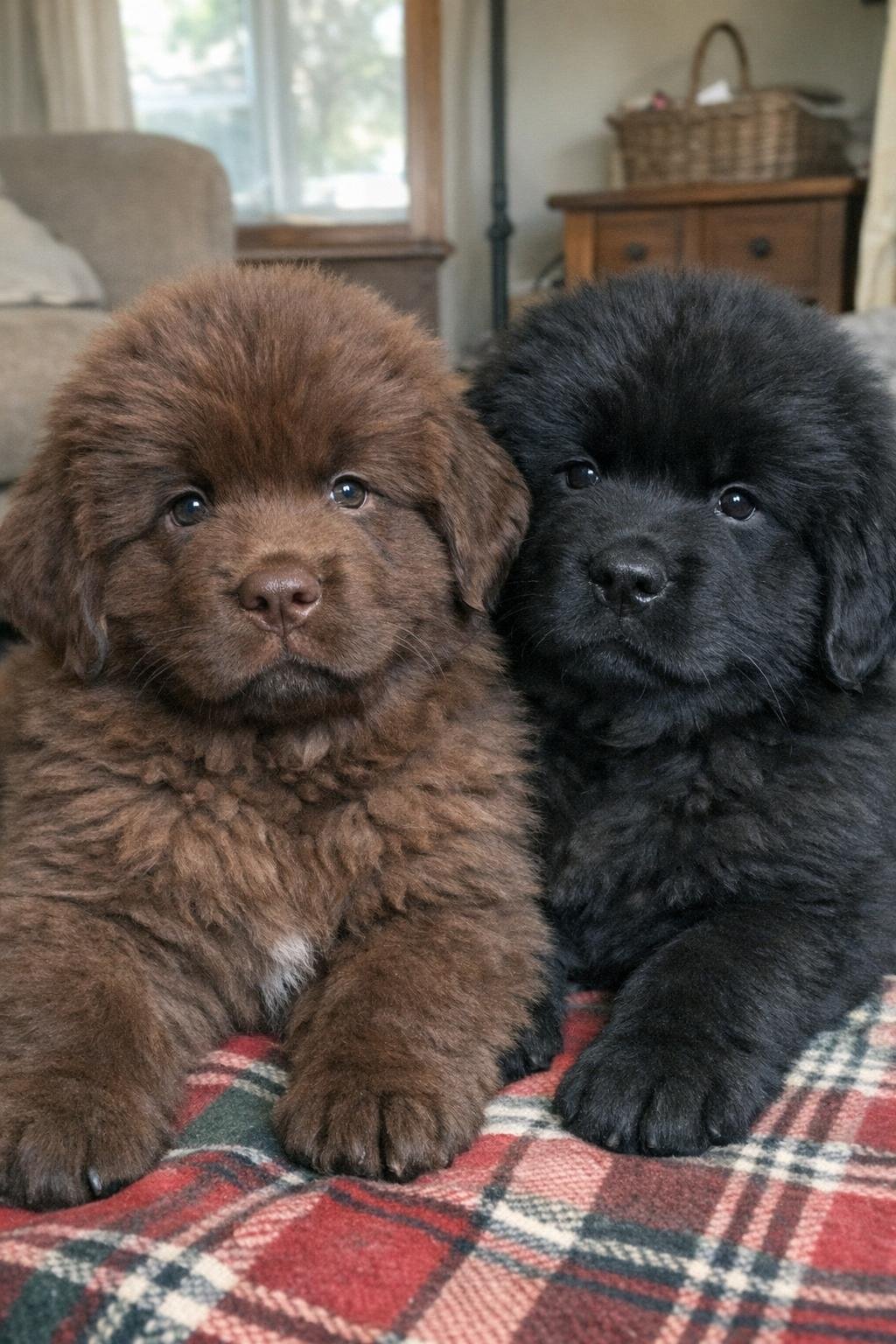
If you’ve ever looked at a giant-breed litter and wondered how one puppy can look so different from the rest, the explanation is a lot less mysterious than it seems. In our case, the surprise comes down to coat-color genetics, specifically a recessive brown gene that can stay hidden for generations and then suddenly appear when both parents quietly carry it. Before I get into how that works, what it means, and why it does not make the puppy “less pure” or “mixed,” here’s the little one everyone is talking about.
See for yourself:
1. The surprise is the brown coat, not a different breed
The last puppy in our litter is a rich chocolate brown, while the others appear black. That alone is enough to make people assume something unusual happened, but a brown Newfoundland is absolutely a real Newfoundland. In the breed, black is the color most people expect, so when a brown puppy shows up in a litter, it feels dramatic even though genetically it can be completely straightforward.
In person, the difference is even more obvious than in photos. Black puppies tend to reflect light with a charcoal or inky sheen, while a brown puppy can look deep cocoa, liver, or warm espresso depending on the room and the time of day. Under morning light by our dining room window, this puppy’s coat looked almost chestnut along the edges of the ears and shoulders.
2. What a recessive gene actually means
“Recessive” does not mean rare in every line, and it does not mean weak, defective, or unhealthy. It simply means a puppy has to inherit the brown version of the gene from both parents for the brown coat to show. If a puppy gets only one brown copy and one black copy, the puppy will usually look black but still carry brown.
A simple way I explain it to friends is this: each parent hands over one coat-color instruction at this location in the DNA. If both instructions say brown, the coat is brown. If at least one says black, the black pigment dominates in visible appearance. That’s why two black-looking dogs can sometimes produce a brown puppy.
3. How two black parents can have a brown puppy
This is the part that makes most people blink. If both parents carry one black allele and one brown allele, each puppy has four possible genetic combinations: black/black, black/brown, brown/black, or brown/brown. In practical terms, that works out to about a 25% chance of brown, a 50% chance of black while carrying brown, and a 25% chance of black without carrying brown.
That 25% figure is per puppy, not per litter. A six-puppy litter does not guarantee one and a half brown puppies, of course. Real litters are a roll of the genetic dice each time. You could get zero brown puppies in six, one brown puppy in six, or more than one. We happened to get one obvious little show-stealer.
4. Why the litter can still be “normal” even if only one puppy is brown
People often expect genetics to distribute evenly, as if a litter should come out like sorted marbles. That is not how it works. In a litter of six, one brown puppy is entirely believable if both parents carry brown. If I had told you ahead of time that each puppy had a 1-in-4 chance of being brown, one out of six would not sound impossible at all.
Small sample sizes create big visual surprises. Toss a coin six times and you might get four heads, one tail, and then one more head. Nobody calls the coin broken. The same logic applies here: a recessive trait can show up once in a litter and still fit perfectly within normal inheritance patterns.
5. Brown can hide in a pedigree for generations
One reason this feels sudden is that recessive genes can stay invisible for a very long time. A black dog can carry brown without showing any sign of it, and if that dog is bred to another black dog that does not carry brown, none of the puppies will be brown either. The gene is still there, just not visible.
That means you can go through several generations seeing only black coats and then unexpectedly get a brown puppy when two carriers are paired. This is why pedigrees matter and why experienced breeders keep detailed notes. Color outcomes are not random chaos; they are often hidden probabilities finally becoming visible.
6. This does not mean the puppy is mixed
I have to say this plainly because it is always the first suspicion from people outside dog breeding: a brown puppy in a mostly black Newfoundland litter does not automatically suggest another breed was involved. Coat color alone is not evidence of crossbreeding. If the breed carries that color genetically, then the appearance is fully explainable within the breed.
In fact, assuming “mixed” based on one recessive trait is one of the quickest ways to misunderstand canine genetics. Ear set, head shape, bone, feet, coat texture, tail, and overall structure tell you far more than a single color surprise. Our brown puppy still has the same blocky Newfoundland look, heavy paws, broad muzzle, and plush double coat as the black littermates.
7. The science behind the brown shade
At the simplest level, brown coat color in dogs is commonly linked to changes affecting black pigment, eumelanin. When a puppy inherits two copies of the brown variant at the relevant locus, black pigment is altered to brown. That change can affect not just the coat but often the nose leather, eye rims, and paw pads as well.
In our puppy, even at just a week old, the difference was starting to show beyond the fur. The nose looked softer liver-brown rather than jet black, and the pigment around the eyes was warmer too. As the puppy matures over 8, 12, and 16 weeks, those distinctions usually become easier to spot, especially in daylight.
8. What the puppy will likely look like as it grows
Newfoundland puppies change fast. In the first 2 weeks, they mostly look like plush little loaves with tiny ears pasted to the sides of their heads. By 4 to 6 weeks, coat texture fluffs out, movement gets bouncier, and color becomes more expressive. A brown puppy may deepen from milk-chocolate to dark mahogany, or appear lighter at the feathering depending on genetics and sun exposure.
Adult Newfoundlands are a giant breed, and a healthy adult can weigh anywhere from about 100 to 150 pounds, sometimes more depending on sex and build. So that tiny brown puppy that currently fits in two hands may one day be a massive chocolate-coated dog draped across your entire entry rug.
9. Whether the brown color affects health
The coat color itself is not a health diagnosis. A recessive brown coat gene does not automatically mean the puppy will have special medical problems because of the color alone. The real health concerns in Newfoundlands are the same ones responsible breeders already watch for: cardiac issues, orthopedic disease such as hip and elbow dysplasia, cystinuria in some lines, and overall soundness and temperament.
What matters much more than coat shade is breeder practice. Puppies should be weighed daily in the first week, monitored for nursing strength, checked for steady gains, and kept in a clean, temperature-controlled whelping area. In our setup, I keep the room around the low-to-mid 70s Fahrenheit for the dam’s comfort, while making sure the puppies have access to a warmer zone and dry bedding changed multiple times a day.
10. How we knew early that this puppy was different
With some breeds, newborn coat color can be hard to read for a few days. In our litter, I noticed one puppy looked “soft black” at first glance, then distinctly brown once I picked the puppy up near the window around midday. Wet neonatal fur, dim lighting, and shadows from the whelping box can all make colors look darker than they really are.
By day 3, I was confident. By day 5, every visitor was spotting it from across the room. The contrast became clearest when that puppy was placed beside one of the darkest littermates on a red-and-navy plaid blanket. Side-by-side comparisons remove almost all doubt.
11. DNA testing can confirm what the eye suspects
If you want certainty, modern DNA testing is very helpful. A simple cheek-swab color test can usually identify whether a dog is clear for brown, carries brown, or expresses brown. For breeders, this is useful not just for curiosity but for planning future litters responsibly and avoiding color surprises that buyers or co-owners misunderstand.
Tests are not especially complicated to do at home. Most kits involve swabbing the inside of the cheek for 20 to 60 seconds, letting the sample dry as directed, and mailing it to the lab. Results often come back in a couple of weeks, depending on the company. For a breed where recessive color can hide quietly, that information can be worth every penny.
12. Why visitors react so strongly
Part of it is contrast. Giant fluffy black puppies already look like tiny bears, so when one appears in deep chocolate, people register it immediately. The other part is expectation. Most people have seen black Newfoundlands in photos, calendars, or at the park. Far fewer have seen a brown one in person, especially as a newborn beside black littermates.
There’s also something about litters that invites comparison. If all six puppies were brown, most visitors would simply say, “What a gorgeous litter.” But with five that read one way and one that reads differently, everyone starts looking for a dramatic explanation. Usually the answer is not scandalous at all. It is just inheritance doing exactly what inheritance does.
13. A quick breeder’s note on honesty and education
Whenever a surprise color appears, I think it is important to explain it clearly rather than lean into mystery. Buyers deserve real information: what the color is, whether it is accepted in the breed context they care about, whether it changes care needs, and what test results say. Vague comments like “the special one” may be cute for social media, but they do not help families understand the dog.
I also think it helps preserve trust. When people hear “recessive gene” explained in plain English, most of the confusion disappears in under 5 minutes. Once they understand that both parents can look black and still carry brown, the whole thing stops sounding impossible and starts sounding fascinating.
14. So how is this even possible?
The short answer is: both parents likely carried a hidden copy of the brown coat gene, and this puppy inherited that brown copy from each of them. That gave the puppy two brown alleles, which turned what would otherwise be black pigment into a rich chocolate brown. Nothing supernatural, nothing suspicious, and nothing contradictory about the litter at all.
Honestly, that is what I love about dogs. You can spend years around a breed, think you know every look in the room, and then genetics hands you one little living lesson in probability wrapped in fluff and oversized paws. Our last puppy is still every bit a Newfoundland. The only difference is that this one arrived wearing chocolate instead of black.