
 Dogs
 Cats
 Birds
 Horses
 On the Land
 In the Sea
When my daughter brought her shelter pup home labeled simply as a “Golden Retriever mix,” I smiled the way any longtime dog lover does when paperwork clearly tells only half the story. The coat was there, certainly—that warm honey-gold fur, soft ears, and that eager, people-focused expression that makes so many of us melt on sight. But from the first afternoon in the kitchen, while I chopped onions for soup and the new pup sat watching every move with almost theatrical intensity, I had a hunch there was another breed in the background.
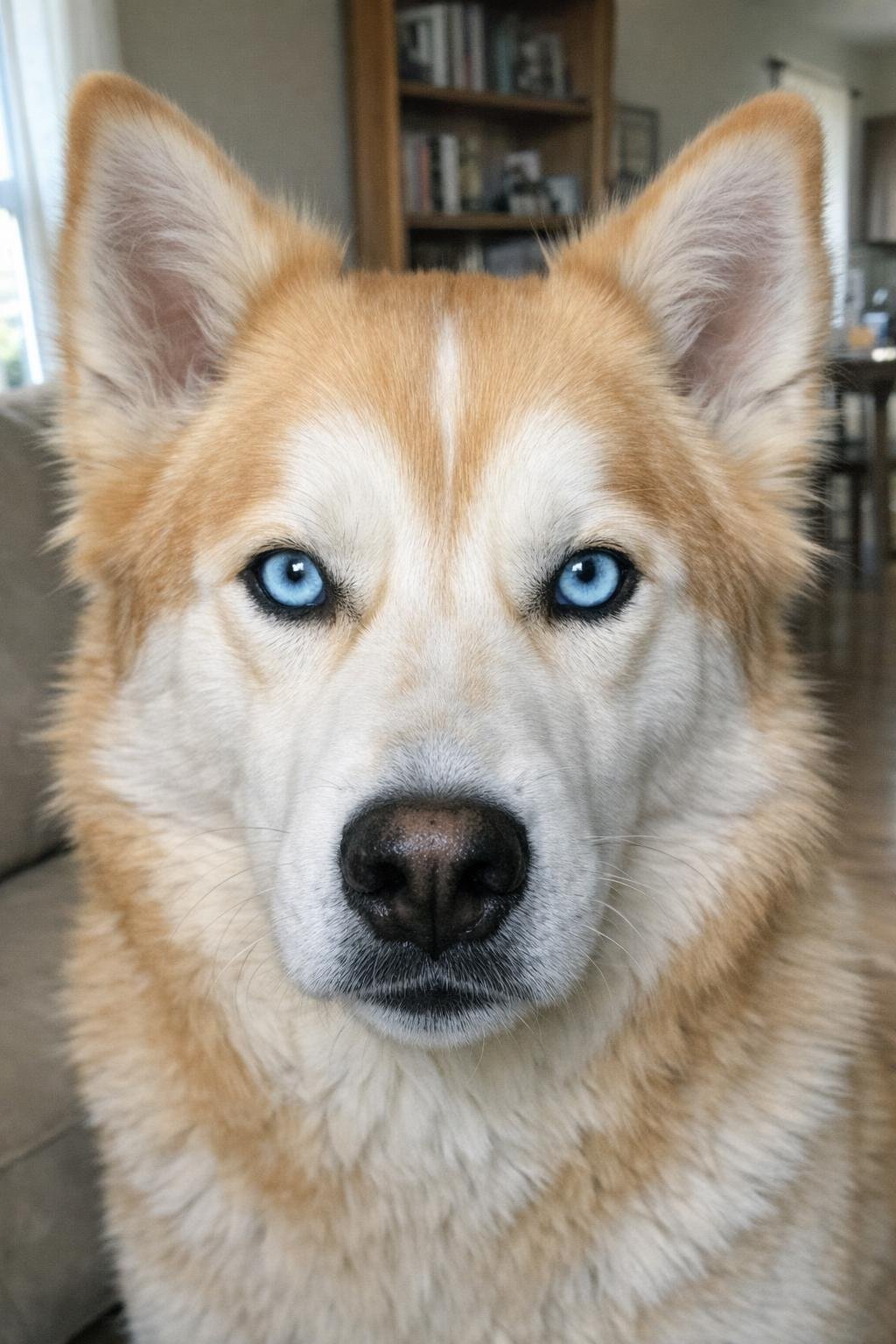
Then came the giveaway: those startling eyes. Not brown, not hazel, but the kind of pale, icy blue that stops conversation mid-sentence. Add a faint white mask dusted across the face and just enough independent streak to make “sit” feel like the opening bid in a negotiation, and I started thinking we were looking at a mix with a lot more northern-dog energy than the shelter card suggested. If you’re wondering what the other half looks like up close, take a look:
Here she is:
1. My best guess: Golden Retriever crossed with Siberian Husky
If I had to put money on it, I’d say this “Golden Retriever mix” is a Golden Retriever and Siberian Husky combination—sometimes casually called a Goberian. It is not an official breed, of course, just a mixed-breed dog with traits that often show up in both parents. The blue eyes are one of the biggest clues, because while Goldens almost always have brown eyes, Huskies commonly carry pale blue eyes or even one blue and one brown.
The facial markings matter too. A soft white blaze or mask over a golden coat is something I see far more often in Husky mixes than in, say, Labrador or Shepherd mixes. Then there’s the body language: affectionate and social like a Golden, but alert, expressive, and a touch opinionated like a Husky. In my experience, that combination is hard to miss once you’ve lived with the dog for a week or two.
2. The physical clues that point toward Husky
When I look at mixed breeds, I start with five basic markers: eyes, mask, ears, tail, and gait. In this pup’s case, the eyes are doing heavy lifting. Ice blue eyes are classic Husky territory. The faint white mask is another clue, especially if it runs symmetrically from the muzzle toward the eyes.
I’d also watch how the tail sits when the dog is relaxed and when excited. A Golden tends to carry a feathery tail more softly, while a Husky mix may lift the tail higher, sometimes with a slight curve. The coat can confuse people because a Golden-Husky mix may not look especially fluffy as a puppy; by 8 to 18 months, the undercoat often becomes more obvious, especially during spring shedding. Even the stride can offer hints: Goldens move with that pleasant, easy athleticism, while Huskies often have a light, efficient trot that looks as if they were designed to keep going for miles.
3. Why shelters often use “Golden Retriever mix” as a catch-all label
Shelters do the best they can, but visual breed identification is famously unreliable. One study frequently cited in animal welfare circles found that shelter staff guesses often did not match DNA results, especially in medium and large mixed-breed dogs. If a dog has floppy ears, a friendly face, and a yellow-gold coat, “Golden Retriever mix” becomes a practical shorthand.
That label can also help adopters imagine temperament, even when the dog’s true ancestry is more complicated. A Husky-Golden mix may present as “golden” to the eye while carrying a good share of Husky behavior—more vocalization, more prey drive, more stamina, and more mischief. I never fault a shelter for making its best estimate, but I do tell adopters to stay flexible. The dog in your living room is always more informative than the breed line on the paperwork.
4. Temperament: where the Golden sweetness meets Husky independence
This mix can be delightful, but it is not necessarily simple. Golden Retrievers are famously eager to please, people-oriented, and generally easy to motivate with praise or treats. Siberian Huskies, on the other hand, are intelligent but often independent. They understand the assignment perfectly well and may still decide they have alternative plans.
Put those together and you can end up with a dog that is deeply affectionate yet not blindly obedient. In practical terms, that might mean a pup who wants to be near the family at all times, greets visitors warmly, and loves games—but also tests boundaries, gets bored with repetition after 5 to 8 minutes, and suddenly finds a squirrel more compelling than your recall cue. To me, that’s not a flaw; it just means training needs to be thoughtful, upbeat, and consistent.
5. Exercise needs are usually higher than people expect
If this dog is indeed part Husky, I would plan for more exercise than a typical laid-back family retriever mix might need. For an adult, that can mean 90 to 120 minutes of total activity per day, split into two or three sessions. A good baseline might be a 30-minute brisk morning walk, 20 minutes of fetch or tug in the late afternoon, and another 30- to 40-minute evening outing with sniffing time.
Puppies need a more measured approach because joints are still developing. I prefer several short bursts—10 to 15 minutes of play, four or five times a day—rather than forced long-distance jogging. Mental work counts too. A 15-minute puzzle feeder session or beginner nose-work game can tire a smart dog almost as effectively as physical exercise. In my house, scattering kibble in a snuffle mat has bought me enough quiet to finish roasting a chicken in peace.
6. Coat care and shedding: prepare for the tumbleweeds
A Golden-Husky mix can shed substantially, especially if the dog inherits the Husky undercoat and the Golden’s feathering. Expect seasonal “blowouts” once or twice a year, often in spring and fall, when handfuls of loose hair seem to appear from nowhere. During those heavy weeks, brushing 4 to 5 times per week is not excessive.
I’d keep three tools on hand: a slicker brush, a metal comb, and an undercoat rake used gently and correctly. Regular brushing sessions of 10 to 15 minutes help prevent matting behind the ears, under the collar, around the britches, and near the tail. Baths every 6 to 8 weeks are usually plenty unless the dog has rolled in something unspeakable, which, if there is Husky mischief involved, remains a real possibility. A quality deshedding shampoo can help, but no shampoo will cancel biology. Good luck to your vacuum cleaner.
7. Training this kind of mix takes strategy, not force
With a dog like this, I recommend short, upbeat sessions—5 to 10 minutes, two or three times a day. Use high-value rewards: pea-sized bits of chicken, freeze-dried liver, cheese no larger than a fingernail, whatever safely captures attention. Huskies can lose interest in repetitive drilling, so rotate skills. Practice “sit,” then “touch,” then “down,” then a brief recall game, and finish before the dog checks out mentally.
Reliable recall deserves special attention. If there is Husky in the mix, I do not assume off-leash trustworthiness in open areas, even with good training. A 20- to 30-foot long line is a useful middle ground for practice. I also like impulse-control games such as “wait” at doorways and “leave it” around dropped food. In a busy family home, those two cues alone can prevent countless problems.
8. Social life, family compatibility, and what to watch with kids
Many Golden-Husky mixes are excellent family dogs when they get enough exercise and structure. The Golden side often brings warmth and sociability, while the Husky side adds animation and energy. For school-age children, this can be a joyful match: a dog eager to play ball, join a backyard game, and lounge nearby afterward.
That said, energy level matters. A young 45- to 65-pound adolescent dog can bowl over a toddler simply by turning too quickly in the hallway. I always suggest teaching children a few simple rules: no hugging the dog tightly, no disturbing meals, no climbing on the dog, and no chasing games indoors. Calm, supervised interactions go a long way. A dog bed placed in a quiet corner gives the pup a reliable place to rest when the house gets lively.
9. Feeding, growth, and keeping joints healthy
If this pup matures into a medium-large dog, adult weight may land somewhere around 45 to 75 pounds, though mixes can vary quite a bit. During growth, I’d choose a high-quality food formulated for puppies, and if the expected adult size is over 50 pounds, a large-breed puppy formula is worth discussing with a veterinarian. Those formulas are designed to support slower, steadier growth, which can benefit developing hips and elbows.
Portion size depends on the exact food and activity level, but many active dogs in this size range eventually eat about 2.5 to 4 cups of dry food per day, divided into two meals. Treats should stay under about 10% of daily calories. I’m a cook, so I understand the urge to slip a little extra from the cutting board, but with smart, active dogs it’s surprisingly easy to overdo it. Lean body condition is kinder to joints than indulgence, no matter how persuasive the eyes may be.
10. Talking, singing, and all the other Husky theatrics
One of the most charming clues in a Husky mix is the voice. Not every dog will “talk,” but many do some version of it—woo-woo sounds, dramatic sighs, conversational grumbles, or full-throated opinions when they feel ignored. If your daughter’s new dog starts narrating dinner prep or protesting bedtime, that would strengthen my Husky suspicion considerably.
I actually enjoy this trait, within reason. It adds personality. But it is worth teaching a quiet cue early if you share walls with neighbors. Reward calm behavior before excitement peaks. If barking or vocalizing starts from boredom, the fix is usually not scolding; it is more enrichment, more exercise, or clearer routines. A tired dog is very often a quieter dog.
11. A DNA test can confirm the mystery, but daily life matters more
If your family wants a real answer, a canine DNA test is the simplest route. Most popular kits cost roughly $80 to $150, depending on the company and whether health screening is included. Results typically take 2 to 5 weeks after the sample reaches the lab. For the most useful outcome, follow the swab instructions carefully and avoid contamination from food or other pets.
Still, I always tell people this: DNA is interesting, but management is practical. Whether the report says 52% Golden and 31% Husky with a little something else mixed in, the important questions are the same. How much exercise does this dog need to stay pleasant in the house? What motivates training? Does the dog get along with strangers, cats, and other dogs? Breed ancestry can guide expectations, but behavior in real time should drive decisions.
12. My final answer—and what I’d expect from this “new kid”
If I were answering the headline plainly, I’d say the other half looks very much like Siberian Husky. The ice blue eyes are the headline clue, and the faint white facial mask seals it for me. Add in the likely energy level, expressive personality, and potential for a plush double coat, and the picture becomes even clearer.
What I would expect from this new family member is a dog who is bright, affectionate, athletic, and occasionally comically stubborn. In other words: a wonderful dog, provided the family is ready for regular brushing, daily activity, and training that keeps both brain and body busy. Personally, I think that combination can be terrific. You get much of the Golden warmth with some of the Husky sparkle—and around my house, that would make the new kid very welcome indeed.