
 Dogs
 Cats
 Birds
 Horses
 On the Land
 In the Sea
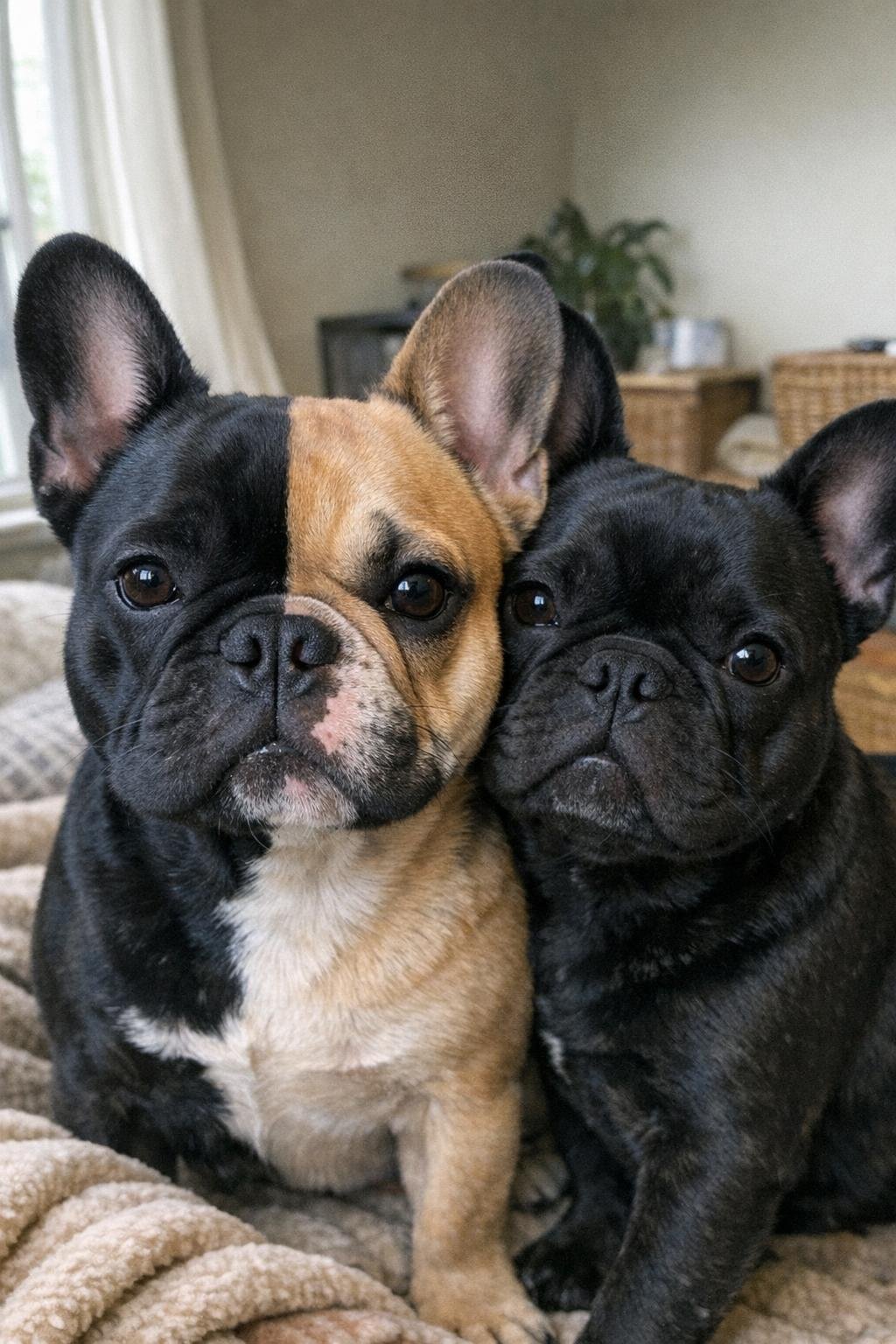
I have lived long enough in the country to know that neighbors will call you over for all sorts of things: a first tomato of the season, a calf with funny markings, a pie that needs tasting, or in this case, two French Bulldog puppies curled up side by side on a living room rug. At first glance they looked like littermate twins, stocky little things with bat ears, broad chests, and those serious faces that always make me think a dog is about to give me advice. But then my neighbor said, “Look closely at the one on the left,” and I did a double take so hard I nearly spilled my coffee.
What I was seeing was not a trick of shadow, not mud, not a half-finished grooming job, and not something I had ever personally seen in quite that neat a line. One puppy looked as though someone had taken a ruler and divided her face straight down the middle, with one side black and the other tan, while her sibling beside her was a solid dark color all over. If you have ever stumbled across an animal with that kind of startling split-face look and wondered what in the world causes it, this is the sort of thing worth talking about carefully and kindly. See for yourself:
Here she is:
1. What makes that face so unusual
The striking part is not simply that the puppy has two colors. Plenty of dogs are brindle, piebald, merle, tan-pointed, or patched in ordinary ways. What catches the eye here is how sharply the color appears divided right down the center line of the face, almost nose-to-forehead, with one half a different shade than the other.
In animals, most markings are irregular, feathered, or spread in patches over the body. A near-perfect bilateral split is uncommon enough that people often assume they are looking at dye, digital editing, or some sort of skin condition. But sometimes it is a real coat-color event, and that is what makes folks stop and stare.
2. The term many people bring up: chimerism
When people see a split-face animal, one word often comes up right away: chimera or chimerism. In plain language, a chimera is an individual made up of two different cell lines, usually because two early embryos fused together very early in development. Instead of developing as separate littermates, they combine into one animal.
That can result in different patches of the body carrying slightly different genetic instructions, including instructions for pigment. If those cell lines are distributed in a way that follows the left-right pattern of the developing face, you can sometimes get that dramatic “half-and-half” look. It is unusual, but it has been documented in several species.
3. But a split face does not always prove chimerism
Now, this is where I like to slow down and mind my manners with the facts. A dog can have a split-colored face without anyone being able to say with certainty, from a photograph alone, that it is a chimera. Genetics are rarely that tidy.
Other explanations can include mosaicism, which is different from chimerism, as well as normal but rare pigment-pattern expression. Mosaicism happens when a genetic change occurs after fertilization, so the animal develops from one embryo but ends up with two or more populations of cells. To the naked eye, mosaic and chimera patterns can sometimes look quite similar.
So if someone says, “That dog is definitely a chimera,” I would take that as an interesting possibility, not a final diagnosis. A veterinary geneticist would want more than a pretty picture before making that call.
4. Why the line can look so exact
In the earliest stages of development, cells are multiplying and moving into position as the body plan forms. The left and right sides of the face develop along a midline, so if two cell populations sort themselves in a particular way very early on, the boundary can end up looking surprisingly straight.
Nature does not always paint with a soft brush. Sometimes she uses a fence line. I have seen tomato halves ripen unevenly, calves born with stockings so crisp they look drawn on, and chickens with lacing so neat you would swear someone sat up all night with a tiny pen. Biology can be messy, but every so often it is neat enough to make you gasp.
5. How this differs from common French Bulldog coloring
French Bulldogs come in a range of coat colors and patterns, though not all are recognized in breed standards. You will commonly see brindle, fawn, cream, white, pied, and combinations of those. Some dogs also show tan points, masks, or darker shading around the muzzle and ears.
What you usually do not see is a face divided almost exactly 50-50 into two solid color fields with such a clean central border. Ordinary tan-point patterns tend to appear above the eyes, on the cheeks, chest, and legs. Brindle tends to stripe or mix. Piebald adds white in patches. This particular presentation stands apart from those more familiar patterns.
6. The littermate comparison is part of what makes it so memorable
Seeing the unusual puppy beside a solid black littermate gives your eye an immediate comparison point. Same general size, same body shape, same age, same breed, same household lighting, but one face looks almost artistically divided while the other does not. That side-by-side view makes the unusual marking even more obvious.
In a litter, puppies can vary quite a bit in color because siblings do not all inherit the same exact combination of genes. Even so, this kind of dramatic split can feel extra surprising when the brother or sister beside the dog looks entirely ordinary by comparison. It reminds us how much variety can exist in one whelping box.
7. If someone wanted a real answer, testing would matter
If the owner truly wanted to investigate whether the dog is a chimera, photographs would only be step one. A veterinarian might refer the case to a veterinary teaching hospital or genetic testing lab. In some cases, testing samples from more than one part of the body can be informative.
For example, geneticists may compare cheek swabs, blood, or hair-root samples from different areas. If the DNA profile differs significantly between tissues, that can support chimerism or mosaicism. The exact workup depends on the question being asked and the lab involved, and costs can range from modest mail-in testing fees of around $100 to several hundred dollars or more for specialized analysis.
Most families never go that far, especially if the dog is healthy and the difference is only cosmetic. But if curiosity is strong, or if there are breeding or medical questions, formal testing is the only way to move from “looks like” to “more likely than not.”
8. Does it affect the dog’s health?
In many cases, unusual coat coloring by itself does not harm the dog at all. A dog can have a remarkable face and still eat well, breathe well, run around the yard, snore on the sofa, and demand supper at 5:02 every evening like clockwork. The appearance alone does not tell you whether there is a health problem.
That said, French Bulldogs as a breed already deserve careful health attention for reasons unrelated to fancy markings. They can be prone to breathing trouble, overheating, spinal issues, skin fold irritation, allergies, and eye problems. So if I were advising a neighbor, I would be much more concerned with good breathing, comfortable movement, and a healthy weight than with the curiosity of the coat pattern.
A healthy adult Frenchie often weighs somewhere around 16 to 28 pounds, depending on build and sex, and because they are a brachycephalic breed, hot weather over 75 to 80 degrees Fahrenheit can be harder on them than on longer-nosed dogs. The color of the face is interesting; the dog’s comfort is what matters most.
9. Why unusual animals travel so fast online
Anything that looks “too perfect to be real” will be shared from one phone to the next in no time. A split-face dog hits that sweet spot between adorable and astonishing. Folks love a visual puzzle, especially one they can discuss over morning coffee or in the comments under a photo.
But the speed of sharing can create confusion. Within a day, a rare-looking dog can be called a mutation, a fake, a one-in-a-million miracle, or proof of all sorts of things nobody has actually verified. I have seen less fuss over a tornado warning. It is always wiser to say, “This may be chimerism,” than to claim certainty without testing.
10. Other animals can show this too
Cats are probably the animals most people think of first when they hear about split-face coloring. You will occasionally see a cat with one half orange and the other half black, and those cases are often discussed in relation to chimerism or mosaic patterns. Birds, cattle, reptiles, and other mammals have also shown unusual bilateral pigment division.
That does not make it commonplace. Even among people who have worked with animals for 30 or 40 years, many have never seen a truly dramatic example in person. In my own years of farm kitchens, county fairs, feed stores, and vet waiting rooms, I can count on one hand the number of animals I have seen that made me stop mid-sentence over their markings.
11. What I would watch if this were my neighbor’s puppy
If the pup were next door and I had any excuse at all to check in, I would be watching the ordinary puppy things: good appetite, steady growth, clear eyes, clean skin, easy movement, normal play, and breathing that does not sound too strained after a few minutes of excitement. In a young French Bulldog, those everyday signs tell you far more than a dramatic coat ever will.
I would also keep an eye on the skin where colors meet, simply because facial folds and moisture can irritate any Frenchie. Gentle cleaning, drying, and regular vet visits matter more than trying to explain every hair on the dog’s head. If the puppy is active, comfortable, and thriving, that is the best news of all.
12. The practical answer to “Has anyone seen this before?”
Yes, people have seen something like this before, though not often. A sharply split face can happen, and chimerism is one possible explanation. Mosaicism or an unusual pigment pattern are other possibilities. From a single image, nobody responsible can promise which one it is.
So the honest answer is this: it is rare, it is real-looking, it is fascinating, and it deserves curiosity without wild claims. If the dog is healthy, then what your neighbor has is not just a conversation starter but a perfectly lovely little reminder that nature still knows how to surprise us.
13. Why these odd beauties stay with us
I think animals like this linger in memory because they remind us that life does not come off an assembly line. Two puppies can arrive in the same litter, in the same home, under the same blanket, and one of them can carry a face nobody in the room will ever forget. There is something heartening in that.
At my age, I have come to treasure these little wonders. A strangely marked puppy, a double-yolk egg, an heirloom bean with pink streaks, a snowfall that outlines every cedar branch just so—they all say the same thing in their own way. The world is older than us, wiser than us, and still full of surprises right under our noses.