
 Dogs
 Cats
 Birds
 Horses
 On the Land
 In the Sea
When one of our dogs has puppies, my kitchen table basically turns into mission control. There are folded towels, a digital scale, a notebook with feeding times, and at least one kid peeking over my shoulder asking, “Can I hold one now?” So when our Chinese Crested delivered 4 puppies last week, I thought I knew more or less what to expect: tiny squeaks, sleepy piles of babies, and a lot of checking to make sure everyone was warm and nursing well. What I did not expect was the reaction every single person had when they saw the last pup.
Three of the babies looked pretty much like what most people picture when they think of Crested litters, but the fourth stopped everyone in their tracks. If you are wondering how one puppy can look so dramatically different from its siblings, the short answer is genetics, and it is actually one of the most fascinating things about this breed. I’ll walk you through what is happening, what “hairless” really means in Chinese Cresteds, why fluffy and nearly naked puppies can show up in the same litter, and why that surprising little baby is not impossible at all. See for yourself:
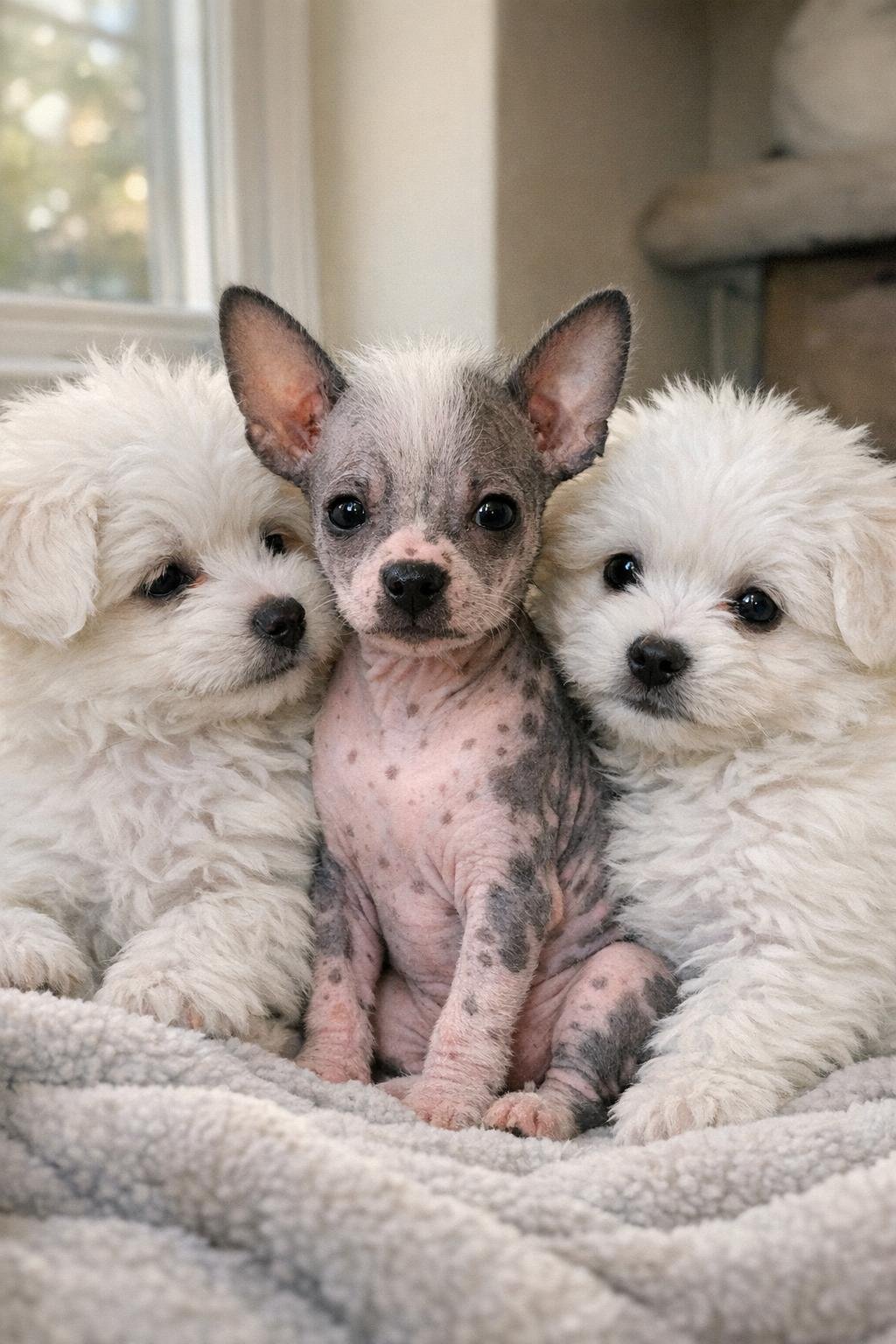
Here she is:
1. What people are reacting to in that last puppy
The big surprise is usually the contrast. In one litter, you can have puppies with soft full coats and another that looks almost completely bare except for a little hair on the head, feet, and tail. To somebody who has never been around Chinese Cresteds, it can look like those puppies could not possibly be related. But in this breed, that contrast is completely normal.
That “gasp” moment comes from seeing a puppy with pink-and-gray spotted skin, very little body hair, and a delicate almost velvety look right beside fluffy siblings with full white coats. Side by side, they look like they came from two different breeds. Genetically, though, they can absolutely come from the same two parents in the same litter, born minutes apart.
2. Chinese Cresteds actually come in two coat types
This is the part that clears up most of the confusion. Chinese Cresteds come in hairless and powderpuff varieties. The hairless type usually has hair on the crest, socks, and plume, while the powderpuff has a full soft double coat over the whole body.
So when a litter includes fluffy puppies and one dramatically less-coated puppy, that is not a fluke and it is not a sign that something went wrong. It is a known, expected feature of the breed. If you spend enough time around Crested owners, you will hear them talk about both types as equally “real” Chinese Cresteds, because they are.
3. The hairless trait is caused by a dominant gene
This is where the science gets so interesting. In Chinese Cresteds, the hairless trait is associated with a dominant gene. In simple terms, a dominant gene is one that shows up even when only one copy is present. So if a puppy inherits the hairless version from one parent, that puppy will usually show the hairless type.
That is why a hairless puppy can appear in a litter right next to powderpuffs. You do not need two copies of the hairless version for the trait to show. One copy is enough to produce the hairless look, although the amount of body hair can still vary from puppy to puppy.
4. Why you can get fluffy and hairless puppies in the same litter
Most hairless Chinese Cresteds carry one copy of the hairless gene and one copy of the coated gene. Breeders often write that as Hh in a simplified chart, with “H” standing for hairless and “h” standing for coated. A powderpuff would be hh, meaning it inherited the coated version from both sides.
If a hairless parent that is Hh is bred, some puppies may inherit the hairless version and some may inherit the coated version. That means one litter can contain both hairless puppies and powderpuffs. If you like visual examples, imagine 4 puppies in a litter: depending on the pairing, you might see 1 hairless and 3 powderpuffs, or 3 hairless and 1 powderpuff, or another mix entirely. Real litters do not always follow neat textbook ratios because small numbers are still small numbers, but the genetics behind the variation are perfectly ordinary.
5. Why the last puppy can look more extremely hairless than the others
Even among hairless Cresteds, expression can vary a lot. One puppy may have a fuller crest and more furnishings on the legs, while another may be much more bare through the body, with just a little fuzz and those lovely mottled skin markings showing clearly. That does not mean they have different parents or that one “should not” look that way. It means genes can express with different intensity.
I always compare it to siblings in a family. One child gets dad’s dark curls, one gets mom’s straight fine hair, and one somehow looks like great-aunt Linda. Same family, different outcomes. In dogs, coat amount, skin spotting, pigment, and texture can all shift the final look. So that last puppy may simply be showing the hairless trait in a very striking way.
6. Hairless does not always mean absolutely zero hair
This trips people up all the time. A “hairless” Chinese Crested is usually not bald from nose to tail like polished marble. Many have hair on the head, lower legs, and tail. Some also have sparse body hair that may be clipped or naturally light. As newborns, they can even have a surprising amount of soft fuzz that changes as they grow.
That means a very bare puppy next to fluffy littermates can look extra dramatic in week 1, especially in natural light where every pink and gray spot shows. At 7 days old, details like skin pigment and tiny furnishings stand out more because the puppies are still so small, often weighing just 4 to 8 ounces depending on the line and the individual pup.
7. The powderpuff siblings are not “less pure” at all
I hear this misconception a lot. People sometimes assume the fluffy puppy must be a mix, because it does not match the picture they had in their head. But powderpuffs are a recognized, normal variety within the breed. A fully coated white puppy in a Chinese Crested litter is still a Chinese Crested.
In fact, powderpuffs often help people understand the breed better once they learn the genetics. The fluffy coat is not an accident. It is part of the breed’s natural inheritance. If you are looking at registration, pedigree, or breeding records, coat type does not cancel out breed identity. Hairless and powderpuff littermates can share the same parents, same birth date, same whelping box, and same habit of waking everybody up at 2:15 a.m.
8. There is a genetic reason some combinations do not occur the way people expect
Here is one of the more technical but important pieces: the hairless gene in Chinese Cresteds is linked to a homozygous lethal effect. In plain language, puppies that would inherit two copies of the hairless version do not develop normally. That is why living hairless Chinese Cresteds are generally heterozygous, meaning they carry one hairless copy and one coated copy.
This matters because it helps explain why breeders often see a mix of hairless and powderpuff puppies instead of “all hairless all the time.” A common simplified expectation in a hairless-to-hairless breeding is that among conceptions, some would be HH, some Hh, and some hh. The HH combination is not viable, so the living puppies are typically hairless Hh and powderpuff hh. That sounds complicated, but the practical takeaway is simple: mixed coat types in a litter are built right into the biology of the breed.
9. Skin color and spotting can make the difference look even bigger
That pink-and-gray spotted look can really stop people in their tracks, especially in a fresh newborn puppy. Chinese Cresteds often have visible skin pigment patterns, and without a full coat covering the body, those markings become part of what everyone notices first.
One puppy may be pale pink with soft gray patches, another may have darker slate spots, and a powderpuff sibling may look solid white because all you are seeing is coat. Put them side by side on the same cream blanket under morning window light, and the visual difference feels huge. But what you are seeing is coat plus pigment, not a mystery puppy from somewhere else.
10. Newborn appearance can change a lot in the first 8 to 12 weeks
One thing I always tell friends is not to assume the 1-week-old look is the final look. Puppies change fast. Over the first 2 weeks, eyes begin to open. By 3 to 4 weeks, movement gets steadier. By 6 to 8 weeks, coat texture, furnishings, and skin pigmentation can look different from those first baby pictures.
A hairless Crested puppy may seem almost entirely bare at first and later show more obvious crest, socks, and plume. A powderpuff may fluff out dramatically and look twice as plush by week 8. So if the last puppy looks especially startling now, part of that is because newborns are all contrast and no subtlety. Give it time, and the family resemblance usually becomes easier for everybody else to see.
11. Caring for the hairless puppy takes a few special considerations
Hairless puppies are every bit as lovable as their fluffy siblings, but they do need a little thoughtful care. Warmth matters. In the first week, I like to make sure the whelping area stays around 85°F, then gradually lower it as the puppies grow and regulate better. Hairless babies can lose warmth faster because they do not have that same coat coverage.
Skin care matters too, though it does not have to be fussy. Keep bedding clean and dry, use soft washable fleece or cotton layers, and watch for any irritation from rubbing or dampness. As the puppy gets older, sun exposure and dry skin become practical concerns, but in the newborn stage it is mostly about warmth, cleanliness, and making sure nursing is going well every 2 to 3 hours around the clock.
12. What to watch for in the first week, regardless of coat type
Whether a puppy is hairless or powderpuff, the basics are the same: consistent nursing, daily weight gain, normal body temperature, and quiet sleep between feeds. I weigh newborns at the same time each day on a kitchen scale that measures in grams. Even a gain of 10 to 20 grams can be reassuring in a toy-type breed puppy.
If a puppy feels cool, cries persistently, cannot latch, or is losing weight over 24 hours, that is a reason to call the veterinarian promptly. The dramatic look of a hairless puppy can distract people, but appearance is not the first priority in week 1. Warm, hydrated, fed, and steadily growing is what matters most.
13. Why this surprises people more than it should
I think part of it is that most folks know dog breeds from one image, not the whole story. If their only mental picture of a Chinese Crested is a show photo of a hairless adult with a fancy crest, then a fluffy powderpuff sibling feels unexpected. If their only reference is fluffy toy breeds, then the hairless baby feels almost unbelievable.
But breeds are often more genetically interesting than the postcard version. Once you know Chinese Cresteds naturally come in both hairless and powderpuff forms, that “How is this even possible?” turns into “Oh, that actually makes perfect sense.” And honestly, I love that moment. It means people are learning something new about a breed beyond the surface.
14. The simplest answer to the question in the headline
So how is this even possible? Because Chinese Cresteds carry a dominant hairless trait, and the breed naturally produces both hairless and powderpuff puppies. The last puppy is not impossible, not a mistake, and not unrelated to the others. That puppy is a textbook example of how coat genetics can create dramatic differences inside one perfectly normal litter.
In a home full of puppy squeaks, warm blankets, and a mom dog keeping careful count of her babies, it can still feel a little magical. But this is one of those lovely cases where the explanation is both scientific and sweet. Genetics wrote the script, and our little spotted surprise simply stole the scene.