
 Dogs
 Cats
 Birds
 Horses
 On the Land
 In the Sea
Last week my sister’s Border Collie had a litter of 6 puppies, and I’ll tell you, our whole family has been taking turns peeking into the whelping box like it’s the most exciting thing in town. Five of those babies looked more or less like what most folks expect from Border Collies: black and white markings, little pink-and-black noses, and that sleepy newborn wobble that makes everybody melt. But then there was the last one, and the minute people saw that coat, the questions started flying. “Was there another dad?” “Is that even a Border Collie?” “How can one puppy look so different from the rest?”
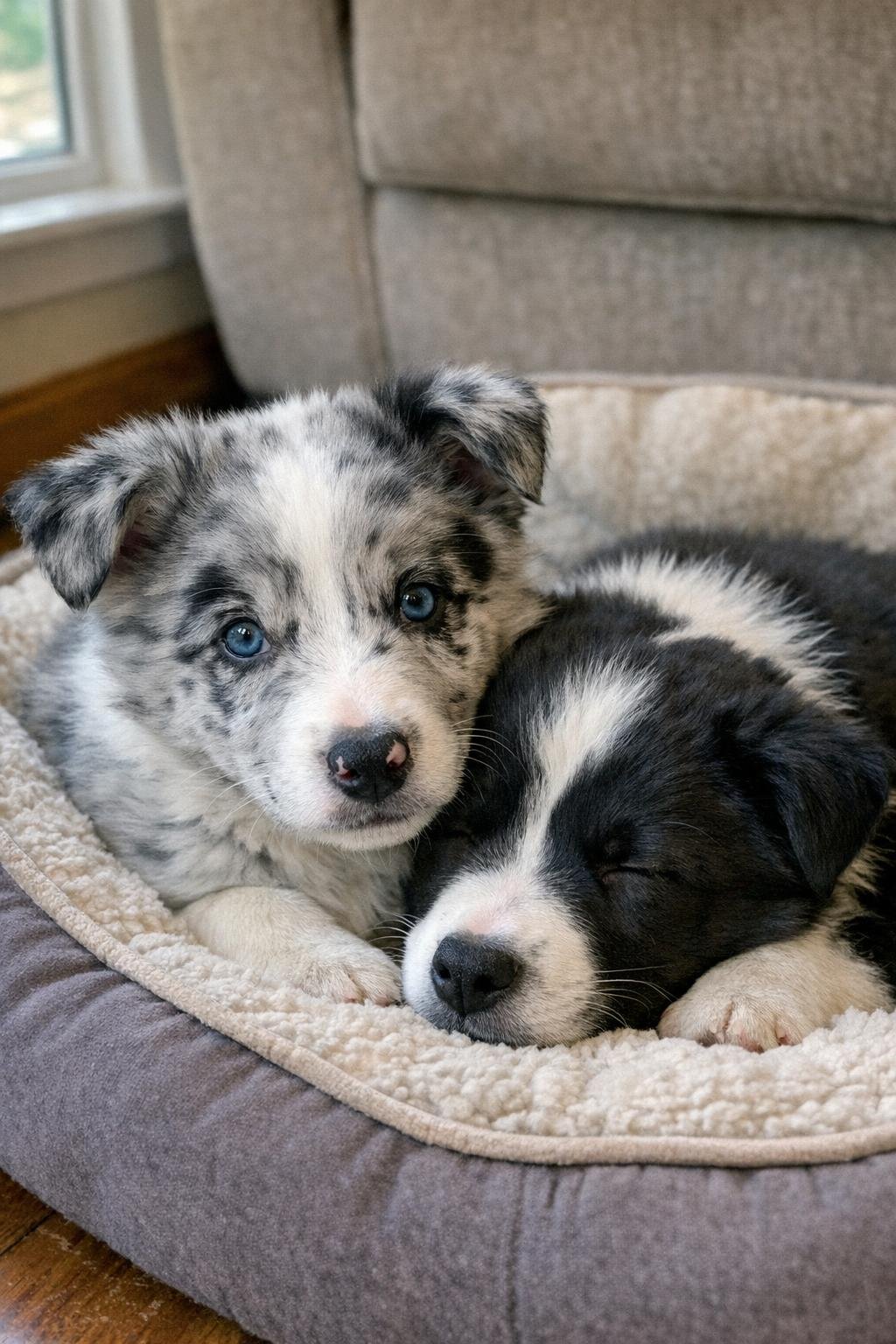
If you’ve ever seen one puppy in a litter that seems to break all the rules, the answer is usually much less mysterious than it looks. In this case, what people are reacting to is almost certainly the merle coat pattern, which is controlled by a dominant gene that can dramatically change how a puppy’s fur looks without making it a different breed at all. I want to walk through how that works, why one puppy can stand out so much from its littermates, and what responsible breeders always need to keep in mind with merle dogs. First, though, here’s the little show-stealer everyone keeps talking about.
See for yourself:
1. What everyone is reacting to is the coat pattern, not a different kind of puppy
That last puppy looks dramatic because the coat has patches of diluted color mixed with darker areas, creating that marbled or mottled effect people call merle. In a Border Collie, a “blue merle” puppy usually has black pigment that has been diluted into soft gray, silver, and charcoal across the coat. You may also notice lighter areas around the face, shoulders, or sides, while the white markings can still show up just like they do on black-and-white littermates.
To the average person, that can make the puppy seem unrelated to the others. But genetically, it can be every bit as much a Border Collie as the black-and-white pups in the same box. It’s a color-pattern difference, not a breed difference.
2. Merle is caused by a dominant gene
This is the part that answers the “How is this even possible?” question most directly. Merle is generally produced by a dominant gene, which means a puppy only needs one copy of that gene from one parent to show the pattern. If one parent carries merle and the other does not, some puppies may inherit the merle gene and some may not.
In plain family terms, think of it like a trait that doesn’t need “double permission” to show up. One copy can be enough. That’s why, in one litter of 6, you might see 1 merle puppy, or 3, or none at all, depending on which genes each puppy happened to inherit.
3. A single litter can have both merle and non-merle puppies
This is what surprises people most. They assume all puppies in the same litter should be colored similarly, but that is not how genetics works. Each puppy gets one set of genes from the dam and one set from the sire, and the combination is a fresh roll of the dice every time.
If one parent is merle and has one merle gene and one non-merle gene, and the other parent is non-merle, a simple expectation is that around 50% of the puppies could be merle and around 50% could be non-merle. That is only an average, though, not a promise. In a litter of 6, you could easily get 1 merle puppy and 5 non-merles, or 4 merles and 2 non-merles. Small litter sizes often look uneven simply because 6 puppies is not a huge sample.
4. “Blue merle” does not mean the puppy is actually blue
When folks hear “blue merle,” they sometimes expect a denim-blue dog. In dog-color language, “blue” usually refers to diluted black pigment. So instead of true black patches, you get gray to silvery areas mixed with black or dark charcoal.
On a newborn Border Collie, that can show up as smoky patches over the back, sides, or head. As the puppy grows from 1 week old to 8 weeks old, the coat may fluff out and the pattern often becomes easier to appreciate. By 6 months, many owners feel the dog’s final look has settled enough to really see the marbling clearly.
5. The merle puppy may also have unusual eye color
Another reason people gasp is that merle puppies can have eyes that are blue, partly blue, or odd-colored, especially as they get a little older and their eyes open fully. Not every merle puppy will have blue eyes, and non-merle dogs can occasionally have lighter eyes too, but merle makes unusual eye color more likely.
In Border Collies, you might see one blue eye and one brown eye, or a brown eye with a blue segment. When that’s paired with a silver-and-black marbled coat, people really do stop in their tracks. It looks exotic, but genetically it can be perfectly expected.
6. This does not mean there were multiple fathers
I’ve heard this one more times than I can count any time a litter has one standout puppy. While litters can, in some cases, have more than one sire, a different-looking coat alone is not evidence of that. A merle puppy appearing among black-and-white siblings is completely explainable if one parent carries the merle gene.
Before anybody jumps to dramatic conclusions, the first place to look is the parents’ genetics and visible coat patterns. If one parent is merle, the mystery is usually solved right there. You do not need a soap-opera explanation when simple inheritance covers it.
7. Sometimes the merle parent is obvious, and sometimes it is not
Many merle dogs are easy to identify because the pattern is bold. But in some dogs, the pattern can be very minimal or partly hidden by white markings, making it less obvious to inexperienced eyes. There are also forms sometimes described as “cryptic” or minimally expressed merle, where the dog may not look dramatically merled at first glance.
That is one reason responsible breeders do not rely only on a quick visual check if there is any uncertainty. Genetic testing through a veterinary or canine DNA lab can help clarify whether a dog carries merle. Those tests often cost anywhere from about $60 to $150, depending on the panel.
8. The big health caution is double merle breeding
This is the part I always think is worth slowing down for, especially when a beautiful puppy gets everyone excited. Merle itself is not automatically a problem, but breeding two merle dogs together can produce what is called a double merle puppy. Those puppies are at much higher risk for serious hearing and vision problems.
If two merle parents are bred, a rough expectation is that about 25% of the puppies could inherit two copies of the merle gene, about 50% could inherit one copy and be merle, and about 25% could inherit no merle gene. Again, real litters may vary, but that 25-50-25 pattern is the standard warning breeders talk about. Responsible breeders work very hard to avoid merle-to-merle pairings for exactly this reason.
9. Border Collies come in more colors than many people realize
In small-town conversations, I’ve noticed many people think Border Collies are only “regular black and white.” But the breed can come in black and white, blue merle, red merle, red and white, tricolor, sable, and more, depending on bloodlines and genetics.
So when one puppy in a litter looks surprising, that often says more about what the viewer is used to seeing than about what is genetically possible in the breed. A striking coat may be less common in your neighborhood, but that does not make it unnatural or suspicious.
10. Newborn coats can change a lot in the first 8 weeks
At 1 week old, puppies are basically tiny warm potatoes with fur, and what you see is not always the final story. Markings can sharpen visually as the coat grows in, and the contrast between gray, black, and white can become more noticeable by weeks 3 through 8.
I’ve seen puppies that looked fairly muted on day 4 turn into real little showstoppers by week 6, just because the coat texture changed and the face markings became more defined. So if that last puppy already looks eye-catching now, there’s a good chance the pattern will become even more distinct as it matures.
11. If you are raising the litter, photos in natural light help a lot
As a home cook and family picture-taker, I can tell you lighting changes everything. If you’re trying to document coat color accurately, take photos near a window in soft morning light, around 8 to 10 a.m., or late afternoon, around 4 to 6 p.m. Avoid harsh overhead bulbs that cast yellow tones.
Use a plain dog bed or cream-colored blanket, keep the phone about 18 to 24 inches away, and get one full-body shot plus one close-up of the face. That makes it much easier to see whether the puppy is truly merle, how the white trim is placed, and whether the nose and eye pigment are developing normally.
12. Families should focus on temperament and health, not just the flashy coat
I understand the excitement. The unusual-looking puppy often gets the first “dibs” requests from friends and relatives. But with Border Collies especially, I always remind people that coat color is the least important thing you’ll live with day to day. Energy level, soundness, hearing, vision, and stable temperament matter far more over the next 12 to 15 years.
A healthy Border Collie puppy will need structure, training, and plenty of activity. By 4 to 6 months old, many are already showing that bright, busy working-dog mind. A family that chooses the “pretty one” without thinking through exercise and mental stimulation can get overwhelmed fast.
13. What your sister should ask the vet and breeder records should note
If this is a planned and well-managed litter, it helps to record each puppy’s birth weight, markings, and early development. Many breeders weigh puppies daily for the first 1 to 2 weeks using a kitchen scale that measures in grams. Healthy newborn Border Collies often gain steadily each day, and keeping records helps catch trouble early.
It is also smart to discuss eye and hearing observations with the veterinarian during early checkups. While a single merle puppy in a litter is not automatically concerning, accurate records are just part of good stewardship. I’m a big believer that calm, organized note-taking saves a lot of stress later.
14. So how is this possible? The short answer is simple genetics
When people gasp at that last puppy, they are reacting to a coat pattern that looks dramatic but can arise in a perfectly ordinary way. If one parent carries the merle gene, one puppy can inherit it and show that beautiful marbled blue merle coat while its siblings inherit the non-merle version and look more traditionally black and white.
That’s really the heart of it: same litter, same breed, different combinations of inherited genes. Nature can look astonishing without being mysterious.
15. My practical takeaway for families who fall in love with the “different” one
If that special-looking puppy steals your heart, enjoy the wonder of it. Take the pictures, ask the questions, and learn the genetics. But also make room for the less glamorous truths: puppies need deworming schedules, safe socialization, quality food, and a whole lot of patient cleanup in the first 8 weeks.
In my experience, the puppy everyone gasps at on week 1 and the puppy who quietly crawls into your lap on week 7 can both end up being equally beloved family dogs. The merle coat may be what starts the conversation, but good care is what really makes the story a happy one.