
 Dogs
 Cats
 Birds
 Horses
 On the Land
 In the Sea
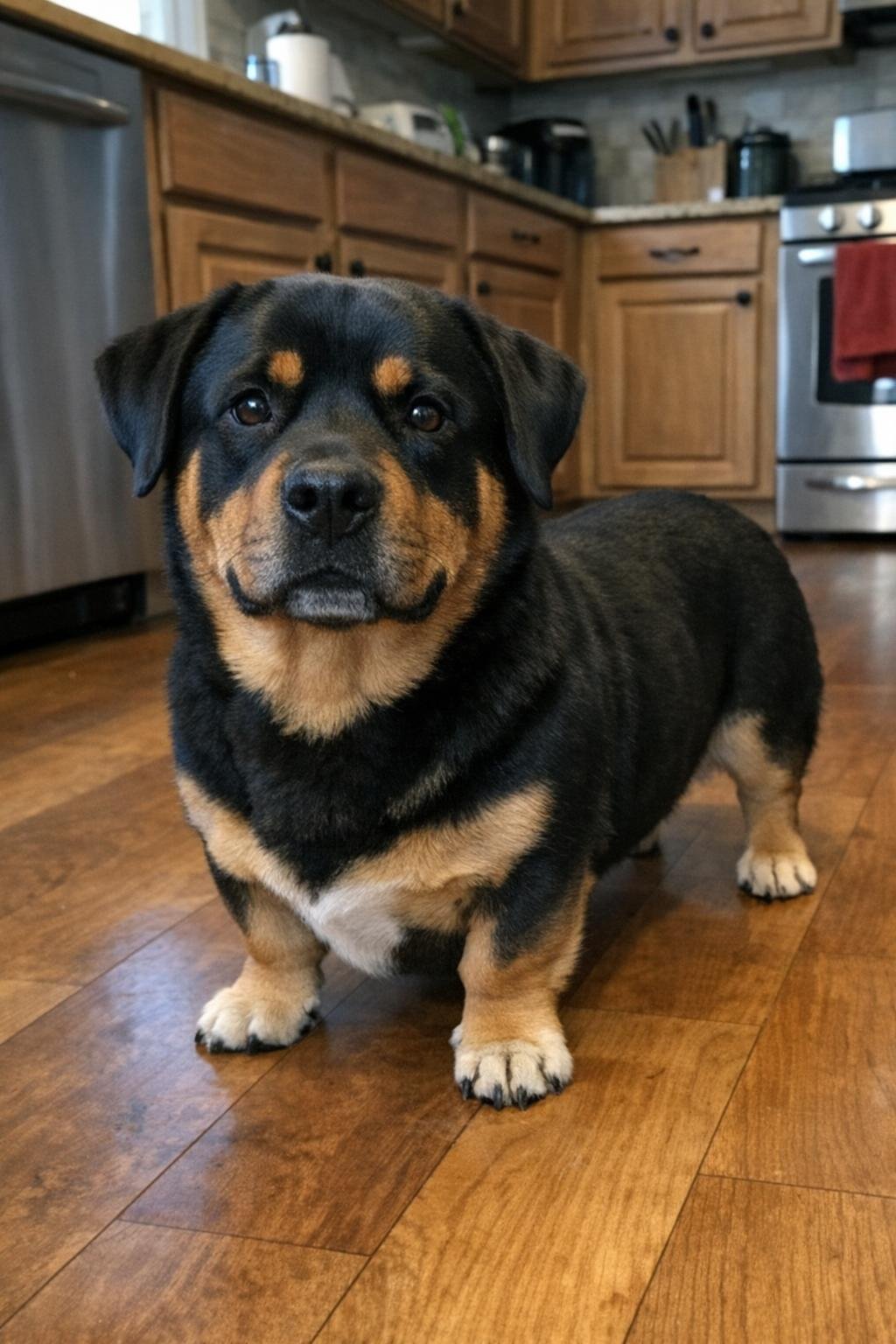
I live in one of those Midwestern neighborhoods where everybody more or less knows which dog belongs to which house, so when my neighbor texted me, “You have to come meet the new shelter pup,” I grabbed my coffee and walked over before I even answered. The dog had been listed as a “Rottweiler mix,” which, to be fair, covered at least half the story. From across the room, I saw the broad head, the rich black-and-tan markings, and that sturdy, confident expression that absolutely said Rottweiler.
Then he turned the corner by the kitchen island, and I nearly laughed into my sleeve because the rest of him looked like somebody had hit the “shrink legs” button. He had the face of a serious working dog and the body height of a loaf of bread with opinions. If you love guessing shelter-dog genetics as much as I do, this one is a fun one, and yes, I have a very strong theory about the mystery half.
Here he is:
1. My first guess was Corgi almost immediately
I am not a veterinarian or a canine geneticist, but I have spent enough time around dogs to know when one trait is doing a lot of heavy lifting. In this case, it was the legs. They were dramatically short compared with the size of his head and chest, and that kind of low-slung build usually points me toward breeds known for dwarfism traits, especially Corgis, Dachshunds, or Basset-type dogs.
What pushed me toward Corgi instead of Dachshund was the overall shape. He was not narrow and long like a typical Dachshund mix. He looked compact, solid, and surprisingly athletic, with a broader rib cage and a body that seemed built more like a little tank than a tube. That stockier outline is very Corgi-coded to me.
2. The head and coloring scream Rottweiler
The shelter label got the obvious half right. He had that classic Rottweiler look in the face: a broad skull, medium-length muzzle, deep stop, and those warm tan eyebrow spots that make them look perpetually concerned and adorable at the same time. His coat pattern was especially convincing, with black over the back and tan on the muzzle, chest area, and legs.
Even his expression felt Rottweiler-ish. He had that calm, observant look where the dog seems to be reading the room before deciding whether to join the chaos. If you have ever met a well-socialized Rottweiler, you know exactly what I mean. There is a steadiness there that is hard to miss.
3. The body proportions are where the mystery gets solved
What made this dog memorable was the visual mismatch. His head looked proportioned for a dog standing 24 to 27 inches at the shoulder, but his actual shoulder height looked closer to 12 to 14 inches. That creates a hilarious and oddly cute silhouette. From some angles, he looked like a regular Rottweiler viewed through a funhouse mirror.
His chest sat low to the ground, and when he walked across the kitchen, his stride had that quick, busy little-leg motion I associate with herding breeds built low to the ground. A lot of Corgi mixes keep that movement pattern even when the rest of the dog pulls strongly toward the other parent breed.
4. Why Corgi mixes show up in such surprising ways
Corgis are famous for passing along their short legs. That trait comes from a form of chondrodysplasia, which is why so many Corgi mixes wind up looking like someone took a full-size dog and lowered it by 6 inches. You can see this in Corgi-Lab mixes, Corgi-Husky mixes, and apparently, in what I am convinced is a Rottweiler-Corgi mix too.
And because Corgis also tend to have sturdy frames, upright or semi-upright ears, and dense double coats, they can influence the final look more than people expect. Even when the other breed is much larger, those short legs often steal the show first.
5. Shelter breed labels are educated guesses, not guarantees
One thing I always remind friends is that shelter labels are often based on appearance alone. Staff members do their best, but unless a dog comes in with verified breeder paperwork or DNA results, “Rottweiler mix” may just mean “this dog definitely looks partly Rottweiler.” The other half can be almost anything.
In busy shelters, those guesses have to be made quickly. A dog with black-and-tan points and a broad head is likely to get tagged as a Rottweiler mix, even if the shorter body, ear set, tail, or leg length suggest another breed in the background. I do not say that critically at all. It is just the reality of rescue work.
6. Temperament clues can support the visual guess
My neighbor told me the new pup was incredibly people-oriented by day two, followed her from room to room, and was already trying to supervise every household task from unloading groceries to folding laundry. That made me laugh because it sounds like a mash-up of two very involved breeds.
Rottweilers often bond deeply with their people, while Corgis are bright, alert, and not exactly shy about inserting themselves into whatever is happening. This dog had that combination of loyalty and comic management energy. He planted himself in the kitchen like he had a shift to finish.
7. A Rottweiler-Corgi mix would likely be a sturdy little powerhouse
If this dog really is a Rottweiler-Corgi mix, I would expect him to land somewhere around 30 to 55 pounds, though mixes can vary a lot. He looked to me like he was probably about 35 to 40 pounds: much heavier than a pure Corgi, but much lower to the ground than a Rottweiler. That kind of build can be cute, but it also means owners should pay attention to joint health and weight management.
Short-legged dogs do best when they stay lean. Even an extra 5 pounds can put noticeable strain on the back, elbows, and hips. As someone who meal preps down to the ounce during the workweek, I am a big believer in measuring dog food too. A proper measuring cup and a treat budget matter more than people think.
8. The everyday care for a dog like this takes some thought
A dog with a heavier front end and shorter legs may need help avoiding repetitive impact. I would skip constant jumping off tall furniture, use a ramp if needed, and keep walks consistent rather than extreme. Two 20-minute walks a day plus a couple of 10-minute play sessions can go a long way for many medium-energy mixes.
Flooring matters too, especially in kitchens and entryways. If a dog is scrambling on slick hardwood or tile, washable runners can help prevent slips. That sounds like such a small domestic detail, but I am forever noticing things like this because my own house turns into a sprint track the second dinner is being made.
9. Grooming would probably be moderate, not minimal
Both Rottweilers and Corgis shed, and Corgis in particular can really drop coat. So if this mix inherited the Corgi undercoat, my neighbor is probably in for regular brushing at least 2 to 3 times a week, and more during seasonal coat blows in spring and fall. A rubber curry brush or slicker brush usually makes a visible difference fast.
The upside is that a shorter coat is often easier to maintain than a long feathered one. Ten minutes on a Saturday morning can keep the hair situation from getting out of hand. That said, I saw enough black fur on her dark leggings after one visit to know this dog is planning to leave souvenirs.
10. Training matters because both breeds can be very opinionated
People sometimes hear “short dog” and assume “easy dog,” but that is not always how it works. Corgis are famously smart and can be bossy, while Rottweilers are intelligent, strong, and benefit from clear structure. Put those together and you may get a dog who learns commands quickly but also develops strong personal views on when those commands should apply.
That is why early routines help so much: meal times at the same hours, short training sessions of 5 to 8 minutes, reward-based practice for sit, down, leave it, and loose-leash walking, and plenty of positive social exposure. Consistency beats marathon sessions every time, especially for busy households.
11. DNA testing would be the fun way to settle the debate
If my neighbor decides to do a canine DNA test, I will absolutely be invested in the results. Most at-home kits use a cheek swab, and results often take about 2 to 4 weeks depending on the company. Prices usually run somewhere around $80 to $150, depending on whether the kit includes health markers in addition to breed identification.
Would I be shocked if there were a surprise third breed in the mix, like Australian Cattle Dog or Shepherd? Not at all. Mixed-breed dogs are full of plot twists. But if that report comes back with Rottweiler and Pembroke Welsh Corgi near the top, I will feel very validated.
12. My final answer: I think the other half is Corgi
So yes, my vote is Corgi, specifically the kind of Corgi influence that shows up loud and proud in the legs and overall height. The big head, black-and-tan pattern, and substantial expression say Rottweiler. The low body, compact frame, and stubby little stride say Corgi. Together, they create one of the funniest and most lovable shelter surprises I have seen in a while.
Honestly, this is one of my favorite things about rescue dogs. You go over expecting a fairly standard “Rottweiler mix,” and instead you meet a dog that looks like two completely different design plans merged at the last second. However the DNA breaks down, the new kid is adorable, unforgettable, and already running the block like he has lived here for years.