
 Dogs
 Cats
 Birds
 Horses
 On the Land
 In the Sea
Last week our standard Poodle had a litter of 6 puppies, and I can tell you I have spent more time than usual standing over a whelping box with my coffee just staring. If you have ever seen a litter born all within a few hours, you know how easy it is to assume they will all look more or less alike, especially when both parents appear to be solid-colored at first glance. That is exactly why the last puppy stopped everyone in their tracks. Friends came by, my kids leaned in, and more than one person said, “Wait, how did that one happen?”
The short answer is that coat color genetics can do some surprising things, and Poodles are a wonderful example of that. In this case, the big gasp-maker is most likely the result of a recessive phantom coloring gene showing up after quietly hiding in the family line. I want to walk through what phantom coloring is, how two dogs that do not obviously show it can still produce a phantom puppy, what the markings usually look like, and what it does not mean. And yes, before I explain the genetics, you really need to see the little one for yourself.
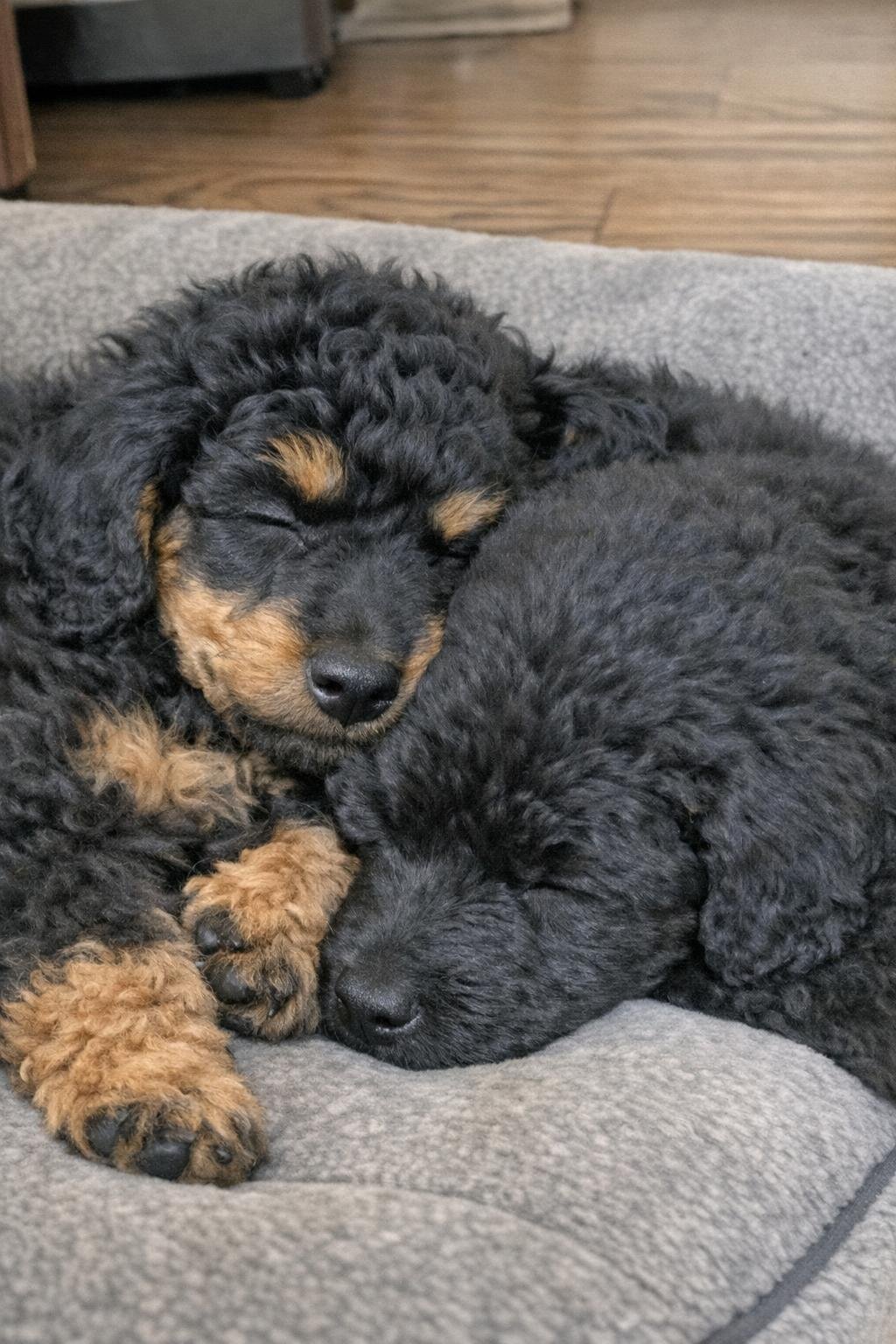
Here she is:
1. What people are noticing in that last puppy
What makes that puppy stand out is the tan-point pattern: little tan “eyebrows,” tan on the cheeks or muzzle sides, and tan on the lower legs. In many dogs, those markings also appear on the chest under the tail and sometimes inside the ears. On a black puppy, the contrast can be dramatic even in the first week of life, especially under a sunny window or warm indoor light.
In Poodles, that look is commonly called phantom. The base coat is one color, usually black, brown, red, silver, or cream, and the second color appears in specific point locations. It is different from random white spotting and different from a merle pattern. The markings follow a pretty recognizable map on the body.
2. Phantom coloring is a real, known Poodle pattern
Sometimes when a surprising puppy shows up, people jump straight to wild conclusions. I have heard everything from “the milkman dog must have visited” to “maybe the coloring will just disappear in a week.” But phantom is a legitimate, established coat pattern in Poodles. It has been around a long time, even if solid colors are more common in some lines.
If you picture a Doberman’s tan points or the black-and-tan pattern on some terriers, that gives you a rough idea of the placement. On a phantom Poodle, you typically see marks above the eyes, on the sides of the muzzle, on the throat or chest, on the lower legs and feet, and under the tail. The exact shade can range from pale cream to rich apricot to deep tan.
3. How two solid-looking parents can produce a phantom puppy
This is the part that sounds magical until you break it down. A recessive trait can stay hidden for generations. That means a dog can carry the gene for tan points without visibly showing tan points. If both parents carry that hidden recessive version, a puppy can inherit one copy from each parent and then express the pattern.
A simple way to think about it at the kitchen table is this: each parent passes along one “instruction” for that part of coat color. If both pass the recessive phantom-related instruction, the puppy has the combination needed to show those markings. If the puppy gets only one copy, it may carry the gene but still look solid.
4. The basic odds, in plain English
If both parents are carriers of a recessive phantom-related tan-point gene, the rough textbook odds for each puppy are 25% visibly phantom, 50% carrier but not visibly phantom, and 25% non-carrier. That does not mean every litter of 4 will contain exactly 1 phantom. Genetics does not sort puppies out like muffin cups on a baking tray.
With a litter of 6, you could get 0 phantom puppies, 1 phantom puppy, 3 phantom puppies, or even all 6 in unusual outcomes. Each puppy is its own genetic coin toss. That is why one standout puppy in a litter of mostly solid siblings is completely believable and not rare enough to be suspicious on its own.
5. Why the last puppy can look so much more dramatic than the others
In the first 7 to 14 days, puppies often have slightly fuzzy, baby-soft coats, and markings can look either muted or extra sharp depending on the light. On a black coat, tan points tend to be especially noticeable. A little pair of eyebrow dots can make a puppy look as though it already has opinions, which is probably why everyone reacts so strongly.
I have seen people overlook subtle markings on one puppy and then nearly squeal over another because the contrast is stronger around the face. Faces pull our attention first. If the eyebrow spots are crisp and the cheeks are bright, that puppy will look dramatically different even if the overall genetic explanation is very ordinary.
6. Phantom is not the same as parti, sable, brindle, or merle
When families start searching online, it is easy to get tangled up in coat-color vocabulary. Parti means large areas of white plus another color, often close to a 50/50 split. Sable usually means individual hairs are banded or tipped so the coat changes visually across the body. Brindle creates striping. Merle causes mottled patches of diluted pigment.
Phantom is more orderly than those patterns. The second color appears in set point locations rather than splashed randomly across the body. That is why the eyebrows, cheeks, and legs matter so much when identifying it. In our case, those bright points are exactly the clue that makes recessive phantom coloring the most likely explanation.
7. What the markings may look like as the puppy grows
Poodle coats can change quite a bit from birth through 8 weeks, 6 months, and even 2 years. Some black phantom puppies keep a strong black-and-tan contrast. Others lighten a little, especially if the line carries silvering or fading genes. The tan areas may deepen from pale cream to warm apricot over the first several weeks.
If I were advising a family with one of these puppies, I would take weekly photos in the same spot, maybe on the same gray bed near the same window, from week 1 through week 8. It is amazing how much you can learn from side-by-side pictures. Coat transitions are easier to notice when you compare week 2, week 4, and week 8 directly.
8. Does this mean one parent is “secretly” a phantom?
Not necessarily in the visible sense. A dog can carry the recessive gene without showing phantom markings at all. That is the whole reason this surprises people. Hidden genes are part of normal inheritance. In well-documented breeding lines, carriers can be identified through pedigree clues or modern genetic testing, but outward appearance alone is not enough.
This is very similar to other family traits people talk about with children: brown eyes, curly hair, left-handedness. Sometimes a grandparent trait seems to skip a generation and then pops right back up. Coat color does not literally skip genes around, of course, but hidden recessive traits can definitely reappear after staying unnoticed for years.
9. Genetic testing can usually confirm the mystery
If you want a more definite answer than “most likely,” a canine coat-color DNA test is the practical next step. Many breeders use cheek-swab tests that can be done at home in about 5 minutes per dog. Results often come back in 2 to 4 weeks, depending on the lab and the shipping speed.
The test cost is commonly somewhere between $70 and $150 per dog for a color panel, though prices vary. If both parents test as carriers for the relevant tan-point allele, the surprise puppy makes perfect sense on paper. I am a big fan of testing whenever a trait matters for breeding decisions, because guessing can get expensive and confusing very quickly.
10. This color surprise does not mean anything is wrong with the puppy
One thing I always want to say in a reassuring mom voice is this: unusual to the eye does not mean unhealthy. Phantom coloring itself is a coat pattern, not an illness. The important health checks for newborn puppies are the same ones you would watch in any litter: steady nursing, warm body temperature, daily weight gain, normal hydration, and clean, calm breathing.
For standard Poodle puppies, many breeders want to see consistent weight gain every 24 hours in the early days. A digital kitchen scale that measures in grams is handy. If a puppy weighed 420 grams on day 2 and 460 grams on day 3, that is the kind of practical information that matters much more than whether it has eyebrow dots.
11. Why these puppies tend to become conversation starters
Let me tell you, families remember the puppy with “eyebrows.” It is the same reason kids always name the oddly shaped pancake or the cookie with extra icing. Distinctive visual features create instant attachment. When visitors see one solid black puppy and one black-and-tan puppy tucked side by side, they immediately start asking questions.
That can actually be helpful if you are raising a litter thoughtfully. It gives you an opportunity to educate people about normal genetic variation and responsible breeding. I think that matters. The more people understand that unusual coloring can be inherited in perfectly ordinary ways, the less likely they are to spread rumors or make unfair assumptions.
12. Responsible breeders look at more than color
As fun as coat color is to talk about, it should never outrank health and temperament. Standard Poodles should be bred with careful attention to testing, structure, stable temperament, and long-term soundness. Hips, eyes, and breed-relevant health screening matter much more than whether a puppy is black, brown, cream, or phantom-marked.
When I am talking with families about dogs in general, I always compare it to picking apples for pie. A pretty blush on the skin is nice, but what really matters is whether the apple is firm, flavorful, and good all the way through. Color catches the eye first. Quality carries the whole experience.
13. If you have a phantom puppy, take better records than you think you need
I say this as someone who labels leftovers and keeps school forms in color-coded folders: write things down. Note birth order, birth weight, markings, and weekly photos. Record where the tan appears at day 3, day 7, and day 14. If you ever decide to test, register, or simply explain the color to a future owner, those records are valuable.
A basic notebook page works fine. For example: “Puppy 6, black with tan points, eyebrows visible at birth, tan on cheeks and front legs, birth weight 390 grams.” It takes less than 2 minutes, and it saves a lot of second-guessing later when everyone is tired and the puppies are all suddenly twice as wiggly.
14. So how is this even possible?
The most likely answer is straightforward: both parents carried a hidden recessive gene associated with phantom tan-point coloring, and this puppy inherited the right combination to express it. That is why one puppy can look dramatically different from solid-colored littermates even though it is absolutely part of the same litter and the same normal genetic story.
Honestly, this is one of the sweetest things about animals and families alike. Traits can travel quietly for years and then show up in one perfect little package at exactly the moment everyone is gathered around to notice. In our house, that means one extra-gasp-inducing puppy on a dog bed, six little lives to watch over, and a fresh reminder that genetics has a way of keeping us humble.