
 Dogs
 Cats
 Birds
 Horses
 On the Land
 In the Sea
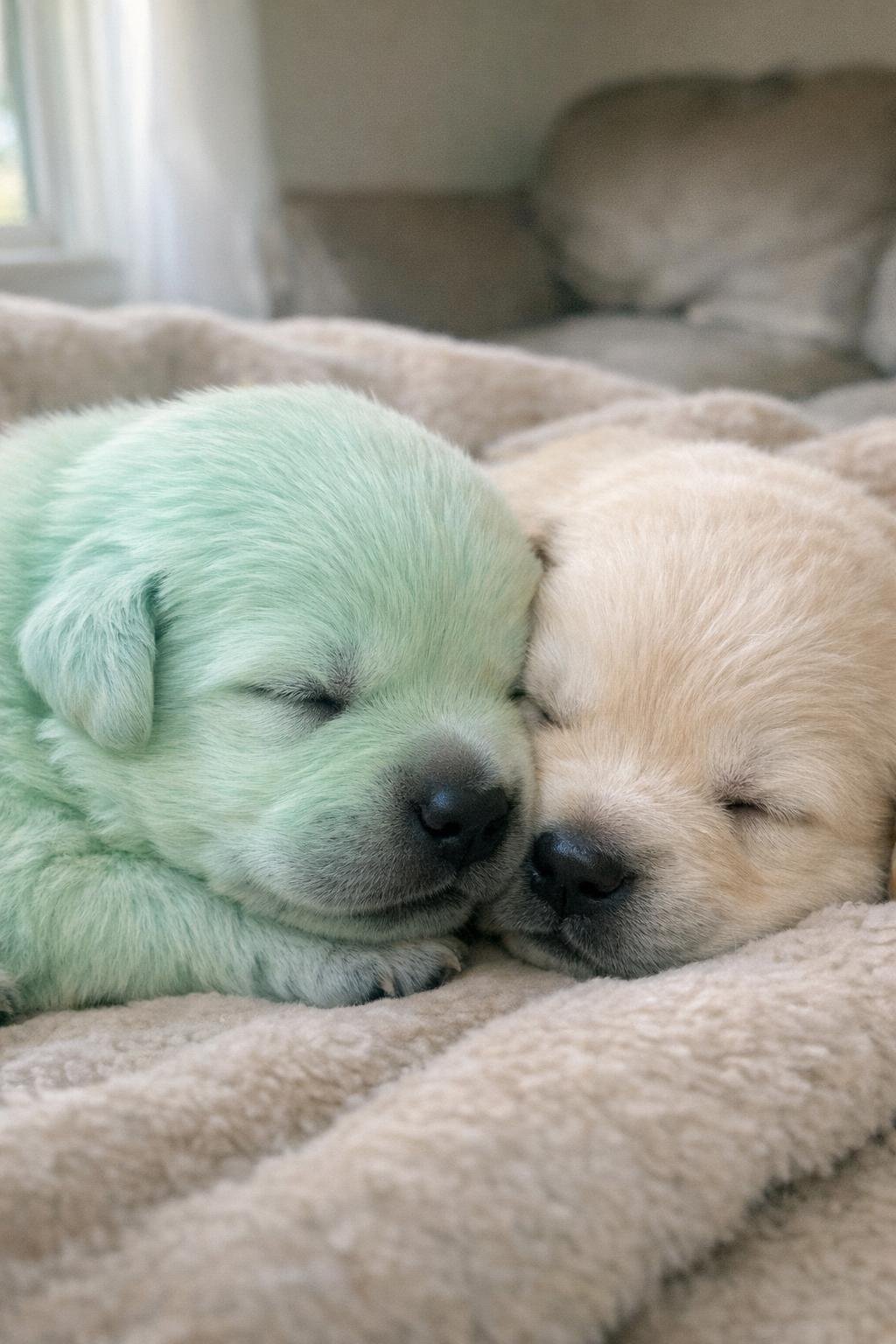
Last week, our golden retriever had a litter of 6 puppies, and I honestly thought I was prepared for anything. I had the whelping box set up in our spare room, stacks of clean towels ready, a digital scale on the dresser, and my phone full of notes from our vet. But when the puppies arrived, one of them stopped all of us in our tracks. I have seen cream puppies, deep golden puppies, and those in-between buttery shades, but I had never seen a newborn with a soft green tint to its fur.
If you are here because you saw a photo like that and immediately thought, “That cannot be real,” I completely get it. My first reaction was somewhere between shock and frantic Googling at 2 a.m. The good news is that this strange color is real, it has a scientific explanation, and in most cases it is not harmful at all. Before I get into what causes it, how rare it is, and what usually happens next, you need to see the little puppy everyone keeps talking about.
See for yourself:
1. Yes, green puppies are a real thing
As wild as it sounds, a puppy can absolutely be born with a greenish tint. It is uncommon, but it has been documented in veterinary medicine and reported across multiple breeds, including golden retrievers, Labradors, mixed breeds, Pomeranians, and Great Danes. The color is usually most obvious in very light-coated puppies because pale cream or white fur shows staining much more clearly than black or red coats.
In our case, the puppy did not look neon green or cartoonishly bright. It was more like a minty or seafoam cast over pale fur, especially across the back, head, and shoulders. Under warm lamplight it looked subtle, but in daylight it was unmistakable. That softer, stained look is actually part of the clue to what is going on.
2. The cause is biliverdin, a green pigment found in the womb
The usual explanation is exposure to biliverdin, a naturally occurring green pigment. Biliverdin is related to the breakdown of blood pigments and can be present in placental fluids. If a light-colored puppy comes into contact with enough of that pigment before or during birth, the fur can come out temporarily stained green.
This is not the same as dye, mold, paint, or an infection coating the puppy’s fur from the outside after birth. It is more like a temporary biological stain. Think of how a white T-shirt shows every spot while a dark navy one hides it. A cream or nearly white puppy basically has no “color camouflage,” so the green tone stands out immediately.
3. Why it usually affects only one puppy in the litter
This was one of my biggest questions. If the same mother delivered all 6 puppies, why would only one come out green? The most likely reason is that the puppies do not all sit in exactly the same position or have the same degree of exposure to placental material. One puppy may be closer to a pocket of biliverdin-rich fluid, or the membranes around that puppy may rupture in a way that creates more contact with the coat.
Timing can matter too. If one puppy is delivered after a little more fluid mixing or pressure in the birth canal, that puppy may end up more heavily stained than the others. In a litter of 6, it is completely possible for 5 puppies to look textbook golden and 1 to look like everyone accidentally turned on a mint filter.
4. It is most noticeable in golden retrievers and other pale-coated dogs
Golden retrievers are a perfect breed for this surprise because many litters include very light cream puppies. On a darker golden puppy, a green stain might barely register. On a pale puppy weighing 12 to 18 ounces at birth, with fluffy damp fur reflecting window light, the color can be dramatic enough that people think the image was edited.
I have noticed that people often assume the green must mean the puppy will “turn out green” as an adult, but coat color genetics and temporary birth staining are two completely different things. The puppy’s actual adult coat color still depends on its genetics, not on the green cast visible in those first days.
5. No, it usually does not mean the puppy is sick
This is the part that matters most. In the vast majority of reported cases, the green color itself is not dangerous. It is simply staining. A green puppy should still be evaluated the same way as every other newborn: checking breathing, nursing, body temperature, activity level, and weight gain.
Our vet told us to focus on the basics. A healthy newborn should nurse vigorously, sleep deeply between feedings, stay warm, and gain weight steadily. For medium-to-large-breed puppies, many breeders track weight every 12 to 24 hours during the first week using a kitchen or postal scale that measures in grams. A pup that starts at, say, 450 grams and gains consistently is much more reassuring than a perfectly colored pup that is weak, chilled, or not nursing.
6. What the vet usually checks in the first 24 hours
Even though the color itself is typically harmless, a vet check is still a good idea after any delivery. Newborn puppies are tiny, vulnerable, and surprisingly easy to worry about. Our vet looked over the entire litter for cleft palate, hydration, body condition, nursing reflex, and any signs of distress in mom.
For the green puppy specifically, the questions were practical: Is the puppy active? Is the stain on the fur only? Is there normal pink tissue where expected, such as the tongue and gums? Is the puppy maintaining warmth and latching well? If the puppy is behaving like its littermates, the coat color generally becomes a fascinating footnote, not a medical emergency.
7. The green color fades, and usually faster than people expect
One of the most reassuring things I learned is that this green tint does not last. The stain usually fades over several days to a few weeks. Grooming from the mother helps. Normal puppy movement, nursing, and gradual coat changes help too. By the time the puppies are opening their eyes and starting to look less like sleepy potatoes, the odd color is often already much lighter.
Some reports mention fading within 5 to 10 days, while others describe it lingering closer to 2 or 3 weeks depending on how strong the staining was and how light the coat is. It does not grow out as a permanent stripe or pattern. It simply disappears as the puppy’s coat changes and the stain wears off.
8. Please do not try to scrub or wash it off right away
I understand the urge. When you see a strange color on a newborn, your instinct is to clean it. But newborn puppies are not meant for cosmetic baths. During the first days, staying warm is far more important than looking photo-ready. A bath can chill a puppy quickly, especially one that weighs barely 1 pound and cannot regulate body temperature well.
If there is genuine debris or mess, use your vet’s guidance and stick to minimal, gentle cleaning with a warm, barely damp cloth, followed by immediate drying and return to mom. But if it is just green staining, the smartest move is usually to leave it alone. Mom will do most of the cleanup work far better than we will.
9. It is rare, which is why photos spread so fast online
Most dog owners will never see a green puppy in person. That rarity is exactly why these stories travel so quickly. The image looks unbelievable at first glance, especially in a breed people know well, like a golden retriever. We all have a mental picture of what a newborn golden puppy should look like, and “mint green” is definitely not on that list.
But rare does not mean impossible. Veterinary oddities often become internet myths because they are unusual enough to sound made up. This one just happens to come with adorable evidence. The combination of something scientifically explainable and visually shocking is basically social media rocket fuel.
10. How to monitor a newborn litter during the first week
Since the color itself is usually not the problem, the better question is how to care for all the puppies well in those first 7 days. I like to keep notes in a simple chart with each puppy’s birth time, birth weight, daily weight, nursing behavior, and any distinguishing marks. With 6 puppies, those details blur together fast if you are exhausted.
Room temperature for the whelping area often needs to stay warmer than most adults find comfortable, commonly around 85 to 90 degrees Fahrenheit for the first few days if there is no supplemental heating directly controlled for puppy safety. Puppies should be warm but not overheated, and they should be able to move away from a heat source. Weight checks once or twice a day, clean bedding, and observing that each puppy gets a turn nursing are much more important than the unusual coat stain.
11. When a green puppy would be a reason to call the vet immediately
The green color alone is usually not an emergency, but certain symptoms absolutely are. Call your vet promptly if the puppy is weak, not latching, crying continuously, feels cold, has trouble breathing, is not gaining weight, or seems less responsive than the rest of the litter. Also call if mom has a fever, foul-smelling discharge, obvious pain, or trouble caring for the pups.
If you notice green discharge from the mother before any puppy is born, that can be more concerning because in dogs it may indicate placental separation and can require urgent veterinary attention. That situation is different from a puppy simply being born with green-stained fur. The details matter, which is why a quick call to your vet is always worth it if something feels off.
12. The puppy will not stay green as it grows
This is probably the question I have been asked most: “So is it going to be a green dog?” No. The puppy is not genetically green, and the adult coat will not come in mint-colored. Once the stain fades, the puppy’s normal coat color takes over, whether that ends up being light cream, honey gold, or a richer golden shade.
In other words, this is a newborn moment, not a lifelong feature. It makes for an unforgettable first-week story and a camera roll full of photos nobody believes are real, but it does not rewrite the dog’s coat color forever.
13. Why this little surprise is actually a good reminder for pet owners
I think the biggest lesson here is that unusual does not automatically mean dangerous, and normal-looking does not always mean healthy. It is easy to fixate on the dramatic thing you can see, like green fur, and miss the more important indicators such as body warmth, nursing strength, hydration, and steady weight gain.
As someone balancing work, family life, and caring for animals, I always appreciate when the answer turns out to be both strange and straightforward. This is one of those cases. It looks shocking, but the explanation is simple biology, and the practical response is calm observation, a vet check, and patience.
14. So how is this even possible?
The short answer is that the puppy’s pale fur was temporarily stained by biliverdin, a green pigment associated with placental fluids. Because the coat was so light, the color showed up clearly. Because only one puppy had enough contact with that pigment, only one looked green. And because it is a stain rather than a true coat color, it will fade on its own.
So yes, it is possible. Weirdly, scientifically, adorably possible. And if you ever find yourself staring at a mint-tinted newborn golden retriever in total disbelief, you can skip the panic and go straight to the explanation.