
 Dogs
 Cats
 Birds
 Horses
 On the Land
 In the Sea
Last week our Beagle delivered a litter of five healthy puppies, and in the blur of towels, whelping pads, kitchen-timer feed checks, and not nearly enough sleep, I thought I’d seen just about everything that normally comes with those first few days. Newborn pups all look a bit unfinished at first: folded ears, pink little bellies, tiny squeaks every 20 minutes, and coat markings that seem to sharpen by the hour. But one of these pups made me stop, pick her up again, and look twice.
It’s the puppy on the left. At first I assumed the marking on her side was just a random brown patch that my tired eyes were turning into a pattern, but by day three it was unmistakable: a near-perfect heart shape set against her white coat. I’ve raised and fostered enough dogs over the years to know unusual markings happen, but this one is so tidy and so symmetrical that it genuinely surprised me. If you’ve ever wondered how rare coat quirks like this are, what causes them, and whether they stay as a pup grows, you’ll probably enjoy this as much as I did. Here she is.
See for yourself:
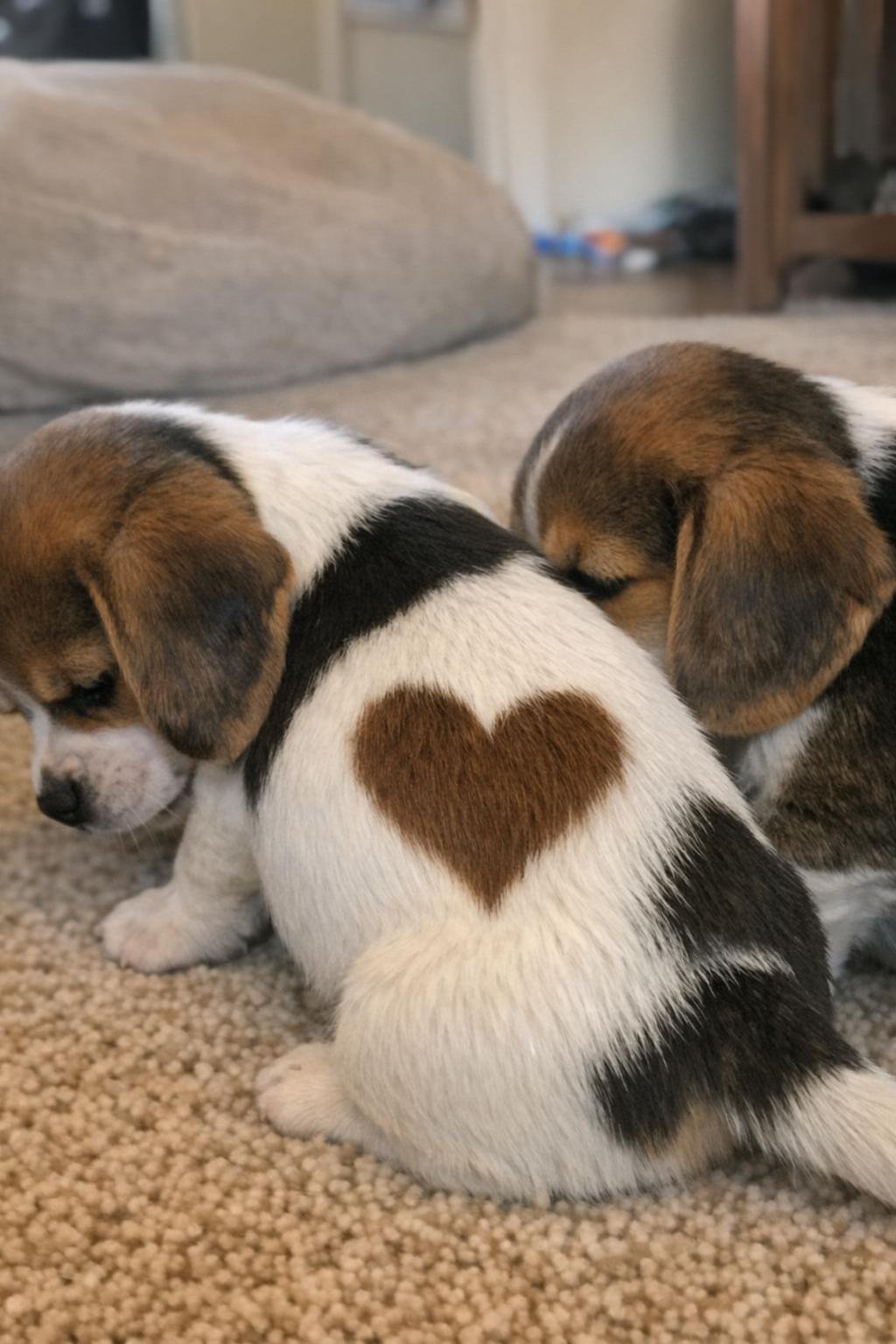
1. The moment we noticed it
We first really spotted the marking during a morning weigh-in on day 2. I weigh newborn pups at the same time each day using a digital kitchen scale with a shallow bowl and a folded hand towel inside it. This puppy was 12.4 ounces that morning, up from 10.9 ounces at birth, which was exactly the kind of steady gain I want to see.
When I turned her slightly to check her belly and make sure the umbilical area looked clean and dry, the brown patch on her left side caught the light. It wasn’t just rounded. It had a defined top, a gentle dip in the middle, and a pointed lower end. My first thought was, “That cannot be real.” By that evening, after seeing it from three or four angles, I gave up pretending it was my imagination.
2. What the heart-shaped patch actually looks like up close
The patch sits on the puppy’s left side, roughly midway between the shoulder and hip, and right now it’s about 1.5 inches tall and a little over 1.25 inches across at the widest point. Because the puppy is so tiny, that makes the marking look even more striking. It’s a warm chestnut-brown patch on a clean white area of coat, with edges that are sharper than I’d expect on a newborn.
What makes it look so heart-like is the balance. The two rounded lobes at the top are surprisingly even, and the lower point narrows naturally instead of fading off in a blotch. In a lot of dogs, odd patches look special from one angle and ordinary from another. This one reads as a heart from almost every side view, which is why everyone in the house noticed it immediately once I pointed it out.
3. Is this something I’ve seen before?
Not in quite this neat a form. I’ve seen plenty of memorable markings over the years: one terrier mix with what looked like a white sock dipped in coffee, a hound with a spot shaped vaguely like a comma, and a black-and-white pup with a patch over one eye that made him look permanently skeptical. But an actual heart shape, clean enough that nobody has to squint or be politely agreeable about it, is new for me.
That said, unusual coat patterns are not unheard of at all. Dogs get all sorts of spots, ticking, saddles, masks, blankets, and asymmetrical patches. Most are simply the result of how pigment-producing cells spread during development before birth. Sometimes those cells create very ordinary Beagle markings, and sometimes they produce something unexpectedly charming.
4. Why coat patches like this happen
Coat color and pattern come from genetics, but the exact placement of a patch often comes down to developmental chance as much as inheritance. In simple terms, pigment cells move and settle in the skin as the puppy develops in the womb. Where those cells concentrate, you get colored fur. Where they don’t, you get white.
That means the brown heart isn’t likely to be a “special heart gene” so much as a lucky arrangement of normal Beagle coloring. Think of it like clouds forming familiar shapes, except this version is printed in fur. The breed gives the basic palette: tan, brown, black, white. The individual pup gives you the exact layout.
5. How common are symmetrical markings in Beagles?
Beagles are famous for attractive markings, but perfect symmetry is less common than people think. Many tri-color Beagles have balanced facial markings or similar saddle patterns along the back, yet side patches tend to be more random. That’s why this stood out so strongly in a litter of five.
In our litter, two puppies are more classically marked with broad dark saddles, one has a heavier tan face, one has a white blaze that runs slightly off-center, and then there’s this little one with the heart. Out of those five, only one has a novelty-shaped patch, which fits my experience that eye-catching “picture” markings are memorable precisely because they don’t happen every litter.
6. Will the heart shape stay as the puppy grows?
Probably, but with a few changes. The basic patch should remain because it’s tied to the pigmented hair growing from that area of skin. What can change is the sharpness of the edges and the apparent proportions as the puppy’s body lengthens and fills out. A mark that looks perfectly compact on a 13-ounce newborn may look a little taller or wider at 8 weeks.
Beagle coats also change in subtle ways as pups mature. Newborn fur is softer and finer, and some shading deepens over the first several weeks. So while I expect the heart to remain clearly recognizable, I also expect it to look slightly less cartoon-perfect by the time this pup is romping around at 10 or 12 pounds.
7. The puppy’s health matters more than the novelty
As fun as the marking is, the first thing I care about is whether the puppy is thriving. So far she is. Her nursing reflex is strong, her body temperature feels normal and consistent, she settles well after feeding, and her daily weight gain has been right where I want it. In the first week, I’m happiest seeing gains of roughly 5 to 10 percent of birth weight per day, and she’s been tracking nicely.
Her mother is eating nearly three times her usual maintenance amount right now, which is typical for a nursing dog with five pups. We’re keeping the whelping area around 85°F for the first days, with enough room for the mother to move away so the pups don’t overheat. Cute markings get the photos, but warm, fed, steadily growing puppies are the real headline in my house.
8. Comparing her to the littermate beside her
One reason the marking looks so dramatic in photos is the contrast with her littermate beside her. That sibling has a more ordinary Beagle distribution of color, with brown and darker areas breaking up in the way most people expect. Put the two side by side, and the little heart patch becomes instantly obvious.
That comparison is useful because it reminds people that both puppies are completely normal. One just happens to have a coat pattern that our brains interpret as a familiar symbol. If she were lying alone, some people might think the image was staged or exaggerated. Next to a typical littermate, it’s much easier to appreciate how naturally the pattern formed.
9. What friends, family, and our vet said
The reactions were immediate and pretty funny. My sister said, “That puppy is going to get claimed first,” which may well be true. A neighbor who has owned hounds for 30 years stared at the photo for a few seconds and then said, “Well I’ll be damned, that’s an actual heart.” That was about the level of scientific commentary I was getting from most people.
At our routine post-whelping check, the vet’s staff enjoyed it too, but the response was exactly what I hoped for: admiration for 10 seconds, then straight back to health checks. Hydration, body condition, nursing, temperature, stools, and weight all came first. The consensus was basically that the marking is adorable and unusual, but not medically meaningful in itself.
10. Could a marking like this affect value or adoption interest?
Realistically, yes, it can affect attention, though I think people should be careful about making too much of that. Distinctive markings often make one puppy more memorable in photos, and memorable puppies get more inquiries. That doesn’t necessarily mean they’re better suited to a home, only that they’re easier to single out.
If someone were placing puppies, I’d encourage them not to let a novelty patch outweigh temperament, health, energy level, and fit for the household. A cute heart on the coat is wonderful. It is not a substitute for asking whether the family can handle house-training, chewing, barking, vet bills, and 12 to 15 years of responsibility.
11. Taking photos without stressing newborn puppies
If you ever end up with a similarly unusual marking and want to document it, keep the session short. I take photos in under 2 or 3 minutes, in the same warm room, with clean hands and a soft towel underneath the pup. No bright flash, no carrying puppies around the house for a better background, and no repeated repositioning just to get a perfect shot.
Natural window light works best anyway. The reveal photo here is exactly the kind of image I prefer: ordinary home lighting, close range, and nothing fussy. Newborns don’t need a production. A quick, calm picture is enough to capture the detail while keeping the focus on the puppy’s comfort.
12. Other unusual puppy markings I’ve heard of
Over the years I’ve heard of puppies born with patches people swore looked like angel wings, a number 7, a Mickey-ear silhouette, a state outline, and even a tiny mustache over the lip. Most of those are more “suggestive” than exact. Human brains are extremely good at finding familiar shapes, especially in high-contrast patterns.
That’s partly why I was skeptical about this one at first. Usually, after a second look, the magic disappears a bit. Here it did the opposite. The more clearly the coat dried and flattened over the first week, the more the heart shape came into focus.
13. What we’re watching over the next 8 weeks
For now, the plan is the standard puppy checklist. Daily weights for the first stretch, nail trims about once a week because those tiny needle claws get sharp fast, regular bedding changes, and careful observation of nursing order so no pup gets crowded out. Around 2 weeks, I’ll be watching for eyes to open. By 3 to 4 weeks, we’ll start seeing much more active movement and early social behavior.
By 6 to 8 weeks, the marking should be even easier to judge because the coat will be fuller and the body shape less curled up. I’m genuinely curious whether the heart stays as crisp as it looks now. I suspect it’ll remain obvious, just a bit stretched as the puppy grows into those long, classic Beagle proportions.
14. So, has anyone seen this before?
I’m sure somewhere, yes. With enough puppies born every year, nature eventually produces all kinds of delightful coincidences. But in my own experience, and among the Beagle folks I know personally, a patch this clean is uncommon enough to stop people mid-sentence. It’s one of those small surprises that makes raising animals such a joy.
So if you’ve seen something similar, I’d believe you happily. But this is my first perfectly heart-marked pup, and I admit I’m a little smitten. In a week filled with laundry, feeding charts, and the usual newborn chaos, that tiny brown heart on the left side of one sleepy Beagle puppy felt like a very nice reward for paying attention.