
 Dogs
 Cats
 Birds
 Horses
 On the Land
 In the Sea
When my daughter called to say she’d found a little “Husky mix” at the shelter, I pictured a lanky youngster with oversized paws, the kind of pup who’d grow into a dramatic winter coat and take over the whole couch by Christmas. Around here in the Midwest, we’ve seen all sorts of shelter surprises over the years, and I’ve learned that breed labels are often more hopeful guesswork than gospel truth. Still, when she brought this new baby through the kitchen door, I laughed right out loud—in the fondest possible way—because one look told me we were dealing with a wonderfully odd little combination.
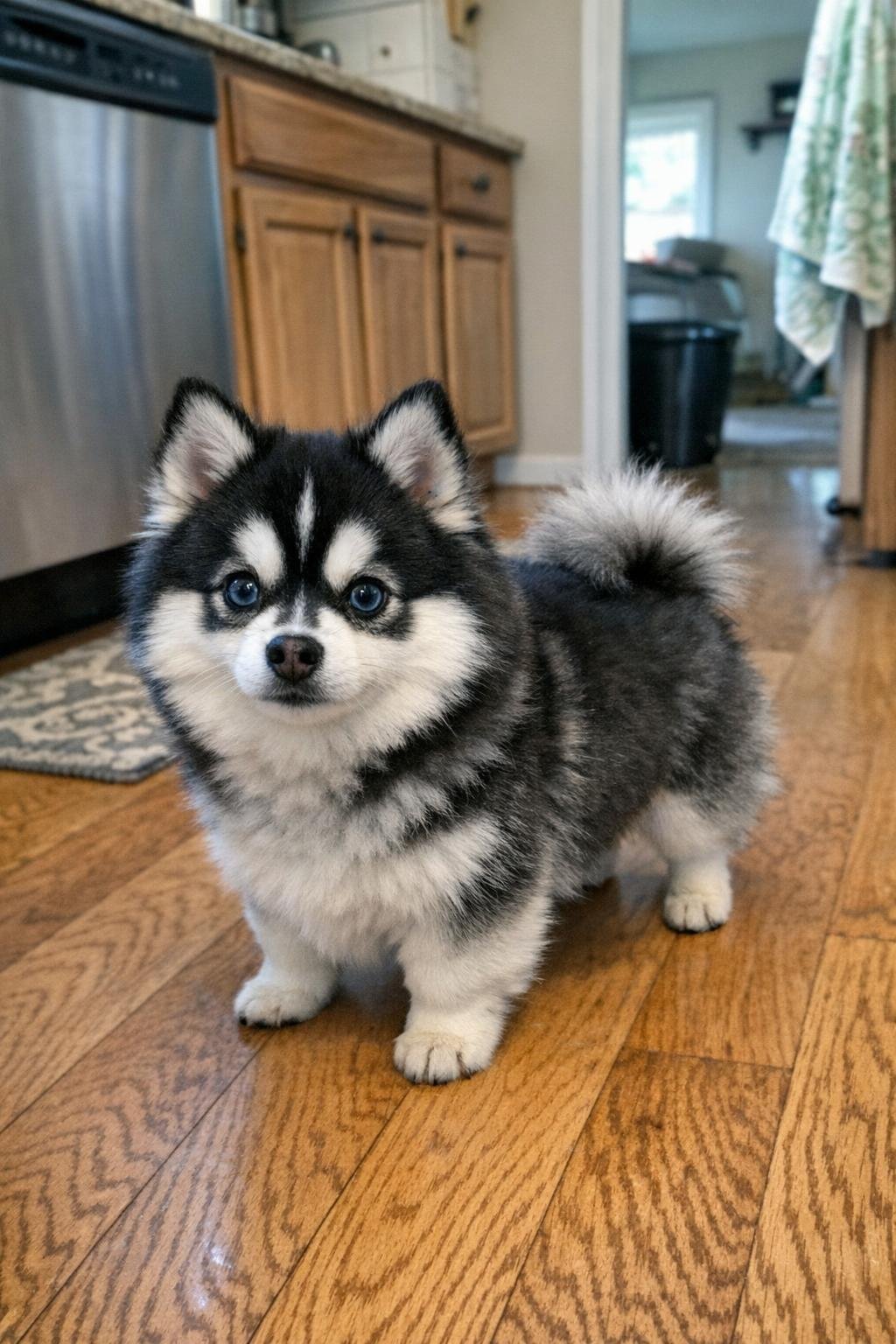
He had the classic wolfy face, those sharp Husky markings, and the bright, alert expression that makes you think he’s already figured out where you keep the treats. But below that proud little head was a compact, fluffy body with short legs and a dainty frame that looked more toy-dog than sled-dog. If you’ve ever wondered what happens when big northern-dog looks meet tiny companion-dog proportions, this sweetheart is about as charming an answer as you could ask for. And yes, once you see him standing there plain as day, I think you’ll guess the other half mighty quickly.
Here he is:
1. The answer sure looks like Pomeranian
If you ask me, the “other half” is Pomeranian, or close enough to it that I’d put money on Pom being in the family tree. The giveaway is the body: short legs, a lighter bone structure, a fluffy little barrel of a middle, and that toy-dog scale that says “I can be picked up with one arm” instead of “I need a harness rated for 60 pounds.” A typical Siberian Husky stands about 20 to 24 inches at the shoulder and often weighs 35 to 60 pounds, while a Pomeranian usually stands just 6 to 7 inches tall and weighs 3 to 7 pounds. Put those two very different builds together, and you can get a dog exactly like this—Husky in the face, Pom in the package.
I’ve seen folks call these pups “Pomskies,” and whether that mix happened by design or by one unexpected chain of events, the look is unmistakable once you know what you’re seeing. It’s one of those combinations that can make people stop mid-sentence and say, “Well, would you look at that.”
2. Why the head throws people off
The reason shelter staff may have led with “Husky mix” is simple: the head is doing a lot of the talking. A Siberian Husky has a very recognizable face—upright triangular ears, almond-shaped eyes, a clean muzzle, and that dramatic mask pattern over the eyes and cheeks. Even on a much smaller dog, those features jump out first.
From across a room, people tend to identify dogs by silhouette and face before anything else. So if a pup has the black-and-white contrast, the centered blaze on the forehead, and that fox-wolf expression, “Husky” is the first guess. Then the little short-legged body comes into focus, and suddenly the whole puzzle shifts.
3. The body shape is where the Pomeranian shows itself
Pomeranians are descendants of larger Spitz dogs, but over generations they were bred down into compact companion dogs. That means a rounded little frame, a dense double coat, a plumed tail, and proportions that stay petite. Even when mixed with a medium working breed, they can pass along that smaller scale very strongly.
On a dog like this, I’d expect an adult weight somewhere in the 10-to-20-pound range, though some Pomsky-type dogs land closer to 25 pounds. Height can fall around 10 to 15 inches at the shoulder. The short legs and fluffy body keep the dog looking almost puppy-like even after adulthood, which is part of the reason these mixes get so much attention.
4. Coat texture tells part of the story too
Both Huskies and Pomeranians have double coats, and that’s important. A double coat means a softer, insulating undercoat beneath longer outer guard hairs. So when the two breeds combine, you often get a truly plush coat that can be thick, airy, and quick to shed when the seasons turn.
In my house, I’d keep a slicker brush, a metal comb, and a good vacuum close at hand. During seasonal blowouts—often spring and fall—you may be brushing 3 to 4 times a week for 10 to 15 minutes at a stretch. In quieter months, once or twice a week might be enough. If there’s one thing country living teaches you, it’s not to wear black slacks when a fluffy dog’s in the family.
5. Those markings are classic northern-dog business
The coloring is another strong clue. Siberian Huskies often carry bold face masks, pale eyebrows, contrasting cheeks, and saddle or cap markings in black, gray, red, sable, or agouti tones. Pomeranians come in many colors too, but the precise “tiny Husky costume” effect usually happens when the Husky patterning comes through loud and clear on a smaller body.
That’s why this dog is such a delightful head-turner. He doesn’t merely resemble a fluffy mixed-breed pup. He looks like someone set a full-size Husky through the gentle wash cycle and got the miniature version back out, all dried and puffed up.
6. Temperament can be a merry little mixed bag
Now this is where experience matters. Huskies are bright, independent, energetic, and famously opinionated. Pomeranians are also bright, often lively, alert, and convinced they are much larger than they really are. Combine those two and you may have a dog that is affectionate and funny one minute, then stubborn as an old gate mule the next.
I’d expect a mix like this to enjoy people, stay very aware of household activity, and possibly be a talker. Huskies are known for vocalizing—woo-wooing, complaining, and commenting on daily life—while Poms can be quick to bark if they hear a car door, a squirrel, or the wind changing direction. With calm training, many settle nicely, but I would not count on this being a silent little lap rug.
7. Exercise needs may surprise people
Folks sometimes see the small body and assume the dog needs only a quick loop around the yard. I wouldn’t make that mistake. If the Husky side is strong, this pup may need 45 to 90 minutes of total daily activity, depending on age and health. That doesn’t all have to be hard running, especially with short legs, but it should include brisk walks, play sessions, training games, and sniffing time.
A good routine for a dog like this might be a 20-minute morning walk, 10 minutes of fetch or tug at midday, and another 25-to-30-minute walk in the evening. On rainy days, puzzle feeders, hide-and-seek with treats, and short obedience sessions can keep that busy little mind from inventing its own household projects.
8. Training should start early and stay cheerful
If this pup is a true Husky-Pomeranian mix, I’d use a light hand and a steady one. Neither breed tends to respond well to harshness. Short training sessions—5 to 8 minutes at a time, two or three times a day—usually work better than one long, nagging lesson that leaves everybody irritated.
I’d start with the practical things first: name recognition, recall, leash manners, crate comfort, sit, wait, and quiet. If the dog is food-motivated, tiny pea-sized treats are perfect. If not, use praise, a favorite toy, or a chance to chase a tossed soft ball. A smart dog that enjoys the game can learn quickly, but a smart dog that finds the lesson boring will also tell you so.
9. Watch the joints, back, and weight
One thing I’d be careful about with a small-bodied mix and short legs is unnecessary jumping, especially off high furniture. If the dog’s frame is more delicate, repeated leaps from a 20-inch sofa or a 24-inch bed can be hard on the joints over time. I’m a big fan of pet steps, area rugs for traction, and keeping nails neatly trimmed so little feet don’t slide on smooth floors.
Weight matters too. On a 12-pound dog, even an extra 2 pounds is significant. That can put strain on knees and hips in a hurry. Feeding measured meals instead of free-feeding is wise. Many small mixed breeds do well on roughly 1/2 to 1 cup of quality kibble per day total, divided into two meals, though exact amounts depend on calorie density, age, and activity level.
10. Grooming is not optional with this kind of fluff
I grew up in a house where dogs were dogs and mud was just part of the season, but even I’ll tell you a coat like this needs proper upkeep. Brushing all the way down to the undercoat helps prevent mats behind the ears, under the collar, at the britches, and around the tail base. Those are the sneaky spots.
Bathing every 6 to 8 weeks is often enough unless the pup finds a mud hole or decides something dead in the pasture smells better than decency. Use a dog shampoo made for double coats, dry thoroughly, and never shave a double-coated dog unless a veterinarian says it’s medically necessary. That coat does more than look pretty—it helps regulate temperature and protects the skin.
11. Shelter labels are often educated guesses
This is worth saying kindly and clearly: shelters do their best, but many breed identifications are visual estimates. Unless a dog comes in with paperwork or a known history, staff are often working from appearance alone. And with mixed breeds, appearance can be downright misleading.
I’ve known dogs labeled “Lab mix” that turned out to be mostly hound, and “Shepherd mixes” that looked entirely different once DNA results came back. If your daughter really wants to know, a canine DNA test in the $80 to $150 range might confirm what the eye already suspects. But honestly, in this case, I think our eyes are making a mighty convincing argument.
12. What life with a Pomsky-type dog is usually like
From what I’ve seen, these little fellows often become the center of the household in about 48 hours flat. They’re eye-catching enough that neighbors ask questions, and personable enough that they tend to know exactly how to win people over. They can do well in apartments or farmhouses alike, provided they get exercise, routine, and company.
The trade-offs are real: shedding, possible vocalizing, and a streak of mischief. But the upside is a dog that can be deeply entertaining, loyal, and sweet-natured. The very things that make them a handful are often the same things that make them unforgettable.
13. My best guess, plain and simple
If this darling walked into my kitchen—and goodness knows that’s where all proper family evaluations happen, between the cookie tin and the coffee pot—I’d call him a Siberian Husky and Pomeranian mix without much hesitation. The Husky is in the face, the markings, the expression, and the erect ears. The Pomeranian is in the stature, the fluff, the short little legs, and the toy-sized overall build.
In other words: say hello to the new kid, because he looks for all the world like a Pomsky.
14. The important part has nothing to do with labels
Of course, breed guesses are fun, and I understand the temptation to solve the puzzle. But after all my years in kitchens full of family, dogs underfoot, and winter boots by the back door, I’ve come to believe the best thing about a shelter pup is not the paperwork—it’s the fact that somebody gave him a home.
So yes, my vote is Pomeranian for the other half. But more importantly, he’s one hundred percent the new kid now: fed, fussed over, admired, and already part of the story. And if he’s anything like the best dogs I’ve known, he’ll repay that kindness every single day.