
 Dogs
 Cats
 Birds
 Horses
 On the Land
 In the Sea
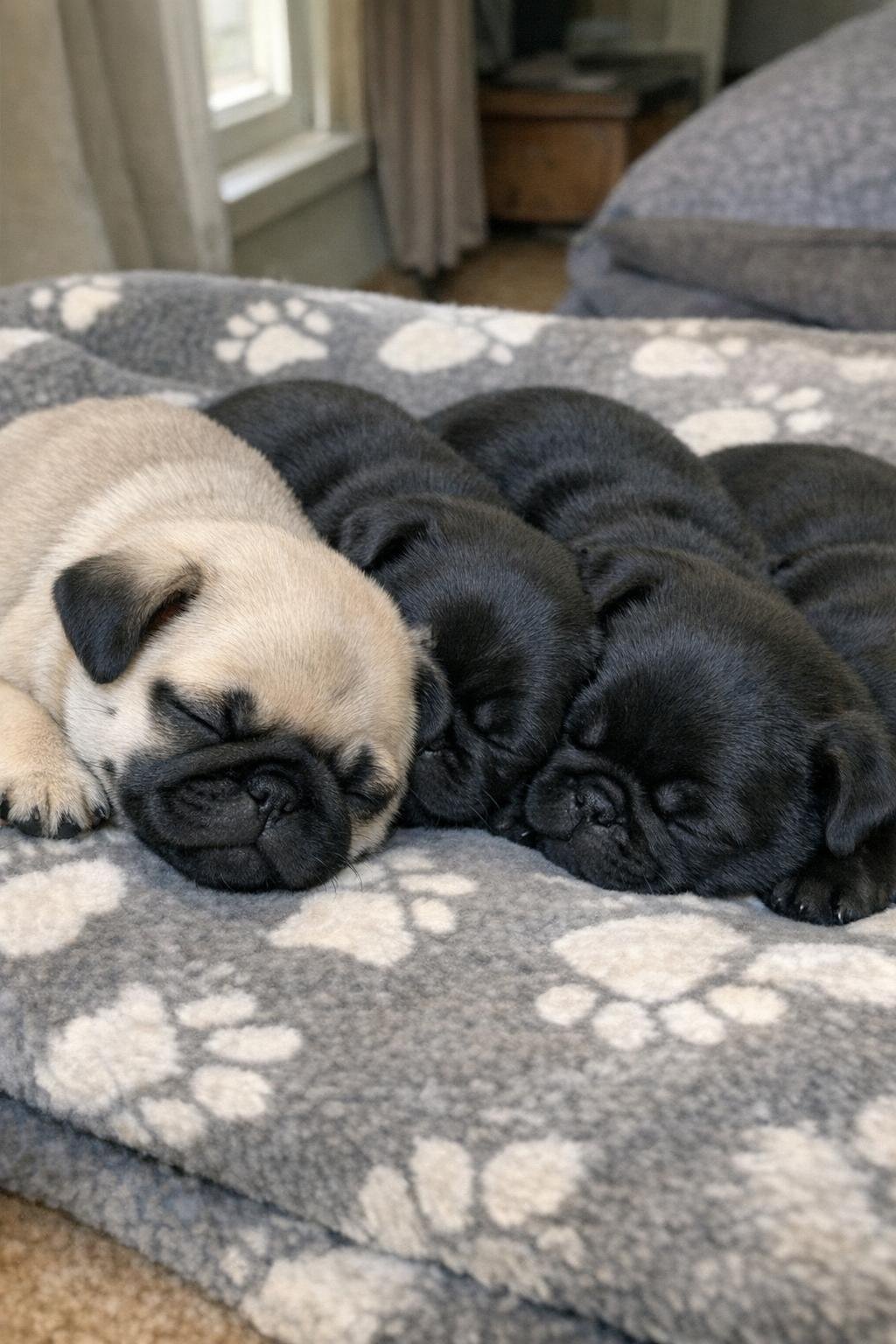
When a litter arrives, most of us expect the puppies to look at least somewhat alike, especially in a breed as recognizable as a Pug. So when a black Pug mama delivers three jet-black babies and then one soft, pale fawn puppy with that classic dark mask, it can stop everybody in their tracks. I’ve raised enough family pets and spent enough time around breeders and vet visits to know that surprises like this feel dramatic in the moment, but they usually have a very down-to-earth explanation.
The short version is this: coat color genetics can hide quietly for generations, and then suddenly show up in one puppy that looks completely different from the rest of the litter. If you’re staring at that last little baby and wondering whether something strange happened, whether the puppy is really related to the others, or how two darker parents could produce a lighter pup, there is a real answer. And once you understand the recessive fawn coat gene, it all starts to make perfect sense. See for yourself:
Here she is:
1. Why that last puppy looks so surprising
Most people expect a litter to come out looking like cookie-cutter copies, but genetics do not work that neatly. In Pugs, black and fawn are both well-known coat colors, and both can exist in the same family line. If your black female had 4 puppies and 1 of them is fawn while 3 are black, that split can absolutely happen naturally.
What makes it feel so dramatic is the contrast. A black Pug puppy often looks like a tiny velvet bean, while a pale fawn puppy has a creamy tan body and a very obvious black facial mask. Put them side by side on one blanket and it looks almost impossible that they belong in the same litter, but they can.
2. The simple genetic answer: recessive fawn
The easiest way to explain it is with dominant and recessive genes. In very simple terms, black can act like the stronger, more visible instruction, while fawn can be hidden and only show when a puppy gets the right combination from both parents.
If both parents carry the hidden fawn gene, they can produce black puppies that carry fawn and also a fawn puppy that receives that recessive fawn version from both sides. You may hear people describe this as each parent “carrying fawn.” That is usually the big reveal behind the mystery.
3. A quick way to picture the gene pairing
Think of each parent as handing over 2 tiny recipe cards for coat color, but the puppy only gets 1 card from mom and 1 from dad. If we use “B” for black and “f” for fawn, a black dog that carries fawn might be written as Bf. That dog looks black, because the black instruction shows on the outside.
Now imagine both parents are Bf. The possible combinations in a puppy are BB, Bf, fB, and ff. Three of those combinations look black, while 1 looks fawn. That is the classic 3-to-1 pattern people talk about. In a litter of 4, that could mean 3 black and 1 fawn, though real litters do not always divide themselves so neatly.
4. Why “3 black and 1 fawn” fits the math so well
When both parents are black but each carries fawn, every individual puppy has about a 25% chance of being fawn, a 50% chance of being black while carrying fawn, and a 25% chance of being black without carrying fawn. That does not mean every litter of 4 will produce exactly 1 fawn puppy. It just means each puppy has those odds independently.
Still, when a family sees exactly 3 black puppies and 1 fawn, it lines up so neatly with the textbook example that it feels especially satisfying. It is one of those moments where nature really does seem to be showing the lesson right in the whelping box.
5. This does not automatically mean anything is “wrong”
I want to say this plainly, because pet families can worry fast, especially in that tired first week with newborn puppies. A fawn puppy in a black litter does not automatically mean a health problem, a mix-up, or an emergency. Coat color alone is not a sign that the puppy is unwell.
What matters much more in those first 7 to 14 days is whether each puppy is nursing every 2 to 3 hours, gaining weight steadily, staying warm at about 85 to 90 degrees Fahrenheit in the earliest neonatal period, and producing that soft, contented sleep that healthy newborns tend to have. Color can be surprising. Behavior and growth are what your veterinarian watches most closely.
6. Does the dad have to be fawn?
Not necessarily. The sire could be black and still carry fawn. That is the part that trips up many people. A dog does not have to look fawn in order to pass along a fawn gene. Hidden recessive traits are exactly that: hidden.
If the mother is black and carries fawn, and the father is also black and carries fawn, then a fawn puppy is possible. If one parent is fawn, the math changes, but the basic principle stays the same: the puppy’s visible color depends on which coat-color instructions it inherited from both sides.
7. Can one puppy in a litter really be that different from the others?
Absolutely. In the same litter, you can see differences in shade, size, appetite, and markings, even among puppies with the same basic color. One puppy may be 8 ounces at birth and another 6.5 ounces. One may have a broader white chest patch if permitted by the line, while another appears more uniform. And yes, one may be fawn while the rest are black.
In my experience, families often notice color first because it is obvious right away in photos. But if you watch a litter for 3 or 4 weeks, you start seeing personality differences too. There is usually one determined crawler, one loud complainer, one champion sleeper, and one that somehow always ends up in the warmest spot.
8. Could this mean the litter has more than one father?
People do ask this, and biologically, litters with multiple sires can happen in dogs. But that possibility is not the first or most likely explanation when a black Pug has one fawn puppy. In a breed with known color genetics, a recessive coat gene is a much simpler and much more likely answer.
If someone truly needed certainty for breeding records or registration purposes, a DNA parentage test could sort that out. But from a basic color-genetics standpoint, one fawn puppy among black littermates is fully explainable without jumping to a dramatic conclusion.
9. Why the black mask still appears on the fawn puppy
This is one of my favorite parts, because it helps people recognize the puppy as unmistakably Pug-like. A fawn Pug is not just “tan all over.” That classic black mask on the face, along with darker ears and often some shading down the back, is part of the expected look.
So when your pale puppy has that creamy body and that inky little mask, that is not contradictory at all. It is actually exactly what many people picture when they think of a traditional fawn Pug. That black mask is what makes the surprise even sweeter, because the puppy looks different from the siblings and yet still very much like a proper little Pug.
10. What to watch in the first week besides coat color
Color may be the conversation starter, but care comes first. During the first week, newborn Pug puppies should be kept warm, dry, and nursing often. A kitchen scale that measures in grams is incredibly helpful. Many breeders weigh puppies once or twice a day at the same time, often expecting gradual gain after the first 24 hours.
If a puppy is losing weight, crying constantly, feeling cool to the touch, or struggling to latch, that deserves more attention than whether the coat is black or fawn. In a brachycephalic breed like the Pug, close observation matters. A small notebook with birth weight, daily weight, and nursing notes can be worth its weight in gold at a vet appointment.
11. What a vet or genetic test can tell you
If you want more than a visual explanation, your veterinarian may discuss canine coat-color testing. A DNA test from a reputable lab can often identify whether a dog carries certain color genes, including those tied to fawn and black in breeds where those genetics are established.
For families who are simply curious, this can be a fun confirmation. For responsible breeders, it can be part of planning future litters more carefully. Testing does not replace health screening, of course, but it can answer the “how is this possible?” question with much more precision than guesswork.
12. Will the fawn puppy stay this color?
Usually, the basic color category will remain the same, but newborn coats can shift in tone over the first several weeks. A very pale fawn puppy may deepen slightly into a warmer apricot or biscuit shade, or the coat may stay fairly light. The black mask generally becomes more defined as the face develops.
By about 6 to 8 weeks, families often get a much clearer picture of the puppy’s mature look, though subtle changes can continue beyond that. The three black littermates may also change a bit, looking less “inky” and more glossy charcoal-black in certain light as their coats grow in.
13. Questions I hear from families all the time
One common question is, “Did the mother somehow choose one different-colored puppy?” No, color is determined at conception, not later in pregnancy. Another is, “Did the fawn puppy take after a grandparent?” In a practical sense, yes, that hidden gene may have been passed quietly through the family line.
I also hear, “Does the fawn one need different care?” In ordinary day-to-day puppy raising, no. Warmth, feeding, cleanliness, and monitoring apply to all 4 puppies the same way. The pale coat may show milk dribbles or blanket lint a little more easily in photos, but that is about as dramatic as it gets.
14. Why surprises like this are part of the joy of a litter
One reason families fall so hard for newborn puppies is that each litter feels like a little unopened gift. Even when you know the pedigree, know the parents, and think you know what to expect, nature still has ways of humbling you. Then suddenly there is one tiny pale baby tucked beside three black siblings, and everyone in the room starts talking at once.
As a mom myself, I think that wonder is part of what makes caring for animals so special for kids and grown-ups alike. It opens the door to curiosity, science, and tenderness all at the same time. You get the sweet moment of “Look at that baby,” and then you get the satisfying answer: hidden genes can wait patiently and then show up all at once.
15. The bottom line
Yes, it is possible. In fact, it is a classic example of how recessive coat-color genetics work. A black Pug can carry the hidden fawn gene, and if both parents pass that recessive fawn version to one puppy, that puppy can be fawn even when the littermates are black.
So if your black Pug had 4 puppies last week and the last one makes everybody gasp, you are not looking at a mystery without an answer. You are looking at genetics doing exactly what genetics sometimes does: turning a hidden family trait into the most memorable puppy in the box.