
 Dogs
 Cats
 Birds
 Horses
 On the Land
 In the Sea
When my daughter brought home her shelter “Chihuahua mix,” I expected the usual little-dog surprises: a dramatic bark, a talent for burrowing into blankets, and perhaps a touch of mystery around the family tree. What I did not expect was a dog who looked as though someone had taken a perfectly standard tiny Chihuahua face and set it atop a body built for the backstretch at a racetrack. The first time I saw him standing still in the living room, I laughed so hard I had to set down my coffee.
Of course, once the laughter wore off, the questions started. Shelter labels are often educated guesses, especially when a dog arrives without paperwork, and mixed-breed genetics can produce some wonderfully odd combinations. In this case, though, there was one very strong clue in plain sight: those long, fine-boned legs, that deep chest, and that sleek, narrow outline. Before I tell you why I’m convinced there’s Greyhound in this little gentleman, take a look for yourself.
See for yourself:
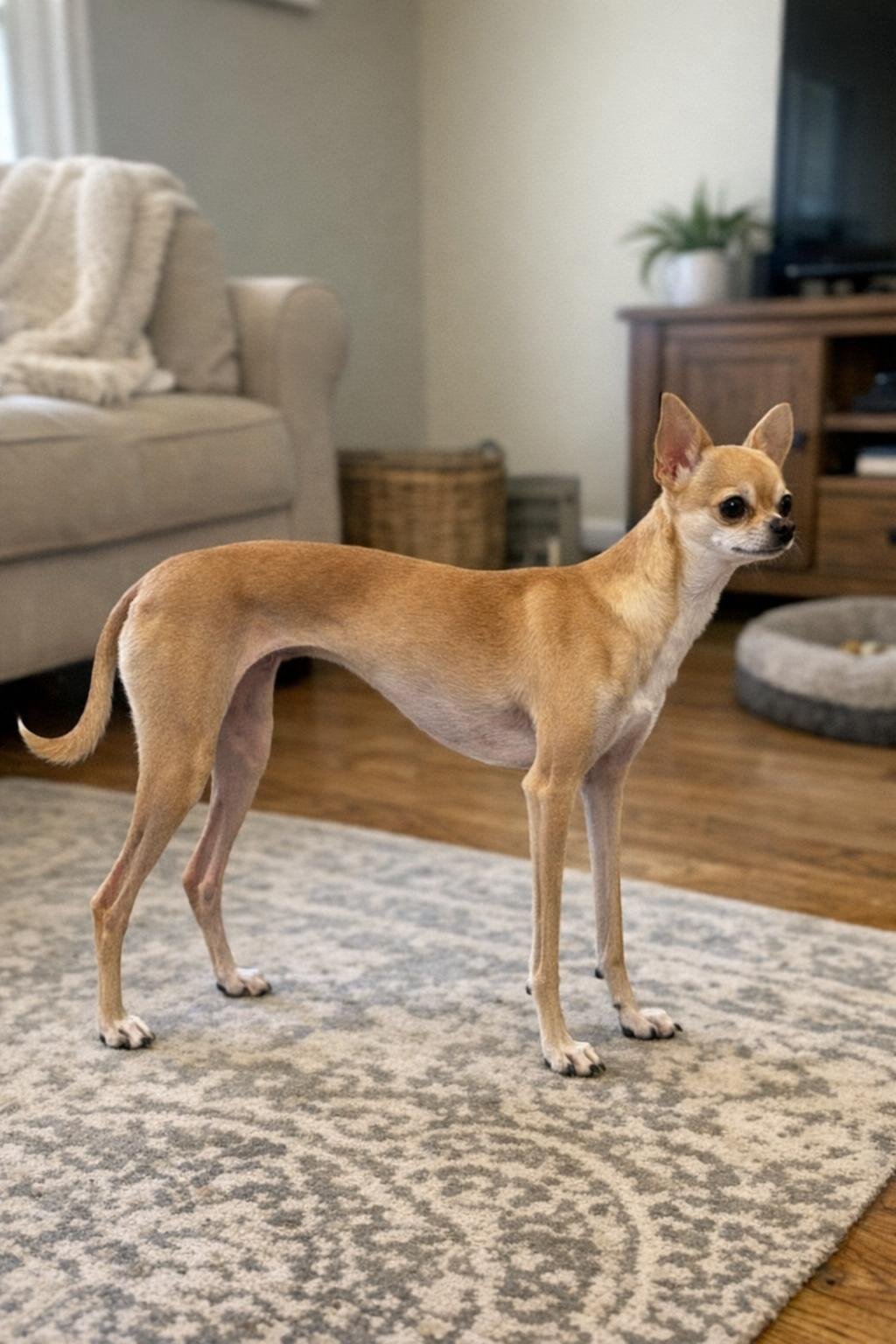
1. First impressions: why this mix catches your eye immediately
Most mixed dogs blend their features in a way that reads as generally familiar. This dog does not. At a glance, the head says Chihuahua: compact skull, large alert ears, round expressive eyes, and that slightly saucy expression small-dog owners know well. Then your eye travels downward and everything changes. The body is stretched, tucked, and athletic, with legs that look several inches too long for a typical Chihuahua cross.
That contrast is exactly why people start guessing. A standard Chihuahua usually stands about 5 to 8 inches tall at the shoulder and commonly weighs under 6 pounds. A Greyhound, by contrast, often stands 27 to 30 inches and weighs anywhere from 60 to 70 pounds. Put those two silhouettes in your mind at once, and suddenly this odd little shelter mystery starts to make sense.
2. The Chihuahua clues are all in the face
If I were identifying only from the head, I would have no hesitation. The small muzzle, the proportionately large ears, and the bright, watchful expression are classic Chihuahua traits. Fawn coloring also fits comfortably within Chihuahua coloring, especially when paired with a short, smooth coat.
Temperament can reinforce the visual guess. Chihuahuas are often deeply attached to one or two people, quick to notice every sound in the hallway, and full of confidence that far exceeds their body weight. Even in mixes, that “I run this apartment” energy can come through loud and clear. If this dog follows your daughter from room to room and comments on every delivery person, that would not surprise me one bit.
3. The Greyhound clues are in the outline
The strongest argument for Greyhound is not the length alone but the specific shape. Greyhounds and other sighthounds tend to have a deep chest, a narrow waist, and long, refined legs built for explosive speed. Their movement is often light and springy, almost floating, even when they are simply crossing the room.
Another giveaway is the tucked abdomen. In many athletic breeds, the belly rises upward behind the ribcage, but in Greyhounds the tuck is especially pronounced. If the dog looks built like a little arrow, streamlined from chest to hips, that is a much better clue than color or ear set. Structure tells a more reliable story than markings do.
4. Why shelters often use the label “Chihuahua mix”
Shelters work quickly, and breed labels are usually visual estimates, not DNA-confirmed facts. Staff may have only a few minutes during intake, and many dogs arrive stressed, underweight, matted, or still growing. A tiny dog with a Chihuahua face is very likely to be entered simply as a Chihuahua mix because that is the most visible, immediate trait.
There is also a practical reason. Adopters understand common breed names. “Chihuahua mix” gives people a starting point, even if the other half is uncertain. I have known plenty of dogs listed as terrier mixes, shepherd mixes, or lab mixes who later turned out, after testing, to be something far more surprising. It is less deception than shorthand.
5. Can a Chihuahua and a Greyhound really mix?
It sounds improbable, but yes, unusual mixes happen. Sometimes the parents are a direct pairing, and sometimes the dog is a multigenerational mix where one side contributed the head shape and another contributed the body type. Genetics do not average out neatly the way many people imagine. A dog can inherit one breed’s head, another breed’s chest, and a coat length that seems to come from neither.
In practical terms, a direct Chihuahua-Greyhound pairing would usually involve human intervention or a very unusual chain of events, simply because of the size difference between the breeds. But once multiple mixed generations enter the picture, stranger outcomes become entirely possible. That is one reason DNA tests so often surprise families.
6. What a Chihuahua-Greyhound mix might weigh and measure
If this really is a Chihuahua-Greyhound type of mix, I would expect an adult dog to land somewhere in a broad middle range, often around 12 to 25 pounds, though some could fall lower or higher. Shoulder height might be 12 to 18 inches, again depending on how strongly either side expresses itself. The dog in your headline sounds less like a stocky small mix and more like a lightly built, elongated one.
That build matters for daily life. A 14-pound dog with a Greyhound-style frame does not handle furniture jumps the way a compact 14-pound terrier might. Long legs and a narrow body can mean elegance, but they can also mean a bit more caution around slippery hardwood floors, steep stairs, and rough play with heavier dogs.
7. Movement tells you almost as much as appearance
One of the best ways to evaluate a mystery mix is simply to watch the dog walk and run. Chihuahuas often have a quick, busy gait with plenty of personality. Greyhounds move with long strides and surprising efficiency, covering ground smoothly with very little wasted motion. If this dog trots across a 12-foot room in what feels like three graceful steps, I would absolutely keep Greyhound high on the suspect list.
Sighthound influence can also show up in bursts of speed. Many Greyhound mixes will go from napping on the sofa to sprinting a loop around the yard in under 3 seconds flat. Then, just as suddenly, they return to being world-class loungers. It is one of the funniest combinations in dogdom: Olympic athlete for 90 seconds, blanket burrito for the next 4 hours.
8. Temperament: what happens when bold meets sensitive
This is where the mix gets interesting. Chihuahuas can be spirited, devoted, and vocal. Greyhounds are often gentle, quiet, and somewhat sensitive, especially in new settings. Blend those together and you may get a dog who is deeply affectionate at home, cautious with strangers, and oddly regal about where he chooses to sit.
In my experience with sensitive dogs, routine matters a great deal. Meals at the same times, walks at consistent hours, and a predictable bedtime can settle them beautifully. If this little fellow has one foot in Chihuahua alertness and one foot in Greyhound delicacy, he may thrive with calm introductions, soft bedding, and gentle handling rather than a noisy, chaotic household rhythm.
9. Exercise needs may be very different from a typical Chihuahua’s
A standard Chihuahua may be quite content with a few short walks and indoor play. A Greyhound-influenced mix may want more room to stretch out and move. That does not necessarily mean marathon exercise. In fact, many sighthounds prefer moderate daily walks, perhaps 20 to 30 minutes once or twice a day, plus a brief chance to trot or zoom in a secure area.
The key is controlled movement. Because of the longer legs and leaner structure, I would use a well-fitted harness and avoid retractable leashes in busy areas. Sighthound types can lock onto motion quickly. A squirrel, rabbit, or blowing plastic bag can turn a casual stroll into a sudden dash, so secure fencing and leash safety become especially important.
10. Feeding a lean, fine-boned dog takes a little attention
Dogs with a narrow build often look “too skinny” to people accustomed to sturdier breeds. With sighthound influence, you may see more rib outline, a marked tuck at the waist, and less bulk over the hips. That alone does not mean the dog is underfed. Body condition is better judged by touch and overall muscle tone than by fluff-free appearance.
For a dog in the 15- to 20-pound range, many quality dry foods suggest roughly 1 to 1.5 cups per day, split into two meals, though caloric needs vary widely with age and activity. I would watch energy level, stool quality, and weight over 2 to 4 weeks rather than making snap decisions based on appearance. Lean athletes can look almost fragile while being perfectly healthy.
11. Health questions to keep in mind
Any mixed breed can inherit traits from either side, so regular veterinary care matters more than guessing games. On the Chihuahua side, vets often watch for dental crowding, luxating patellas, and heart murmurs. On the Greyhound side, the concerns may lean more toward thin skin, sensitivity to cold, and injuries related to high-speed movement or awkward landings.
I would be especially mindful of temperature. Fine-coated, low-body-fat dogs can get chilly fast once the thermometer drops below about 45°F. In a Midwest winter, that may mean a fitted sweater or coat for walks from November through March. Indoors, they are often happiest with a soft bed, a fleece blanket, and the warmest patch of sun in the house.
12. Living-room logistics: the home setup that helps
A dog built like a miniature sighthound benefits from a thoughtful setup. Rugs or runners on slick floors can prevent slipping. A bed with at least 2 to 3 inches of cushioning helps protect bony pressure points on elbows and hips. If the dog likes to perch on furniture, a pet step or low ottoman can reduce repeated jumping strain.
I would also keep nail trims on schedule, usually every 3 to 5 weeks depending on growth. Long nails change the way a dog stands and moves, and on a delicate-legged dog that can matter quite a bit. It is one of those small maintenance tasks that pays off more than people realize.
13. DNA testing can answer the question, but not the whole story
If your daughter truly wants to know, a canine DNA test is the clearest next step. Most kits use a cheek swab, and results typically return in 2 to 6 weeks. Prices often run from about $80 to $150 depending on the company and whether health screening is included. It is a fun project, and sometimes a remarkably useful one for understanding likely behavior patterns and inherited risks.
That said, DNA will not change who the dog is in your home. I have seen families become so focused on breed percentages that they miss the more immediate reality: this individual dog likes one specific blanket, dislikes rain, and insists on dinner at 5:32 p.m. Breed can explain tendencies. It does not replace observation.
14. My honest guess: yes, Greyhound is a very plausible “other half”
If I were placing a friendly wager from appearance alone, Greyhound would be near the top of my list, or at least another close sighthound relative such as Whippet or Italian Greyhound. The long limbs, narrow frame, deep chest, and tucked waist all point in that direction much more strongly than they point toward terrier, dachshund, or miniature pinscher.
The Chihuahua part seems written all over the face. The sighthound part seems written all over the rest of him. And that, frankly, is what makes this dog so memorable. Shelters are full of wonderful mysteries, but every now and then one walks out looking like a punch line and a supermodel at the same time.
15. The best part of the story is not the breed mix
As entertaining as the guessing game is, the real headline is that this dog found his people. A shelter dog comes home, learns the sound of the treat jar, picks his favorite corner of the sofa, and begins the slow work of belonging. Whether he is 50 percent Chihuahua and 50 percent Greyhound, or some far messier arithmetic, he is now the new kid in a family that is paying attention to him.
And as someone who has cooked for a crowd, hosted plenty of family chaos, and watched more than one rescue animal settle into a household rhythm, I can tell you this: being adored matters more than being easily classified. Still, if you ask me what the other half is, I would smile, look at those legs, and say, “Honey, that dog is giving Greyhound.”