
 Dogs
 Cats
 Birds
 Horses
 On the Land
 In the Sea
Last week, my neighbor stopped me on the sidewalk with the kind of grin that usually means either fresh zucchini or breaking neighborhood news. This time, it was puppies. Her Dalmatian had delivered a litter of six, and by day three half the block was already comparing tiny noses, pink paws, and the first dusting of spots beginning to come in. I’ve cooked for many gatherings in my life, but I’ll admit very little clears my afternoon schedule faster than an invitation to see newborn puppies.
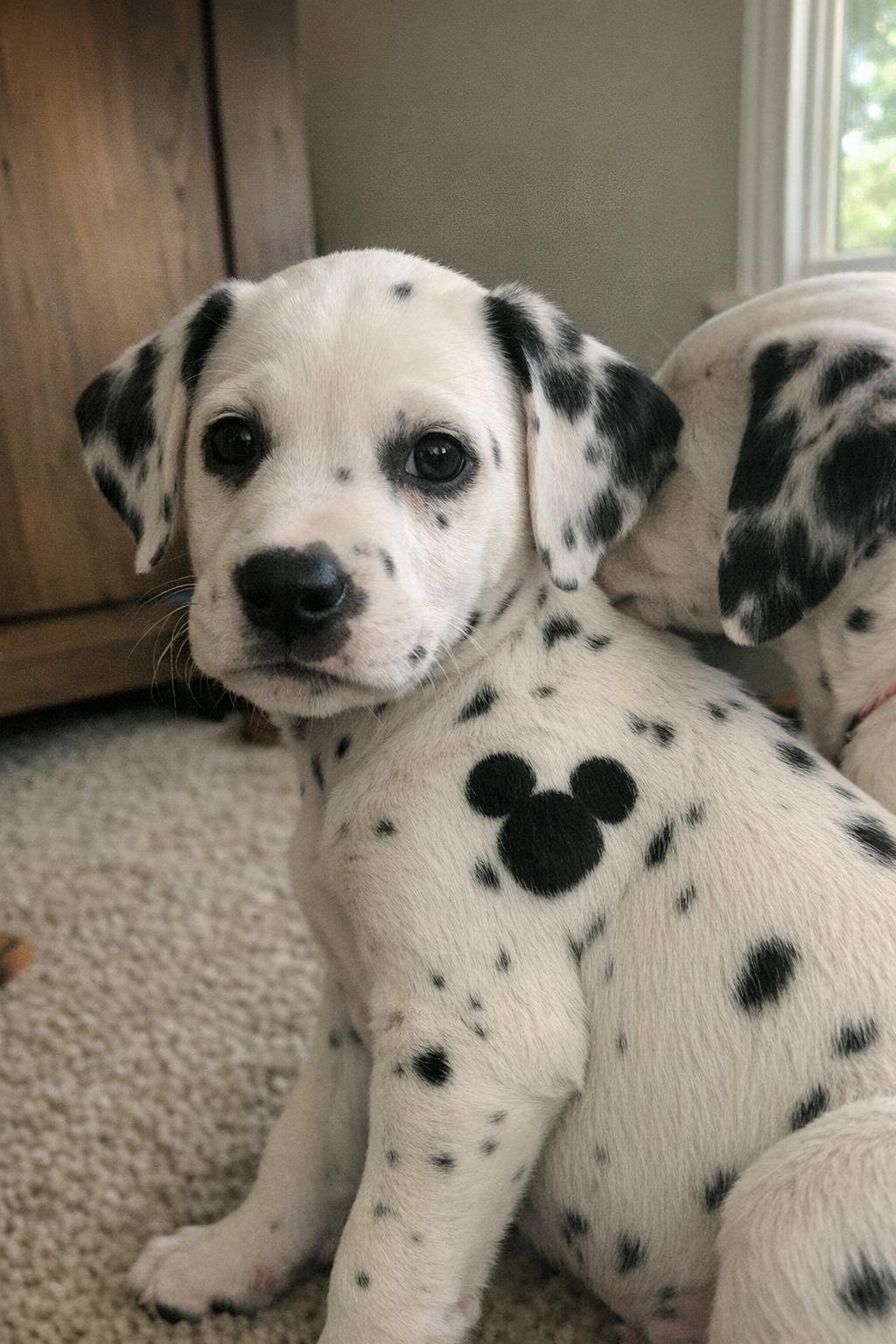
Dalmatians are already one of those breeds that make people do a double take because no two coats ever settle in quite the same way. But one of these pups had something so oddly precise that every person who saw it reacted the same way: first a pause, then a laugh, then an immediate “Wait—have you seen this?” If you’re wondering whether coat patterns can really line up into a shape that recognizable, this little one is exactly why people are talking.
See for yourself:
1. The little surprise everyone noticed
The last puppy in the litter has three crisp black spots grouped on one shoulder: one larger round spot about 1.5 inches across, with two smaller round spots above it, each roughly 0.75 inch wide. Taken together, they look remarkably like a classic Mickey head silhouette. Not vaguely, not if-you-squint, but immediately recognizable.
What makes it so striking is placement. Dalmatian spots can land almost anywhere across the body, but these three are spaced in a balanced triangle, with the “ears” sitting high and evenly enough that the pattern reads as a familiar icon in a split second. I’ve seen heart-shaped potatoes, star-like tomatoes, and one eggplant that looked suspiciously like a swan, but this is the first time I’ve seen a puppy carry such a neat little visual coincidence in its coat.
2. Why Dalmatian puppies don’t look like this at birth
One detail surprises people every single time: Dalmatian puppies are born almost completely white. Their famous spots do not appear fully formed on day one. In most litters, the first true spotting starts to become visible within 10 to 14 days, and additional spots continue developing over the following weeks.
That means a pattern like this often reveals itself gradually. A patch that seems insignificant at day 5 can sharpen by day 12. A tiny grayish mark can darken into a defined black spot by week 3. So when my neighbor said, “You have to come back and look again,” she wasn’t exaggerating. The coat was still changing from one visit to the next.
3. The difference between spots and patches
In Dalmatians, breeders often distinguish between regular spots and what are called patches. A patch is typically present at birth, feels smoother-edged, and is larger and more solid than standard spotting. Common patch locations include the ears, around the eyes, or larger areas of the body.
What this puppy appears to have is not one solid patch, but three distinct spots that emerged in close formation. That matters because it makes the Mickey-like shape even more unusual. It is the spacing, not just a single blotch, that creates the image. In practical terms, that kind of arrangement is simply chance and timing working together on a very photogenic canvas.
4. Has anyone seen this before?
Yes and no. Unusual coat markings happen in many breeds and species. People regularly share dogs with heart-shaped chest markings, cats with perfect mustaches, cows with numbers or letters on their sides, and horses with facial blazes that resemble arrows or birds. So in the broad sense, recognizable shapes in fur are absolutely a known phenomenon.
But a Dalmatian spot cluster that so cleanly resembles a Mickey head is uncommon enough that most people have probably never seen one in person. Statistically, when you consider that Dalmatians can have dozens to hundreds of spots developing over time, some memorable visual coincidences are bound to happen. The striking part is when those spots are both symmetrical and easy to interpret instantly.
5. How coat patterns form in the first place
Without turning this into a genetics lecture over coffee, the simple version is that pigment cells migrate and settle during early development. In spotted animals, melanin distribution does not spread evenly over the skin, which leads to isolated areas of dark pigmentation appearing later in the coat.
That process is influenced by genetics, but the exact placement of each spot is not something anyone can map out like floor tiles in a kitchen. Think of it more like marbling in a loaf of rye or the way bubbles set in a crepe batter: the final pattern follows biological rules, but the exact design varies from one individual to the next. That is why littermates can share the same parents, the same due date, the same food bowl lineup, and still end up looking entirely different.
6. Why our brains see familiar symbols in random patterns
There’s a name for this tendency: pareidolia. It’s the human habit of seeing meaningful shapes in randomness—faces in clouds, animals in wood grain, a map of Italy in a splash of tomato sauce. We are very good at recognizing silhouettes quickly, especially simple ones made of circles and lines.
In this case, though, I’d argue people are not stretching too hard. Three rounded black spots arranged just so are enough for almost anyone to reach the same conclusion. If 10 out of 10 visitors point to the same shoulder within 2 seconds, that tells you the resemblance is strong and not just wishful thinking.
7. When the pattern is easiest to photograph
If you ever try to capture a marking like this on a puppy, timing matters. The best results usually come in soft natural light near a window between 8 a.m. and 11 a.m. or again in late afternoon, when the light is bright enough to show contrast but not so harsh that white fur blows out in the photo.
With a phone camera, I’d stand about 18 to 24 inches away and tap to focus on the shoulder area rather than the eye. White coats can trick a camera into overexposing, so lowering the exposure slightly helps keep the dark spots crisp. A plain background—a beige rug, light wood floor, or neutral sofa—also makes the pattern easier to see than a busy blanket full of prints.
8. How the marking may change as the puppy grows
This is the question everybody asks next: will it stay? The answer is mostly yes in structure, though the look can shift a bit as the puppy grows. As the dog’s body expands from, say, 3 pounds at 2 weeks to 12 or 15 pounds a couple of months later, the spots will spread farther apart simply because the skin surface is larger.
The individual spots can also appear more defined as the coat thickens and the puppy loses that very soft newborn look. So the Mickey-like arrangement may remain obvious, but the proportions could seem slightly less compact at 6 months than they do at 2 or 3 weeks. Even so, signature markings often remain a dog’s “calling card” for life.
9. Whether markings like this affect health
A distinctive spot pattern by itself does not indicate a health problem. A puppy with a funny, heart-shaped, or cartoon-like arrangement of spots is not automatically healthier or less healthy than its littermates. Coat pattern is just coat pattern.
That said, Dalmatians as a breed do have some important health considerations unrelated to novelty markings. Responsible owners and breeders pay attention to hearing checks, since congenital deafness can occur in the breed, and to urinary health, because Dalmatians are prone to urate stone issues. Those are the topics worth discussing with a veterinarian, not whether a shoulder spot resembles a famous mouse.
10. What makes Dalmatians such a fascinating breed to watch
I’ve always found Dalmatians especially interesting because they combine elegance with a touch of unpredictability. Adults typically stand around 19 to 24 inches at the shoulder and weigh roughly 45 to 70 pounds, yet when they are small, they look almost porcelain delicate—until they start tottering around and proving otherwise.
The breed’s history is layered, too. Dalmatians have been associated with carriage work, firehouses, and companionship, and their visual identity is one of the most recognizable in the dog world. That recognizable base coat is exactly why an unusual arrangement jumps out so strongly. A quirky spot on a brindle dog might get lost; on a bright white Dalmatian, it reads like ink on clean paper.
11. Why neighbors and visitors react so strongly
Part of it is simple delight. We live in a time when everyone is overbooked, half-distracted, and usually hurrying somewhere with a grocery list in one hand and a phone in the other. Then suddenly there is a tiny puppy with a naturally formed symbol on its shoulder, and for 30 seconds the whole room becomes charmingly undignified.
The reaction is also social. One person spots it and calls over the next person. Then somebody says, “Take a picture before he wiggles,” and another insists the sibling should be in the frame for scale. Before long, the puppy has an audience. In my neighborhood, that kind of small shared surprise is the sort of thing that still gets people onto the front walk, and I’m all for it.
12. A quick note on handling newborn puppies
If anyone is lucky enough to visit a litter this young, restraint is the polite word of the day. Puppies in the first couple of weeks need warmth, rest, and minimal disruption. Hands should be clean, visits should be brief—10 to 15 minutes is plenty—and the mother’s comfort always comes first.
I’m a cook, so I think in practical steps: wash hands as if you were about to handle pastry dough, keep your sleeves clean, avoid strong fragrances, and don’t pass puppies around like party favors. A calm room, a temperature around 75 to 80 degrees for young pups, and low noise make for a much better experience than an excited crowd leaning in all at once.
13. If this puppy keeps the marking, expect a nickname
Families almost never leave a marking like this unnamed. Even if the registered name becomes something stately and formal, the everyday nickname tends to write itself. I’ve met dogs called Dot, Dice, Boots, Smudge, and Button, all because of one memorable patch of color or one odd little behavior at 8 weeks old.
If this were my puppy, I’d probably spend an embarrassingly long time trying not to choose the obvious nickname and then give in by supper. That’s the thing about visual quirks: they quickly become part of the dog’s story, and stories are how households bond. By the time the puppy is old enough for leash walks, the marking will have become neighborhood lore.
14. So, has anyone seen this before?
Somebody, somewhere, probably has. The world is wide, dogs are many, and chance is creative. But it is still unusual enough to stop people in their tracks, and that’s what makes it fun. This isn’t a new breed trait or a mysterious condition. It’s one of those delightful accidents of nature that remind us how much variation lives inside familiar things.
After years in the kitchen, I’ve learned that people never tire of little wonders—an unexpectedly perfect loaf, a tomato shaped like a heart, a spice blend that smells exactly like a market from a trip you took 20 years ago. This puppy belongs in that category. A small surprise, beautifully ordinary, and just rare enough to make everyone gasp when they reach the last one.