
 Dogs
 Cats
 Birds
 Horses
 On the Land
 In the Sea
When my sister texted me, “They said Husky mix, but you need to see this dog,” I figured I had a pretty good shot at guessing. Usually with shelter labels, you’re working from a quick visual once-over, maybe a little paperwork, and a whole lot of mystery. But the minute I saw this pup’s face, with those dramatic black-and-white Husky markings and that bright, alert expression, I understood why everyone at home was already obsessed. Then I saw the rest of him, and let’s just say the plot thickened fast.
I’m the person in my family who cooks Sunday chili while also somehow ending up on the floor with the dog, trying to decode paws, ears, body shape, and personality like it’s a full-time side project. This new rescue is one of those dogs who looks like two completely different breeds met in the middle and decided to make something unforgettable. If you’re wondering what the “other half” might be, there are some pretty big clues once you look past the mask and take in the whole build. See for yourself:
Here he is:
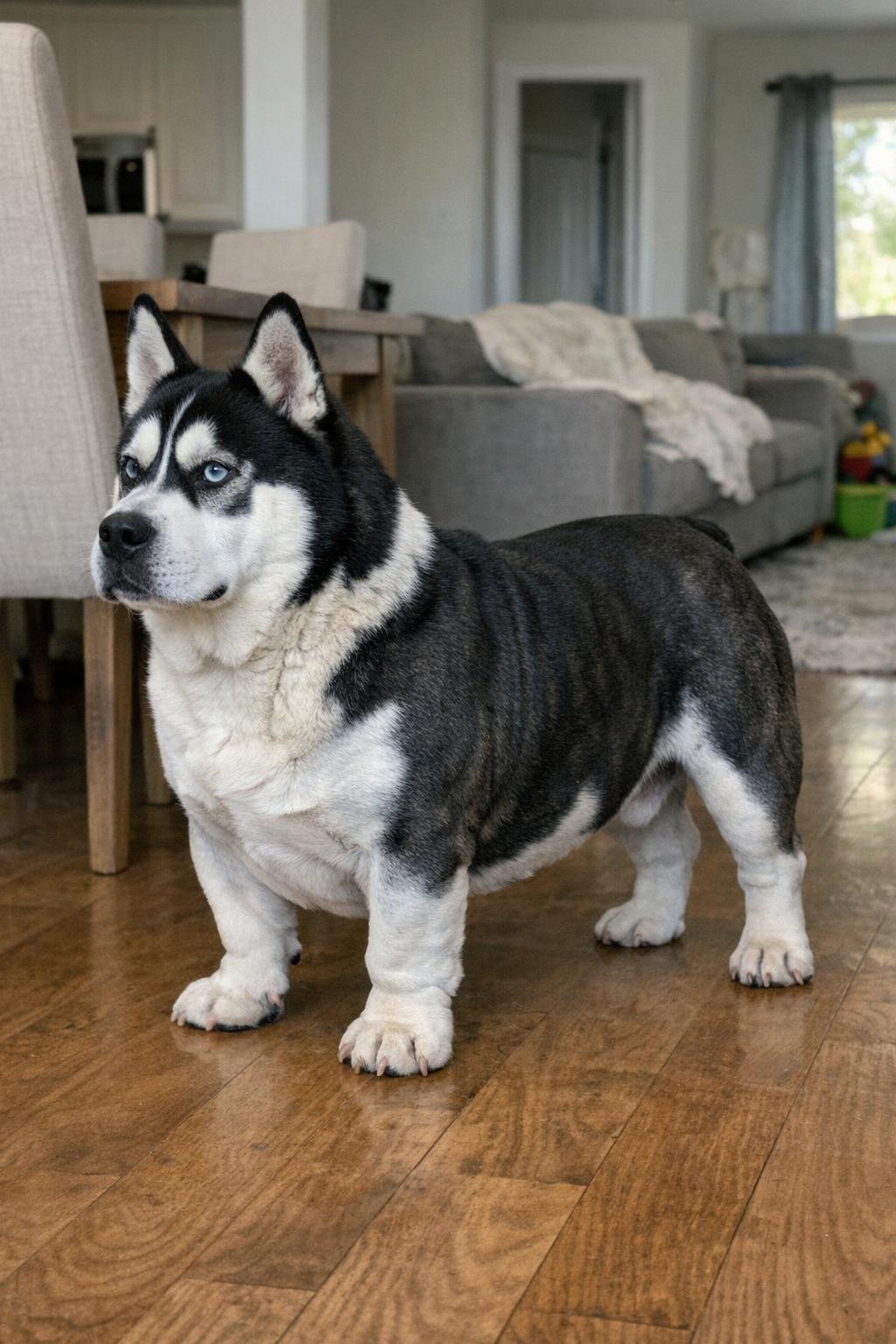
1. My guess: English Bulldog is the other half
If I had to put money on it, I’d say this dog is a Siberian Husky and English Bulldog mix. The face is what pulls you toward Husky first, especially the dark mask and lighter contrasting areas around the muzzle and forehead. But the body tells a different story almost immediately: broad chest, thick shoulders, lower center of gravity, stockier frame, and that unmistakable bulldog heft through the front end.
In a lot of mixed-breed dogs, one parent shows up mostly in the coloring and the other in the structure. That’s exactly what seems to be happening here. The head and markings are giving “snow dog,” while the torso is saying, very confidently, “absolutely not built for pulling a sled.”
2. The biggest clue is the chest and front end
One of the first things I noticed was how wide the front of the dog appears compared with a typical Husky. A Siberian Husky usually has a more moderate, athletic chest built for endurance and efficient movement over long distances. An English Bulldog, on the other hand, often has a much broader front, heavier shoulders, and a thicker neck.
That wide, wrinkly chest is a huge tipoff. Even in a casual home photo, you can see the dog carries weight low and forward. That’s not the usual silhouette of a lean 35- to 60-pound Husky-type dog. It looks much more like bulldog substance layered underneath Husky markings.
3. The low-slung body really changes the silhouette
When people picture a Husky mix, they often imagine a medium-to-large dog with a fairly leggy, rectangular frame. This pup doesn’t read that way. The body sits lower to the ground, with a denser, more compact look. That lower stance is common in bulldogs, which are built closer to the floor and tend to look almost barrel-bodied from the side.
I’ve seen plenty of mixed dogs where the coat or mask throws people off at first. Once you step back and look at the full side profile from nose to tail, though, structure wins. In this case, the side view is doing a lot of the identification work.
4. Those wrinkles are not a Husky trait
Huskies can have expressive foreheads, but they generally don’t have the pronounced skin folds and chest wrinkles you associate with bulldogs. Wrinkling around the neck, chest, and shoulders strongly suggests influence from a breed with looser skin. English Bulldogs are famous for that soft, folded look, especially around the face, neck, and front assembly.
Even a moderate amount of wrinkling in a mixed dog can stand out clearly. If the dog has a smoother athletic coat pattern but visible folds through the chest and shoulder area, that’s another reason I’d lean bulldog over a lot of other possible “other half” guesses.
5. The head may be mixed, but the expression is pure comedy
One thing I love about dogs like this is that they often end up with a wonderfully confusing expression. You get the upright, alert, almost wolfy Husky face pattern, but then it’s paired with a sturdier muzzle, thicker cheeks, or a broader skull. The result is a dog that looks both athletic and slightly unimpressed at the same time.
My sister said he walked into the house like he owned it within about 20 minutes, then flopped dramatically in the middle of the kitchen while everyone was making dinner. That tracks for a mix that may have some Husky curiosity and some bulldog confidence. Honestly, it also tracks for every lovable rescue who figures out where the snacks live on day one.
6. Coat pattern can fool people more than body structure
Shelter labels are often best guesses, and coat color tends to dominate those guesses. A dog with a black-and-white facial mask, lighter muzzle, and alert eyes can easily get tagged as a Husky mix even if the rest of the body points strongly somewhere else. Color is visible right away. Structure takes a second look.
That’s why mixed breeds are so interesting. The genes for coat, head shape, leg length, and musculature don’t arrive as a neat half-and-half split. You can absolutely get a dog that looks 70% Husky from the neck up and 70% Bulldog from the neck down. Genetics loves to keep us humble.
7. How big a Husky-Bulldog mix might get
If this is truly a Husky and English Bulldog combination, adult size can vary a lot, but many would likely land somewhere around 35 to 55 pounds, with some outside that range depending on sex, diet, and which parent’s build dominates. A standard Siberian Husky often weighs about 35 to 60 pounds, while an English Bulldog commonly falls around 40 to 50 pounds, though body composition is very different.
What matters more than the number on the scale is how the weight sits on the frame. A 45-pound Husky-type dog and a 45-pound bulldog-type dog can look completely different standing side by side. This pup looks like the kind of dog whose healthy condition will be easier to judge by waist definition, rib feel, and movement than by weight alone.
8. Temperament could be a very funny blend
This mix could be delightfully unpredictable in the best way. Huskies are often energetic, vocal, social, and famously opinionated. English Bulldogs tend to be affectionate, stubborn, people-oriented, and sometimes surprisingly goofy. Put those together and you might get a dog who wants to be near the family at all times but has very specific ideas about when it is, or is not, time for a walk.
My sister’s first 48-hour report included “very cuddly,” “weirdly dramatic about going outside in light rain,” and “acts like the sofa was included in the adoption paperwork.” That sounds believable. If this mix takes after both sides, expect bursts of playfulness followed by hard-core lounging.
9. Exercise needs may land right in the middle
A pure Husky typically needs serious daily exercise, often 1 to 2 hours of activity, plus mental stimulation. An English Bulldog usually needs much less and can overheat or tire more quickly, especially in warm or humid weather. A mix between the two may fall somewhere in the middle, but I would still be cautious and let the dog’s breathing, stamina, and recovery time guide the routine.
For a dog like this, I’d think in practical blocks: maybe two 20- to 30-minute walks per day, one short 10- to 15-minute training or sniff session, and indoor play that doesn’t overtax the joints. In a Midwest summer, I’d do early morning and evening outings, not 2 p.m. pavement walks in 88-degree heat.
10. Breathing and heat tolerance are worth watching
This is one of the biggest care considerations if bulldog is indeed in the mix. Huskies are built for cold-weather work, while English Bulldogs can struggle with heat and breathing because of their compact build and shorter muzzle structure. A mix may not inherit the full bulldog breathing profile, but it’s smart to pay attention to panting, snoring, recovery after exercise, and tolerance for hot, humid days.
In my area, summer can swing from pleasant to sticky in a hurry, and I’m always the annoying person reminding everyone to bring water, find shade, and quit before the dog gets too warm. For a stockier dog, I’d keep fresh water available at all times, use a harness instead of neck pressure if needed, and watch for signs like noisy breathing, excessive drooling, or lagging behind on walks.
11. Joint health may need extra support over time
A lower, heavier body on relatively shorter legs can put more stress on joints, especially if the dog also has a muscular front end. Bulldogs can be prone to orthopedic issues, and while mixed breeds sometimes benefit from more genetic variety, they can still inherit structural challenges. Keeping this dog lean will matter a lot.
That means measured meals, limited high-calorie treats, and smart movement. I’m a big fan of using part of the kibble ration for training, especially during the first few weeks at home. If the dog eats 2 to 2.5 cups of food per day, pulling out a quarter cup for reward-based training can help avoid accidentally turning every “sit” into extra calories.
12. Grooming may be easier than you’d expect, but shedding could still be real
If the dog inherited more Husky-type undercoat, shedding could be significant, especially in spring and fall. If the coat is shorter and denser with less undercoat, grooming may be simpler, but there can still be regular brushing needs. A good routine might include brushing 2 to 3 times a week, wiping facial folds if present, and checking ears regularly.
I always tell busy friends to keep a rubber grooming mitt by the back door or laundry room. Five minutes here and there is more realistic than a giant grooming session you keep putting off. That’s especially true when you’re balancing work, errands, and trying to remember what you thawed for dinner.
13. Training will probably require consistency and a sense of humor
Huskies are smart, but they are not famous for blind obedience. Bulldogs can also be stubborn, though often in a slower, more “I heard you and chose peace” kind of way. If this dog got a double helping of independent thinking, training should stay short, upbeat, and very consistent.
I’d aim for 5- to 8-minute sessions, 2 or 3 times a day during the adjustment period. Focus first on name recognition, recall, leash manners, “sit,” “wait,” and settling on a mat. Rescues do best when the rules are simple and repeated. Same potty door, same meal schedule, same bedtime rhythm. Dogs thrive on predictability, and honestly, so do I on a weeknight.
14. A DNA test would be fun, but the dog in front of you matters more
If the family really wants to know, a canine DNA test could confirm whether English Bulldog is in the mix. Those tests have gotten much more useful in recent years, especially for broad breed identification, though they still can’t predict everything about health or behavior. If I were them, I’d absolutely be tempted, mostly because this is the kind of dog that starts debates at every holiday gathering.
Still, the practical stuff matters more than the label. Whether he is exactly Husky-Bulldog or has a few other breeds in there too, the important questions are the same: How does he breathe after activity? How much exercise helps him settle? What food keeps him at a healthy weight? How does he do with people, stairs, car rides, and other pets?
15. My final answer: Husky face, Bulldog body, 100% adorable
If you asked me for the simplest answer, I’d say the “other half” looks very much like English Bulldog. The broad, wrinkled chest, muscular low-set frame, and compact build are just too strong to ignore. Pair that with the classic Husky facial markings, and you’ve got one unforgettable shelter surprise.
And honestly, this is exactly the kind of rescue story people fall for. He doesn’t look assembled from a breed book in the usual order, and that’s what makes him so charming. Around my family, the dogs who keep you guessing are always the ones who become legends fastest. This one already sounds like he’s going to fit right in.