
 Dogs
 Cats
 Birds
 Horses
 On the Land
 In the Sea
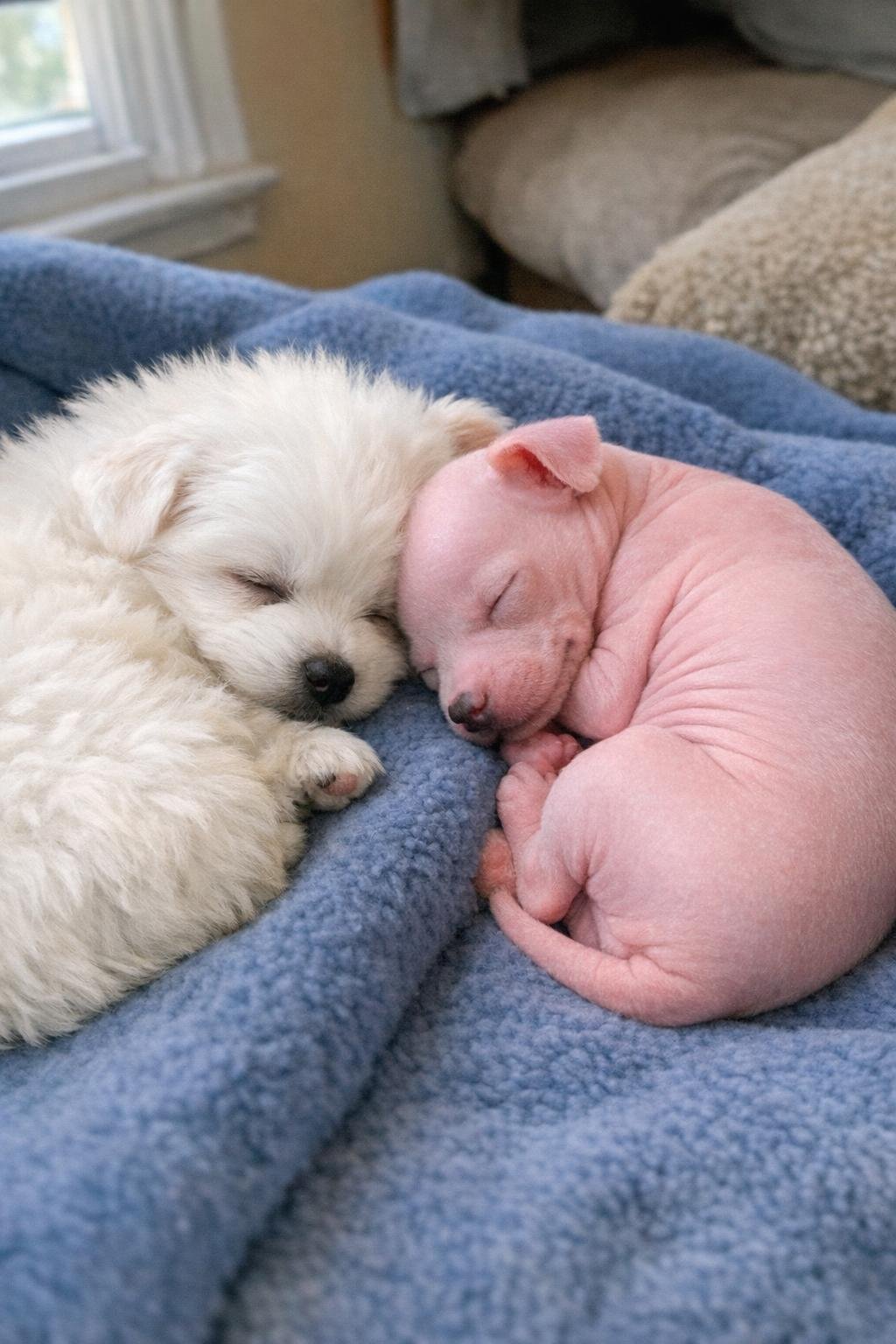
When a little dog has a litter, folks around here tend to gather updates the way we once swapped pie recipes over the church basement table. Last week our Chinese Crested had 4 puppies, and I have spent more hours than I care to admit peeking into the whelping box, counting tiny rib cages rising and falling, and making sure every baby gets a turn to nurse. Three of the pups looked just about how most people expect a Chinese Crested to look at first glance—warm pink skin, soft furnishings on the head, feet, and tail, and that unmistakable delicate little face. But the fourth one made everybody stop short.
I have had enough years in the kitchen, the garden, and the dog room to know that nature does not always follow the picture in people’s minds. Even so, when friends saw this litter, the same question came flying every time: “How is that possible?” The answer is simpler than it seems, and it has everything to do with basic coat genetics, especially the recessive powderpuff coat gene carried in this breed. Before I explain how one litter can hold such a surprise, let me show you the baby everybody is talking about.
See for yourself:
1. The surprise is real, but it is completely normal for the breed
That fluffy little white puppy is called a powderpuff Chinese Crested. It is not a mix-up, not evidence that the wrong dog visited the yard, and not some once-in-a-lifetime accident. Powderpuffs are a recognized and well-known coat variety of the Chinese Crested breed. In the same litter, you can absolutely have hairless puppies and fully coated puppies together.
I think this shocks people because the hairless variety is what most folks picture first. It is the dog they remember from television, dog shows, or funny calendars back in the 1990s. But any longtime breeder or breed enthusiast will tell you that the fluffy sibling has been part of the story all along.
2. Chinese Cresteds actually come in two coat types
The breed has two natural varieties: hairless and powderpuff. A hairless Chinese Crested usually has bare skin over most of the body, with hair on the head, feet, and tail. A powderpuff has a full soft coat over the entire body, often silky or veil-like, and it can be white, cream, black, slate, spotted, or mixed in color.
In practical terms, when I am caring for newborns, the difference is visible almost at once. The hairless pups feel warm and suede-soft, with pink or spotted skin that needs extra protection from chill and rubbing. The powderpuff pup has a fine coat right from the start, and as the days pass, that fuzz becomes more obvious, especially along the back, ears, and shoulders.
3. The reason comes down to genetics, not chance in the everyday sense
The simplest way to explain it is this: Chinese Cresteds can carry genes for either the hairless or powderpuff variety, and those genes combine in predictable ways. The powderpuff coat is recessive, which means a puppy must inherit the powderpuff version from both parents to be fully coated.
If both parents carry that recessive powderpuff gene, then some puppies in the litter may be powderpuffs even if one or both parents look hairless. That is why a fluffy pup can pop up in a litter and leave everybody wide-eyed, while the breeder is just nodding and reaching for a clean blanket.
4. What “recessive” really means in plain English
I have always thought genetics sounds scarier than it is, a bit like canning used to sound before you actually put peaches in jars. “Recessive” does not mean weak, bad, hidden in a dramatic sense, or unusual. It simply means that a trait shows up only when a puppy gets the same recessive version from both parents.
For a powderpuff Chinese Crested, that means the puppy receives two powderpuff coat genes—one from the mother and one from the father. If a puppy gets a hairless-associated version and a powderpuff version, it will usually be hairless in appearance while still carrying the powderpuff gene. So two hairless-looking dogs can produce a powderpuff puppy if each parent passes along that recessive gene.
5. A simple breeding example makes it easier to picture
Let us use the sort of shorthand breeders often use. If each parent carries one hairless-associated gene and one powderpuff gene, each puppy gets one gene from each parent. Across a litter, the combinations can vary. In broad terms, a mating like that can produce hairless puppies that carry powderpuff, powderpuff puppies with two recessive genes, and combinations that are not viable in the same way.
The important point for the average family is that a litter of 4 can very reasonably include 1 fluffy powderpuff and 3 hairless pups, or 2 and 2, or other variations. Genetics is governed by probabilities, not promises. Much like planting 12 rows of beans and having one row come in stronger than the others, the pattern is expected even if the exact count is not guaranteed.
6. Why the litter can look so dramatically different
What makes people gasp is not just that one puppy has hair. It is the sharp visual contrast. A pink, nearly hairless littermate lying nose-to-nose beside a cloud-soft white powderpuff looks like somebody tucked two different breeds into the same blanket. In good morning light, the difference seems even bigger than it is.
At 1 week old, all four puppies may weigh within just a few ounces of one another—say 5.5 to 8 ounces depending on sex, nursing strength, and birth size—yet the coat changes the whole impression. The fluffy baby often appears rounder and larger simply because the coat adds volume. I have seen folks assume the coated pup is older, when in truth it was born the same night as the rest.
7. No, this does not mean the mother had puppies by two different fathers
This is one of the first questions people whisper, and I understand why. When littermates look very different, folks jump to dramatic explanations. But in this case, a powderpuff puppy beside hairless siblings is entirely explained by normal Chinese Crested genetics. No mystery visitor is required.
In dogs, superfecundation—where puppies in a litter could theoretically have different fathers—is a real biological possibility in some circumstances, but it is not the explanation people should leap to when they see a coated Chinese Crested puppy. In this breed, the fluffy coat is already part of the package. The ordinary explanation is the correct one here.
8. Powderpuffs are not “better” or “worse,” just different
I always feel protective of the odd one out, whether it is the last biscuit on the plate or the puppy that gets the longest stare. Powderpuffs are not mistakes, and hairless puppies are not the “real” dogs while powderpuffs are somehow extras. Both are authentic Chinese Cresteds.
What changes is care. A hairless puppy will need skin attention throughout life—sun protection, gentle bathing, and care around dryness or blackheads. A powderpuff will need coat maintenance instead, including regular brushing, combing behind the ears, and keeping mats from forming in the fine coat. Same breed, different chores.
9. The hairless variety carries its own genetic wrinkle
Here is a detail many people do not know: the hairless trait in this breed is tied to a gene that behaves differently from a simple everyday dominant-recessive classroom example. Breeders have long known that the hairless form is associated with particular inheritance patterns, and powderpuffs are an expected part of breeding programs.
That is one reason responsible breeders study pedigrees so carefully and keep accurate records across generations. A litter is not just four babies in a box. It is the visible outcome of years of planning, health testing, and understanding how traits travel through a family line.
10. What we watch for in the first 7 days after birth
In our house, the first week is all about warmth, weight, and quiet observation. Newborn puppies cannot regulate their body temperature well, so the whelping area is usually kept around 85°F the first few days, then adjusted gradually as the pups strengthen. I like fresh fleece or soft vet bedding, changed as often as needed, sometimes 2 to 4 times a day in a busy litter.
Each puppy gets weighed daily on a small gram scale. A healthy newborn should trend upward steadily. A gain of 5 to 10 percent of body weight per day is a comforting sign, though every litter has its own rhythm. We also check nursing vigor, hydration, and whether each pup is rotating fairly among the best milk spots. The fluffy one may steal the show, but the sensible work is the same for all four.
11. How care differs between the fluffy pup and the hairless siblings
Even at a week old, I handle them a little differently. Hairless puppies can lose warmth faster through exposed skin, so I am extra careful about drafts, cool hands, and damp bedding. If one gets milk on the skin or tummy, I clean it gently and make sure the pup is fully dry before settling it back down.
The powderpuff puppy, on the other hand, can trap milk or moisture in the fine coat if you are not paying attention. I use a soft cloth and a light touch. Later on, grooming becomes the main difference. A powderpuff may need brushing several times a week, sometimes daily in friction areas, while the hairless siblings will likely need skin moisturizer and sunscreen instead of a slicker brush.
12. Why responsible breeders expect questions and answer them openly
Any good breeder should be able to explain this without acting offended. If somebody has never seen a powderpuff Chinese Crested before, of course they are surprised. I would rather have a curious question than a wild rumor passed from porch to porch.
When families ask, I explain the coat genetics, show them the breed standard, and point to real-world differences in grooming and health care. I also tell them that “rare” is a word thrown around far too loosely. A powderpuff is special because every puppy is special, but not because it is some impossible creature. Clear information is kinder than suspense.
13. What this means if you are hoping to bring one home
If you are drawn to the fluffy puppy, ask yourself whether you truly want the coat care that comes with it. A powderpuff may need regular comb-outs, face trimming if you keep a tidy pet clip, and professional grooming every 6 to 8 weeks depending on coat texture and your own skill. Over a year, that can add up to several hundred dollars if you use a groomer.
If you prefer the hairless look, remember that “less hair” does not mean “less maintenance.” Skin products, soft sweaters in winter, shade in summer, and routine bathing all matter. I tell people to choose the dog whose daily needs suit their household, not the one that startled them most in a photograph.
14. The big answer to “How is this even possible?”
In the end, the answer is both scientific and sweetly ordinary: two Chinese Crested parents can have both hairless and fully coated puppies because the powderpuff coat gene is recessive and part of the breed. That fluffy last puppy is not a puzzle piece from somewhere else. It belongs right there, tucked against its pink littermate.
After all these years, that is still what I love most about raising animals and feeding people: the old truths keep turning up in fresh ways. A pan of biscuits still rises. Tomato vines still surprise you. And every now and then, in a litter of four tiny puppies, genetics gives you a perfect little lesson wrapped in white fluff and sleeping on a blue blanket.