
 Dogs
 Cats
 Birds
 Horses
 On the Land
 In the Sea
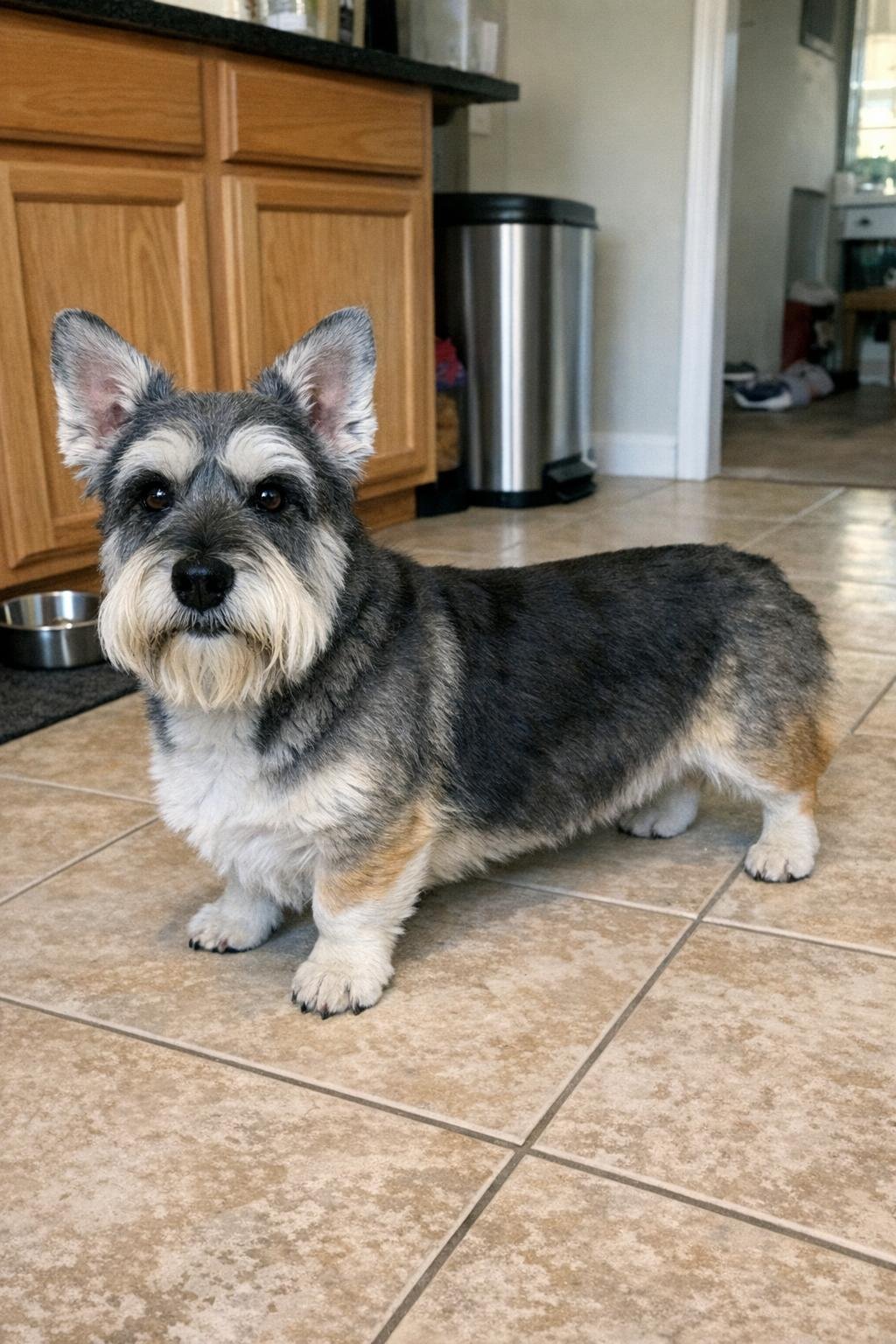
When my daughter brought her new shelter dog through the front door labeled as a “Schnauzer mix,” I figured I had a decent mental picture: wiry coat, sturdy little frame, maybe a terrier-ish bounce. Then he trotted across my kitchen floor and I actually laughed out loud. From the front, he looked like a tiny old man in a tidy beard. From the side, though? Completely different story.
If you’ve ever adopted a rescue, you know those breed guesses can be part science, part shrug emoji. This little guy had the classic salt-and-pepper Schnauzer face, but his body looked like it had been borrowed from a totally different dog. My daughter and I spent the first evening doing what every dog-loving family does now: staring, guessing, and comparing him to every breed we could think of until the answer became pretty hard to ignore.
See for yourself:
1. My best guess: Schnauzer and Corgi
The other half looks very strongly like Corgi to me. The biggest clue is the body shape: long through the back, very low to the ground, and carried on those short, sturdy legs that give Corgis that unmistakable “rolling loaf with opinions” silhouette. Add in the Schnauzer beard and eyebrows, and you get one of those mixes that almost looks like two dogs were combined right down the middle.
I’ve seen enough shelter “mixes” over the years to know breed ID is never perfect without a DNA test, but if I had to put money on it, I’d say Schnauzer-Corgi before I’d say anything else. Around our house, we’d probably call him a “Schorgi” by day two and never stop.
2. The body shape is the giveaway
When I look at mixed-breed dogs, I start with structure before color. Coat color can come from all kinds of combinations, but body proportions are often more revealing. This dog appears to have a torso that’s noticeably longer than it is tall, with a chest that sits low and front legs that are short but solid. That combination points strongly toward a breed with dwarf-type leg structure, and Corgi is one of the most recognizable examples.
A Miniature Schnauzer on its own usually stands around 12 to 14 inches tall at the shoulder and has a much squarer outline. Corgis, by contrast, are low-set and longer-bodied, typically around 10 to 12 inches tall but built with more length from shoulder to hip. That low-rider frame is exactly what jumps out here.
3. The face says Schnauzer almost immediately
The beard is doing a lot of work here, in the best possible way. A Schnauzer-type face tends to have that distinct rectangular muzzle, bushy brows, and a wiry, whiskered look around the nose and chin. Even when mixed with another breed, those facial furnishings can stay surprisingly obvious.
That’s why this dog reads “Schnauzer mix” right away when you see the head. Shelters often identify the most visually dominant feature first, which makes sense. If the face says Schnauzer and the body says Corgi, the shelter wasn’t exactly wrong. They just didn’t finish the sentence.
4. Why shelters often miss the second breed
Shelter breed labels are usually educated guesses made quickly, often without parent information, and sometimes after the dog has just arrived stressed, dirty, or underweight. Staff members are doing their best, but unless they have a DNA panel or a known surrender history, they’re working from appearance alone.
I’ve had friends adopt dogs listed as Lab mixes who later turned out to be part Boxer, part Pit Bull, part Australian Cattle Dog, and one very confusing 8 percent Chihuahua. In a busy shelter, “Schnauzer mix” is a practical label if the beard, brows, and coat are the first obvious clues.
5. What a Schnauzer-Corgi mix is usually like
If this dog is indeed a Schnauzer-Corgi mix, I’d expect a smart, alert, people-oriented little shadow with a stubborn streak about 2 inches wide and 2 miles long. Both breeds are bright. Schnauzers tend to be lively and watchful, and Corgis are famously intelligent, vocal, and not at all shy about supervising the household.
That can be a wonderful combination in a family dog, especially if you like personality. It can also mean you need consistency. Dogs like this often learn routines within a week, memorize where the treats are by day three, and figure out which family member is easiest to persuade by the end of the weekend.
6. Energy level might be higher than his short legs suggest
One mistake people make with low-to-the-ground dogs is assuming they need very little exercise. A Corgi-type build may look compact, but these dogs often have more stamina than expected. If he’s carrying both Schnauzer and Corgi traits, I’d plan on 45 to 60 minutes of total activity a day, split into manageable chunks.
That doesn’t have to mean marathon outings. For a busy household, two 20-minute walks plus 10 to 15 minutes of indoor training or puzzle play can go a long way. On workdays, I’m a huge fan of a quick morning sniff walk, then a food puzzle or treat scatter in the evening while dinner is in the oven.
7. Grooming will probably land somewhere in the middle
This mix could end up with a coat that needs more upkeep than a typical short-haired Corgi but maybe less than a hand-stripped wiry terrier coat. If the beard and brows are prominent, you’ll likely need regular face wiping, especially after meals or rainy walks. I’d keep a small towel by the door and unscented pet wipes handy.
Brushing 2 to 3 times a week is a realistic starting point. If the coat is dense or double-layered from the Corgi side, seasonal shedding may be more noticeable than you’d expect from a Schnauzer-looking face. A professional grooming visit every 6 to 8 weeks could help keep the outline tidy, especially around the feet, ears, and sanitary areas.
8. Watch the back and joints with this build
Any dog with a long back and short legs deserves a little extra thought about body condition and impact. I’m not saying you need to wrap him in bubble wrap, but keeping him lean matters. Even 2 or 3 extra pounds can put meaningful stress on a small dog’s spine, elbows, and knees.
At home, that can mean using a ramp for furniture if he’s a frequent jumper, discouraging repeated leaps off beds or couches, and keeping nails trimmed so he has stable traction on slick floors. In a kitchen like mine, a washable runner rug can make a big difference. Better footing means less sliding and less strain.
9. Feeding matters more than people think
For a small-to-medium mixed dog with this kind of frame, portion control is one of the kindest things you can do. Exact amounts depend on age, activity level, and food type, but many dogs in this size range do well on roughly 3/4 cup to 1 1/2 cups of quality dry food per day, divided into two meals. Of course, the label on the bag is just a starting point, not a command.
I always tell people to use their dog’s waist, ribs, and energy level as the real guide. You should be able to feel ribs under a light layer of tissue without pressing hard. If the waist disappears and the dog starts looking like a coffee table with ears, it’s time to scale back treats and measure meals more carefully.
10. Temperament clues to expect in the first month
Newly adopted dogs often don’t show their full personality right away. The first 3 days can be quiet or overwhelmed, the first 3 weeks are often about testing routines, and by around 3 months you usually have a much clearer sense of the real dog. With a mix like this, I’d expect some combination of attachment, curiosity, alert barking, and comic confidence once he settles in.
My guess is he’ll become the kind of dog who follows your daughter from room to room, keeps one eye on the front window, and believes all snack preparation is a group activity. That combination is honestly part of the charm.
11. Training should start simple and fast
Smart little dogs can pick up cues quickly, but they also notice inconsistency quickly. I’d start with a 5- to 7-minute training session twice a day: name recognition, sit, touch, down, and “leave it.” If he’s food-motivated, tiny soft treats the size of a pea will keep sessions moving without overfeeding him.
For busy families, I love stacking training onto routines you already have. Ask for a sit before meals, a wait at the door, and a touch before clipping on the leash. That can give you 15 or 20 useful repetitions a day without carving out a huge separate training block.
12. Barking could absolutely be part of the package
This is the one area where I’d prepare with humor and realism. Schnauzers can be alert barkers, and Corgis are not exactly known for suffering in silence. If this dog inherited both opinions and the need to announce them, you may have a tiny neighborhood commentator on your hands.
The fix usually isn’t to scold louder than the dog. It works better to teach an alternate behavior: go to mat, look at me, or come for a treat when the doorbell rings. Practice when nobody is actually at the door. Five calm repetitions a few times a week can save your sanity later.
13. A DNA test would be fun, but the visual answer is already pretty strong
If your daughter wants certainty, an at-home canine DNA test can help, and many run between $70 and $150 depending on the brand and sales. It won’t change who he is, but it can satisfy curiosity and sometimes flag breed-related health tendencies worth discussing with a vet.
That said, if I were betting based on appearance alone, I’d be very comfortable saying Schnauzer plus Corgi is the leading theory. Some mixed dogs are total mysteries. This one feels like a much easier puzzle.
14. The real win is that he already looks like he belongs
What I love most about dogs like this is that they don’t come in reading from a breed standard. They come in as themselves: odd proportions, huge personality, and all. And somehow those are often the dogs that settle into a family the fastest and leave the deepest mark.
From one busy Midwestern kitchen to another, this “Schnauzer mix” looks an awful lot like a Schnauzer-Corgi kid to me. More important, he looks like the kind of dog who will soon have a favorite spot on the floor, a preferred person on the couch, and absolutely no doubt that he runs at least 40 percent of the household.